Persistent Alterations in Inflammatory and Cartilage Biomarkers Following Anterior Cruciate Ligament Reconstruction: Insights Into Postoperative Joint Biology
Anterior cruciate ligament (ACL) injury, a common orthopedic trauma especially among young athletes, initiates a cascade of biological events that can lead to long-term joint degeneration and osteoarthritis. Despite surgical reconstruction (ACLR) and standard rehabilitation protocols, a significant subset of patients progress to cartilage deterioration, highlighting an unmet clinical need to better understand the evolving joint biology post-injury and surgery. Serum biomarkers reflective of inflammation and cartilage matrix metabolism offer a minimally invasive window into intra-articular pathological processes. However, the longitudinal profile of these markers during the critical first postoperative year, particularly compared to uninjured controls, remains incompletely characterized. This knowledge gap impairs the development of targeted therapies to modulate post-ACLR biological responses and ultimately improve joint outcomes.
Study Design
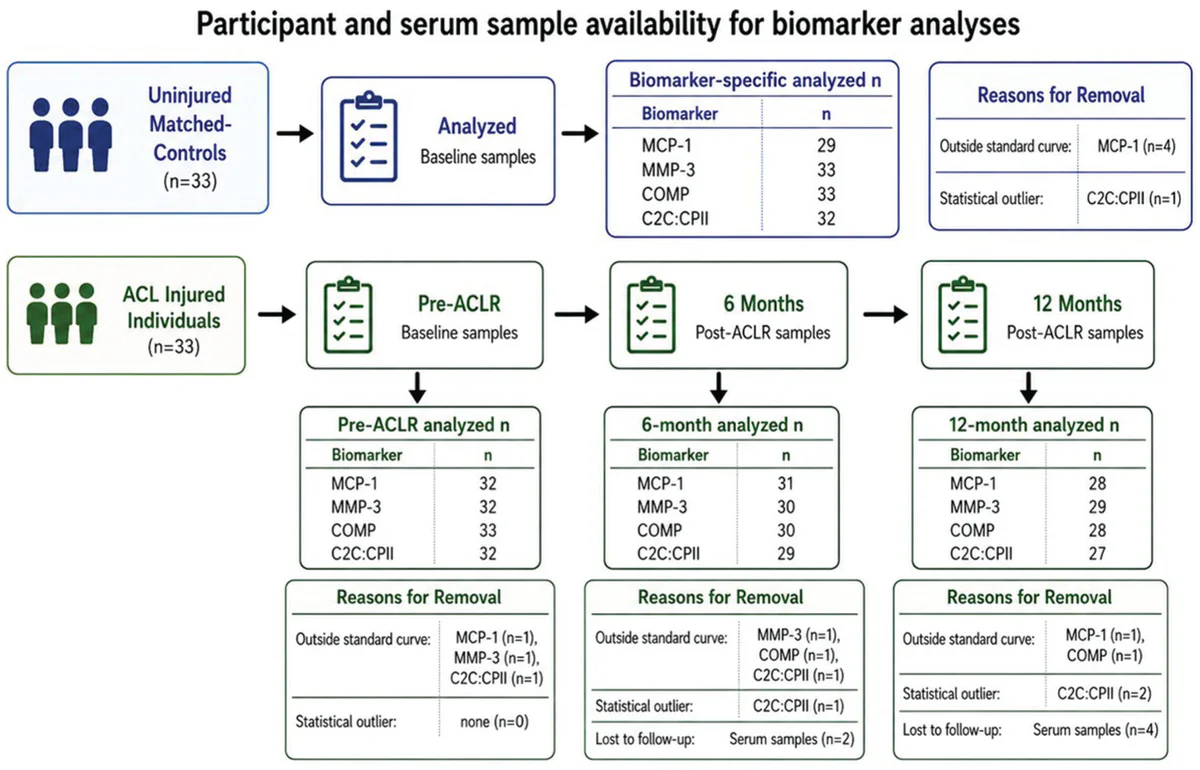
This Level 2 cohort study enrolled 33 young adults (mean age 20.8 years, 52% female) with ACL injuries, assessed at three time points: pre-ACLR, and 6 and 12 months post-ACLR. A matched control group of 33 uninjured individuals provided comparative baseline biomarker data. Serum concentrations of key biomarkers were quantified via enzyme-linked immunosorbent assays: monocyte chemoattractant protein-1 (MCP-1) representing inflammation, matrix metalloproteinase-3 (MMP-3) indicative of matrix degradation, and cartilage oligomeric matrix protein (COMP) alongside the type II collagen degradation-to-synthesis ratio (C2C:CPII) reflecting cartilage turnover. Linear mixed-effects models assessed temporal changes and differences between injured and control groups, while regression analyses examined associations between preoperative and postoperative biomarker levels. Exploratory analyses considered the influence of concomitant injuries.
Key Findings
The study revealed distinct biomarker trajectories following ACLR:
MCP-1 (Inflammatory Biomarker): Serum MCP-1 levels were significantly elevated in the ACL-injured group compared to uninjured controls at all evaluated time points (pre-ACLR, 6 months, 12 months; P_adj < .001). Notably, MCP-1 concentrations did not significantly change across post-ACLR time points, suggesting persistent inflammatory activity throughout the first postoperative year.
MMP-3 (Matrix Degradation Marker): MMP-3 levels increased significantly from pre-ACLR to 6 months post-ACLR (P_adj < .001), indicating an early postoperative surge in cartilage matrix degradation. However, MMP-3 levels did not differ significantly from controls at any assessment point, reflecting a complex temporal pattern possibly influenced by surgical remodeling and rehabilitation.
COMP (Cartilage Turnover Marker): Across all time points, COMP concentrations remained consistently higher in the ACL-injured cohort relative to controls (P_adj ≤ .021), without significant temporal changes postoperatively. Elevated COMP suggests ongoing alterations in cartilage matrix homeostasis in both the acute and chronic phases after injury and reconstruction.
C2C:CPII Ratio (Type II Collagen Degradation to Synthesis): This ratio significantly increased at 12 months post-ACLR compared to pre-ACLR and 6-month time points (both P_adj < .001), and was also elevated relative to uninjured controls (P_adj = .001). This finding suggests a shift favoring collagen degradation over synthesis late in the first postoperative year, highlighting sustained cartilage matrix imbalance.
Associations Between Pre- and Postoperative Biomarkers: Pre-ACLR concentrations of MCP-1, MMP-3, and COMP strongly predicted their respective levels at both 6 and 12 months post-ACLR (P ≤ .006). The C2C:CPII ratio pre-ACLR was associated only with its 12-month levels (P = .018), indicating the prognostic value of early biomarker profiles for long-term joint biological status.
Influence of Concomitant Injuries: Although exploratory, post hoc analyses suggested differences in biomarker profiles based on the presence of concomitant injuries such as meniscal or cartilage lesions, underscoring the heterogeneity of post-ACL biological responses.
Expert Commentary
These data illuminate the protracted nature of biological alterations after ACL reconstruction, challenging the traditional notion that surgical stabilization and standard rehabilitation signify biological normalization. Persistently elevated MCP-1 underscores ongoing monocyte-driven inflammation that may perpetuate cartilage breakdown. The temporal dynamics of MMP-3 and significantly increased cartilage turnover reflected by COMP and C2C:CPII ratios suggest sustained cartilage matrix remodeling and net catabolism up to one year postoperatively.
This raises important clinical considerations: current rehabilitation timelines may not fully address underlying joint metabolic disturbances, potentially contributing to eventual osteoarthritis. Monitoring serum biomarkers could personalize rehabilitation intensity or prompt adjunct biological interventions. Limitations of the study include modest sample size and lack of direct longitudinal imaging correlates for cartilage status, which remain critical future directions.
Conclusion
The study by Lemus et al. provides compelling evidence that inflammatory and cartilage metabolic perturbations persist throughout the first year following ACL reconstruction. These findings point to an extended window in which biological modulation might mitigate post-traumatic joint degeneration. Future research focusing on integrating biomarker monitoring with imaging and clinical outcomes will be essential to translate these insights into improved patient care and osteoarthritis prevention after ACL injury and reconstruction.
Funding and ClinicalTrials.gov
Not specified in the original publication.
References
1. Lemus SA, Spang JT, Longobardi L, et al. Longitudinal Serum Biomarker Profiles of Inflammation and Cartilage Matrix Metabolism During the First Year After Anterior Cruciate Ligament Reconstruction. Am J Sports Med. 2026 Oct 26:3635465261493224. doi:10.1177/03635465261493224. PubMed PMID: 42929659.
2. Lohmander LS, Englund PM, Dahl LL, Roos EM. The long-term consequence of anterior cruciate ligament and meniscus injuries: osteoarthritis. Am J Sports Med. 2007;35(10):1756-1769.
3. Krishnan Y, Williams RJ 3rd. Osteoarthritis after ACL injury in an active population. Curr Sports Med Rep. 2019;18(5):141-146.
4. Goldring MB, Goldring SR. Osteoarthritis. J Cell Physiol. 2007;213(3):626-634.
5. Loeser RF, Goldring SR, Scanzello CR, Goldring MB. Osteoarthritis: a disease of the joint as an organ. Arthritis Rheum. 2012 Jun;64(6):1697-707.