Highlight
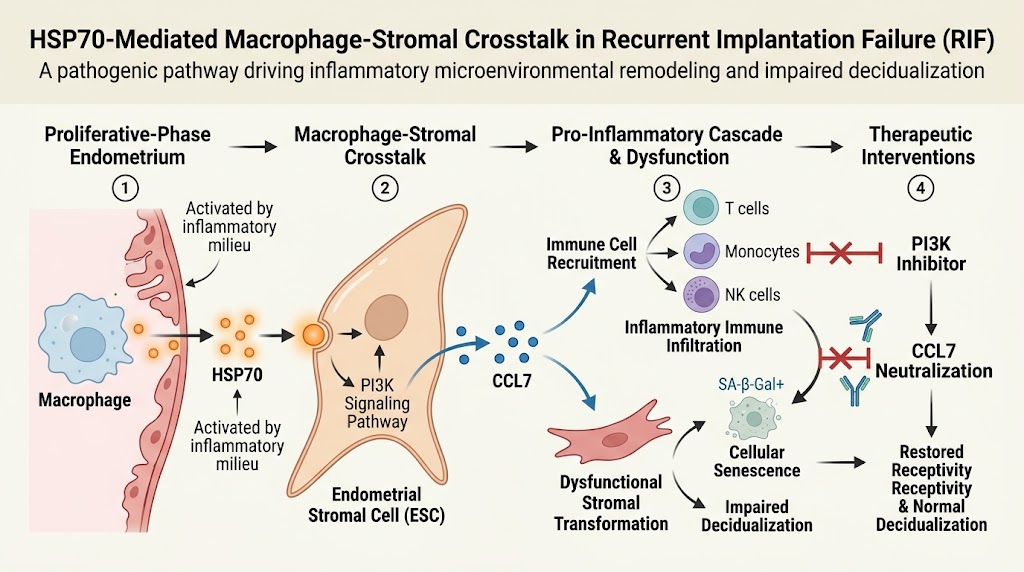
– Single-cell RNA sequencing reveals excessive inflammatory immune infiltration in the proliferative-phase endometrium of recurrent implantation failure (RIF) patients.
– The study identifies a pathogenic HSP70/CCL7-mediated macrophage-stromal communication network driving inflammation.
– HSP70 induces stromal cell CCL7 production via PI3K signaling, promoting immune cell recruitment and stromal cell senescence.
– Targeting this HSP70/CCL7 axis holds therapeutic potential to restore endometrial receptivity and prevent RIF.
Study Background
Recurrent implantation failure (RIF) poses a significant clinical challenge in assisted reproductive technology (ART), affecting patients despite transferring multiple high-quality embryos. The condition is characterized by the failure of embryo implantation after several attempts, severely impacting couples’ fertility outcomes and psychological well-being. Although abnormalities of the endometrium, particularly impaired receptivity, are recognized contributors to RIF, the detailed molecular and cellular mechanisms underlying this dysfunction remain elusive.
The proliferative phase of the menstrual cycle, preceding decidualization and embryo implantation, is a critical window during which the endometrium prepares biologically and immunologically to support implantation. The endometrium comprises dynamic and heterogeneous populations of epithelial, stromal, vascular, and immune cells that remodel cyclically. Distinct immune-stromal interactions influence the microenvironment, yet the specific cell-type alterations and pathological immune crosstalk during the proliferative phase in RIF patients have not been fully characterized at a high-resolution, single-cell level.
Study Design
This innovative study employed single-cell RNA sequencing (scRNA-seq) to profile proliferative-phase endometrial tissue from women diagnosed with RIF and matched control subjects. The approach provided a granular view of cell-type-specific transcriptional changes and intercellular communication patterns underpinning the endometrial landscape. Peripheral blood scRNA-seq was concurrently performed to distinguish whether observed immune alterations were localized to the endometrium or reflected systemic immune dysregulation.
Further functional assays evaluated the role of 70-kDa heat shock protein (HSP70) derived from macrophages in modulating stromal cell behavior. Endometrial stromal cells exposed to HSP70 underwent transcriptomic analysis via RNA sequencing. Levels of HSP70 and chemokine CCL7 were quantified in patient samples by ELISA. The reciprocal interactions between macrophages and stromal cells through the HSP70/CCL7 axis were experimentally examined using Transwell migration assays, quantitative PCR, and senescence-associated β-galactosidase staining. PI3K signaling pathway activation was predicted computationally and confirmed by Western blotting and related assays. Pharmacologic inhibition and neutralization experiments further validated the functional relevance of this signaling axis.
Key Findings
The scRNA-seq analysis illuminated a distinct pro-inflammatory endometrial microenvironment in RIF patients during the proliferative phase. There was a notably increased infiltration of immune cells, including T cells, monocytes, and natural killer (NK) cells, compared to controls. This immune cell abundance correlated with a pathogenic crosstalk between macrophages and endometrial stromal cells.
Mechanistically, macrophages within this inflammatory milieu exhibited upregulated expression of HSP70. This chaperone protein acted on stromal cells to promote secretion of chemokine CCL7 through the activation of the PI3K signaling pathway. Elevated CCL7 subsequently attracted more immune cells, amplifying the local inflammatory infiltrate. This positive feedback mechanism was interrupted by neutralizing CCL7 or inhibiting PI3K, which reduced immune cell recruitment.
Importantly, exposure to HSP70 and the downstream inflammatory cascade induced senescence in endometrial stromal cells, demonstrating increased SA-β-Gal activity and altered gene expression profiles. Senescent stromal cells showed impaired decidualization capacity, vital for embryo implantation. These molecular and cellular disruptions suggest that the HSP70-CCL7 axis drives inflammation and stromal dysfunction that underlie endometrial non-receptivity in RIF.
Expert Commentary
The study by Tang et al. provides significant mechanistic insights into immune stromal interactions in RIF that were previously unknown. The use of scRNA-seq during the proliferative phase is particularly valuable, revealing that aberrant inflammatory remodeling predates the morphologic window of implantation. This challenges prior paradigms that similarly implicated inflammation primarily during or after decidualization.
HSP70, a well-known stress-inducible protein, emerges here as a critical immunopathogenic factor. Its role in stimulating CCL7 production and sustaining immune cell infiltration via PI3K signaling lends biological plausibility to the observed endometrial dysfunctions. These findings align with growing evidence highlighting the importance of immune homeostasis for successful implantation and support the concept that excessive immune activation impairs fertility.
From a therapeutic perspective, modulation of the HSP70/CCL7 pathway offers an attractive target. Interventions aiming to restore the balance of macrophage-stromal crosstalk or inhibit key inflammatory mediators could improve endometrial receptivity and pregnancy outcomes in RIF patients. However, further in vivo and clinical studies are needed to translate these findings into treatment protocols. Limitations include the relatively small sample size and the need to confirm causality in longitudinal cohorts.
Conclusion
This pioneering single-cell transcriptomic analysis elucidates how dysregulated macrophage-stromal communication mediated by HSP70 and CCL7 establishes a pro-inflammatory endometrial environment during the proliferative phase. The resultant immune cell infiltration and stromal cell senescence compromise decidualization and embryo implantation, identifying a key immunopathogenic driver of RIF. These insights enhance our understanding of the molecular basis of implantation failure and pave the way for innovative therapeutic strategies targeting immune-stromal interactions to improve ART success rates.
Future research should focus on the clinical translation of targeting the HSP70/CCL7 axis and explore its applicability across diverse patient populations. Integration of immunomodulatory therapies with conventional ART offers potential to overcome RIF and fulfill unmet reproductive needs.