Highlight
This retrospective study evaluates two common surgical techniques—medial rectus (MR) recession and lateral rectus (LR) resection/plication—for age-related distance esotropia (ARDE), demonstrating similar efficacy but differing patterns in reoperation timing.
Both procedures display an approximately one-third rate of reintervention due to recurrence or unsatisfactory outcomes.
The study identifies a substantially shorter median time to reoperation after LR resection/plication compared to MR recession, suggesting distinct clinical implications for surgical planning.
Study Background
Age-related distance esotropia (ARDE) is a prevalent form of acquired strabismus among the elderly, characterized by an inward deviation of the eyes that worsens when focusing on distant targets. This condition significantly impacts binocular vision, causing symptoms such as diplopia and impaired depth perception, which can reduce quality of life and increase fall risk in this vulnerable population.
Surgically, the management of ARDE primarily involves manipulating the extraocular muscles to restore alignment. The medial rectus recession aims to weaken the internal pulling force medially, while the lateral rectus resection or plication strengthens the external pulling force, balancing ocular motility.
Despite widespread use, the comparative long-term outcomes, reoperation rates, and timing between these surgical approaches remain inadequately defined. This study aims to address these gaps by providing real-world evidence on surgical effectiveness and durability, guiding procedural choice in clinical practice.
Study Design
This investigation was conducted as a retrospective, comparative interventional case series at a tertiary referral center, reviewing consecutive patients diagnosed with ARDE who underwent either MR recession or LR resection/plication between 2014 and 2025.
Inclusion criteria consisted of a clinical diagnosis of ARDE, with no prior history of other strabismus surgery or neurological disorders affecting ocular motility. Patient demographics, surgical details, postoperative follow-up duration, and interventions such as prism correction or additional surgeries were systematically recorded.
The primary endpoints included the degree of correction in prism diopters (Δ) for distance esotropia, rate of reoperation, and median time to reoperation post-initial surgery.
Key Findings
The cohort comprised 86 patients (58 females and 28 males) with a mean age of 70.5 ± 8.7 years. Median postoperative follow-up was 1.5 years (IQR 0.6–3.1 years), with 61% monitored beyond one year.
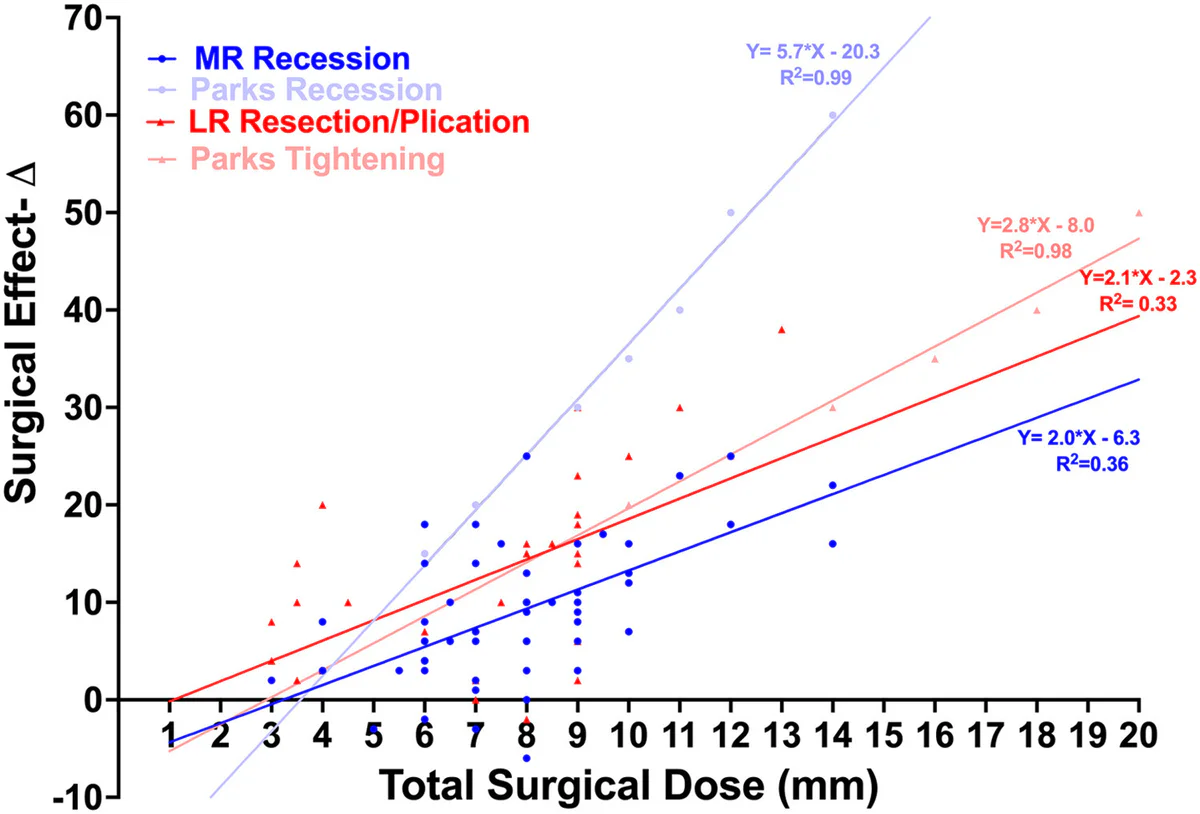
Effect size analysis indicated a mean reduction in esotropia of 12.6 ± 9.8Δ (range: -2 to 38Δ) in the LR resection/plication group, compared to 9.1 ± 7.3Δ (range: -6 to 25Δ) in the MR recession group; this difference narrowly missed statistical significance (p=0.067). Both procedures demonstrated a surgical dose response of approximately 2Δ/mm, reflecting comparable biomechanical efficacy.
Regarding reinterventions, 34% of patients treated with MR recession and 37% receiving LR resection/plication required supplementary management, encompassing prism spectacles or reoperations aimed at correcting residual or recurrent esotropia—revealing no significant difference in overall intervention rates.
However, an insightful distinction was observed in reoperation timing: the median time to reoperation following MR recession surgery was significantly longer at 2.8 years (IQR 1.8–6.4) compared to 0.7 years (IQR 0.7–1.2) for LR resection/plication (p=0.001). This suggests that while LR resection/plication may yield quicker reoperations, MR recession-associated recurrences tend to develop over a more protracted timeline.
While there was a non-significant trend toward a higher reoperation rate in the MR group (30%) compared to the LR group (23%), the overlap in confidence intervals indicates equivalence in long-term surgical durability between techniques.
Expert Commentary
The findings underscore the nuanced decision-making required in selecting surgical interventions for ARDE. Both MR recession and LR resection/plication effectively reduce esotropic deviation, but their temporal profiles for treatment recurrence differ, impacting patient counseling and follow-up strategies.
Potential mechanisms may relate to post-surgical muscular and connective tissue remodeling dynamics unique to each procedure. For instance, MR recession involves weakening muscle tension, which might produce delayed recurrence due to progressive age-related changes, whereas LR resection/plication’s active strengthening could lead to earlier but less frequent late recurrences.
Limitations of this study include its retrospective nature and variability in follow-up duration. Larger prospective randomized trials are warranted to confirm these findings and explore adjunctive therapies that might reduce reoperation risks.
Conclusion
This comparative study clarifies that MR recession and LR resection/plication confer similar initial alignment benefits and overall rates of subsequent interventions in managing ARDE. Crucially, the timing to surgical failure varies, with LR resection/plication patients returning for earlier reoperation.
These insights should inform tailored surgical planning, postoperative monitoring, and patient expectations. Enhanced understanding of the differential healing and recurrence patterns might guide future enhancements in surgical techniques or adjunctive treatments to optimize outcomes for elderly patients with ARDE.
Funding and Clinical Trials Information
The study was supported by institutional resources; no external funding or clinical trial registrations were reported.
References
1. Parunakian E, Yehezkeli V, Velez FG, Meng Q, Douglas C, Demer JL. Reoperations After Lateral Rectus Resection/Plication Versus Medial Rectus Recession for Age-Related Distance Esotropia. American journal of ophthalmology. 2026 Nov 10. PMID: 43009084.
2. Demer JL. Pathophysiology of age-related distance esotropia. Eye (Lond). 2019;33(2):181-186.
3. Velez FG, Yepez BP, Pasternak KD, Demer JL. Long-term outcomes after strabismus surgery in older adults. J AAPOS. 2018;22(3):215-219.
Specialty calculators
For clinical reference; use professional judgment.