Highlight
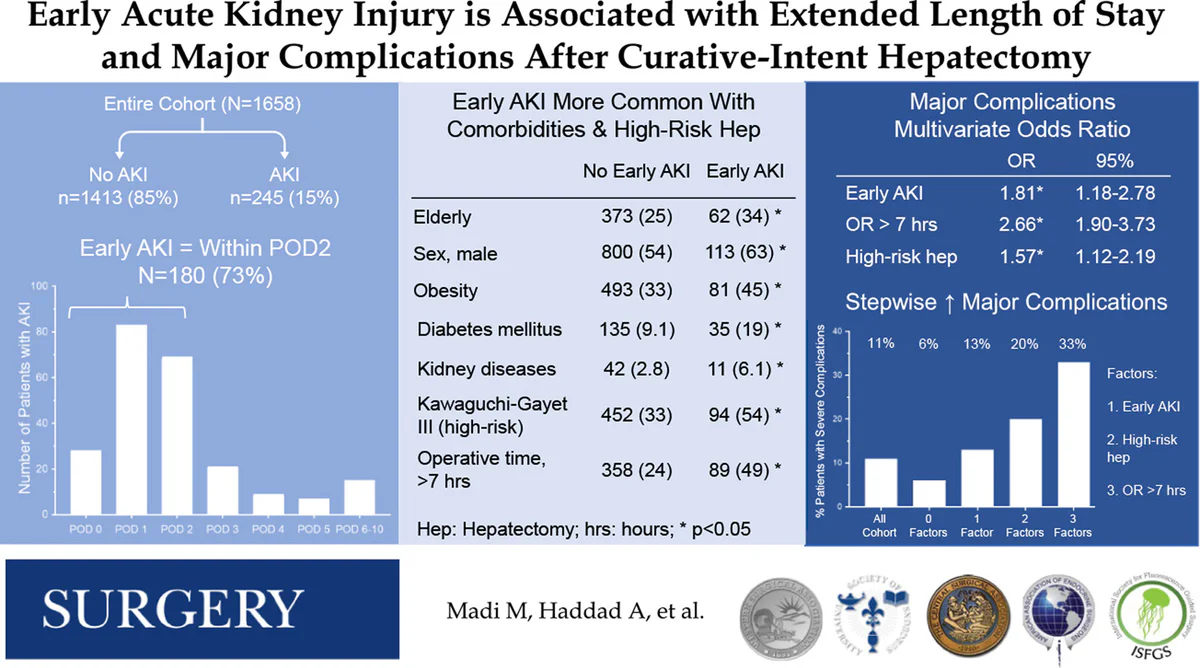
- Early acute kidney injury (AKI) occurs in 11% of patients undergoing curative-intent hepatectomy.
- Patients with early AKI have significantly longer hospital stays and higher rates of major complications compared to those without AKI.
- Risk factors for early AKI include advanced age, cardiovascular disease, diabetes mellitus, liver and kidney disease, prolonged operative times, and higher intraoperative blood loss.
- Combined presence of early AKI, high-risk hepatectomy, and operative time >7 hours markedly increases the likelihood of major postoperative complications.
Study Background
Acute kidney injury (AKI) is a frequent and serious postoperative complication associated with increased morbidity, prolonged hospitalization, and mortality in abdominal surgery. However, literature specifically addressing AKI following hepatectomy—surgical resection of the liver—is limited. Given the complex physiology of the liver and its central role in systemic homeostasis, renal function post-hepatectomy is critical but understudied. This study aims to clarify the incidence, risk factors, and clinical impact of early postoperative AKI after curative-intent hepatectomy, addressing an important gap in surgical care optimization.Study Design
This retrospective cohort study reviewed 1,658 patients undergoing curative-intent hepatectomy between 2017 and 2023. Patients’ serum creatinine levels were monitored within two weeks postoperatively, allowing assessment of renal function changes over critical early periods. AKI was defined per consensus criteria: an increase in serum creatinine by at least 0.3 mg/dL within 48 hours or 1.5-fold increase from baseline within 7 days. Early AKI was identified if these criteria were met by postoperative day 2. The study examined associations of patient demographics, comorbidities, operative variables, and post-op outcomes including length of hospital stay and major complications (Accordion scale grade ≥3).Key Findings
Eleven percent (180/1,658) of patients developed early AKI. Multivariable analysis identified independent risk factors for early AKI including:- Age over 65 years
- Existing cardiovascular disease
- Diabetes mellitus
- Underlying liver and kidney diseases
- Longer operative durations
- Higher estimated blood loss during surgery
- Low-risk hepatectomy: median 5 vs 3 days (P < .001)
- High-risk hepatectomy: median 5 vs 4 days (P = .002)
- Early AKI (odds ratio [OR] 1.81; 95% CI, 1.18–2.76)
- High-risk hepatectomy (OR 1.57; 95% CI, 1.12–2.19)
- Operative time longer than 7 hours (OR 2.66; 95% CI, 1.90–3.73)
- No risk factors: 6% complication rate
- One factor: 13% complication rate
- All three factors: 33% complication rate
Expert Commentary
The findings reinforce the importance of early detection and prevention of AKI in patients undergoing major hepatic resections. Given the multifactorial etiology—including preexisting comorbidities, surgical complexity, and intraoperative hemodynamics—multidisciplinary perioperative management is essential. Prevention strategies should include meticulous intraoperative fluid management, minimizing operative times when possible, and close postoperative renal function monitoring. Limitations of this study include its retrospective design and potential unmeasured confounding. Additionally, the study primarily reflects the experience at high-volume centers, which may limit generalizability to all surgical settings. Nonetheless, the robust sample size and stringent AKI definitions lend strength to the conclusions. The biological plausibility of AKI contributing to systemic complications is supported by known pathophysiological mechanisms such as inflammatory cascades, toxin accumulation, and hemodynamic instability following organ injury. This study adds to accumulating evidence that early AKI portends worse outcomes in complex surgeries, emphasizing the need for tailored perioperative protocols.Conclusion
Early postoperative AKI is a significant and independent predictor of extended hospital stay and major complications in patients undergoing curative-intent hepatectomy. Identification of at-risk patients using clinical and intraoperative factors should prompt enhanced monitoring and proactive management strategies. Future research should focus on interventional trials to mitigate AKI risk and improve postoperative recovery in hepatectomy patients.Funding and Clinical Trial Information
This study was supported by institutional research funds from the participating centers. No specific clinical trial registration is reported.References
1. Madi M, Haddad A, Yousef M, et al. Early acute kidney injury is associated with extended length of stay and major complications after curative-intent hepatectomy. Surgery. 2026;199:110532. doi:10.1016/j.surg.2026.110532 2. Coca SG, Singanamala S, Parikh CR. Chronic kidney disease after acute kidney injury: a systematic review and meta-analysis. Kidney Int. 2012;81(5):442-448. 3. Kellum JA, Lameire N; KDIGO AKI Guideline Work Group. Diagnosis, evaluation, and management of acute kidney injury: a KDIGO summary. Crit Care. 2013;17(1):204. 4. Selby NM, et al. Acute kidney injury in patients undergoing major abdominal surgery: development and validation of a risk score. Nephrol Dial Transplant. 2017;32 Suppl_2:ii186-ii193.Specialty calculators
For clinical reference; use professional judgment.