Highlights
- Parent-captured oropharyngeal videos via handheld telemedicine devices demonstrate strong interrater reliability in tonsil size grading compared to traditional in-person clinical exams.
- Diagnostic performance shows high specificity (86%) and moderate sensitivity (70%) for identifying clinically significant tonsillar hypertrophy relevant to surgical planning.
- Video usability issues, particularly in younger children, remain a challenge, with approximately 12% of videos unusable by all evaluators.
- Complementary grading systems and evolving telehealth approaches hold promise for refining remote evaluation and personalized management of pediatric sleep-disordered breathing (SDB).
Background
Sleep-disordered breathing (SDB) in children encompasses a spectrum from primary snoring to obstructive sleep apnea (OSA), conditions commonly associated with adenotonsillar hypertrophy that contribute significantly to morbidity. Adenotonsillectomy remains a first-line treatment for pediatric SDB; thus, accurate evaluation of tonsil size is essential in clinical decision-making. Traditional clinical examination requires in-person assessment, which may be limited by access, scheduling, and present challenges such as in pandemics or remote care settings. Emerging telemedicine solutions aim to facilitate remote evaluation to improve accessibility and convenience without compromising diagnostic accuracy.Key Content
Chronological Development of Tonsil Size Assessment and Telemedicine Integration
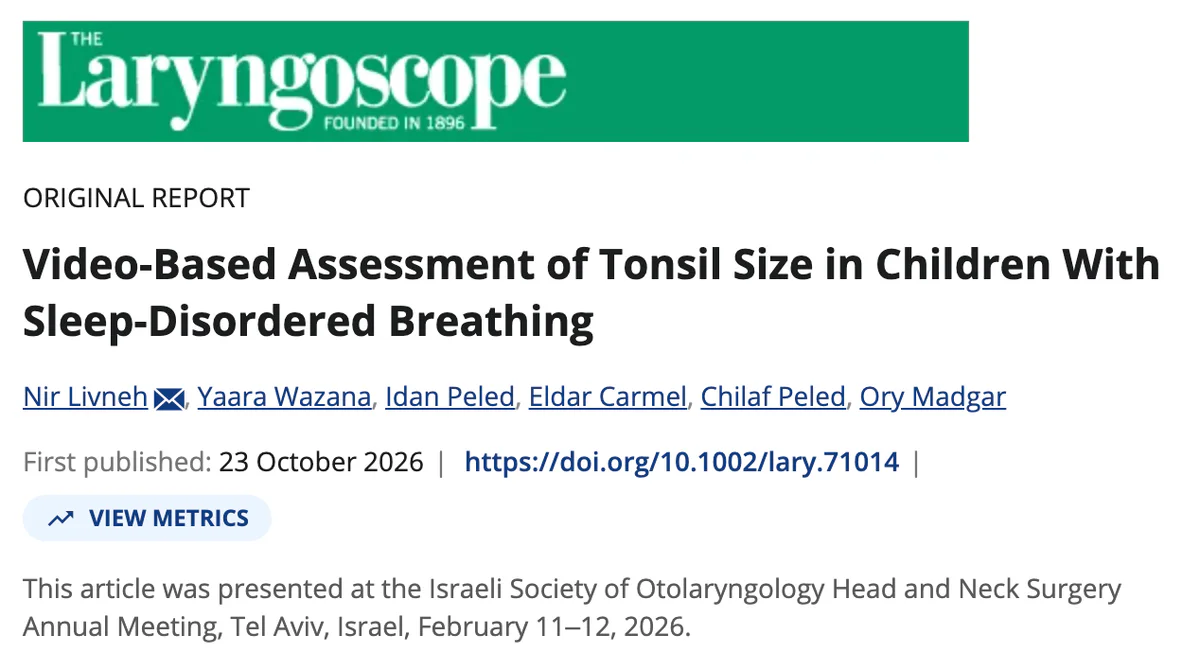
The Brodsky scale, a widely used grading tool for tonsil size, provides a clinical framework for classifying tonsillar hypertrophy based on degree of oropharyngeal airway obstruction (Brodsky, 1989). Earlier studies have established acceptable inter- and intra-observer reliability of this scale using video recordings (Reproducibility of clinical grading, 2010). Traditional assessment often requires a tongue depressor for adequate visualization, which can be challenging in young children or those with high Friedman palate position (Pediatric airway study, 2018). Recent advancements have introduced video-based remote assessment. Livneh et al. (2026) pioneered a prospective diagnostic accuracy study evaluating parent-captured oropharyngeal videos using the TytoCare handheld device to grade tonsil size in 169 children with sleep-disordered breathing. The study reported strong interrater agreement (Kendall’s W=0.88, p<0.01) and substantial Fleiss κ=0.65 for dichotomized grading (grades 0-2 vs 3-4), comparing favorably to in-person examination as the reference standard.Evidence by Diagnostic Performance and Usability
Livneh et al. demonstrated sensitivity of 70% and specificity of 86% for video-based grading to detect clinically significant tonsillar hypertrophy (grade ≥3). Positive predictive value (PPV) and negative predictive value (NPV) were 84% and 73%, respectively. Despite promising accuracy, video usability limitations were noted: 12% of videos were unusable by all evaluators, and 32% by at least one evaluator, with higher unusability rates in younger children. These findings underscore the feasibility but also the constraints of parent-captured videos in routine clinical practice. Complementary studies reflect the clinical challenges of remote or video-based tonsil evaluation. A 2021 telehealth study (Comparing telehealth with office-based visits) reported telemedicine feasibility in pediatric SDB evaluation but noted physical examination limitations, especially in oropharynx visualization. Child cooperation and technical factors affect exam completeness and reliability.Related Advances in Pediatric Sleep-Disordered Breathing Assessment
Other grading systems and endoscopic tools, such as the Pediatric Drug-Induced Sleep Endoscopy (PedDISE-8) grading system, have demonstrated good reliability in identifying multiple upper airway obstruction sites including tonsils (Reliability and validity of PedDISE-8, 2025). Endoscopic grading allows a more comprehensive three-dimensional assessment of airway obstruction without anatomic distortion caused by tongue depressor use (Pediatric airway study, 2018). Video monitoring combined with polysomnography and clinical measures improves OSA severity prediction (Screening pediatric OSA using video monitoring, 2025), highlighting the growing role of video-based and telemedicine approaches in the multi-dimensional assessment of pediatric SDB.Methodological Considerations and Interrater Agreement
Standardized and reproducible tonsil grading is vital for consistent clinical management. Studies (Interexaminer agreement in pediatric OSA, 2024) reveal variability among clinicians, including pediatric dental specialists, in tonsil and Friedman Tongue Position assessment from video recordings, suggesting the need for refined training and objective criteria. Livneh et al.’s method of using three blinded pediatric otolaryngologists and the Brodsky scale provides robust interrater reliability evidence for video-based assessments, reinforcing its potential as a clinical tool pending further validation.Expert Commentary
The introduction of parent-captured oropharyngeal videos represents an innovative approach to pediatric SDB evaluation, offering potential to alleviate barriers to in-person assessment while maintaining clinical rigor. Strong interrater reliability and favorable diagnostic metrics support its utility in identifying children with significant tonsillar hypertrophy who may benefit from adenotonsillectomy. However, the limitations—including video usability challenges especially in younger children, moderate sensitivity that could miss some cases, and reliance on parent video quality—warrant cautious integration into clinical pathways. Training parents on video capture techniques and device user-friendliness are critical to improving usability. Comparisons to other modalities such as in-clinic endoscopy or polysomnography reveal the strengths of video-based assessment as an adjunct rather than a standalone diagnostic tool. Integration with multi-modal evaluation, including clinical history, physical exam findings, and objective sleep assessments, will enhance diagnostic accuracy and inform surgical decision-making. Additionally, variability in clinician assessments across specialties highlights the importance of consensus training and possibly incorporating artificial intelligence-driven analytic tools for more objective tonsil size quantification. Current clinical guidelines emphasize adenotonsillar hypertrophy as a primary surgical indication in pediatric SDB, underscoring the need for accurate and accessible tonsil assessment methods. Video-based remote evaluation aligns with evolving telemedicine trends but requires further multicentric studies and validation before routine clinical adoption.Conclusion
Parent-captured oropharyngeal video assessment using handheld telemedicine devices offers a promising and feasible modality for remote tonsil size evaluation in children with sleep-disordered breathing. High interrater reliability and favorable diagnostic performance compared with in-person examination support its potential role in clinical decision-making. However, limitations in video usability, especially among younger children, and moderate sensitivity necessitate further validation and optimization. Future research should focus on improving video capture technology, standardized training, and integration with comprehensive clinical assessment to enhance remote management of pediatric SDB.References
- Livneh N, Wazana Y, Peled I, Carmel E, Peled C, Madgar O. Video-Based Assessment of Tonsil Size in Children With Sleep-Disordered Breathing. Laryngoscope. 2026 Oct 23. doi:10.1002/lary.71014. PMID:42920092.
- Reproducibility of clinical grading of tonsillar size. Arch Otolaryngol Head Neck Surg. 2010;136(2):159-62. doi:10.1001/archoto.2009.170. PMID:20157062.
- Pediatric airway study: Endoscopic grading system for quantifying tonsillar size in comparison to standard adenotonsillar grading systems. Am J Otolaryngol. 2018 Jan-Feb;39(1):56-64. doi:10.1016/j.amjoto.2017.10.013. PMID:29092747.
- Comparing telehealth with office-based visits for common pediatric otolaryngology complaints. Int J Pediatr Otorhinolaryngol. 2021 Jun;145:110712. doi:10.1016/j.ijporl.2021.110712. PMID:33887549.
- Reliability and Validity of a Pediatric Drug-Induced Sleep Endoscopy Grading System (PedDISE-8). Ann Otol Rhinol Laryngol. 2025 Jun;134(6):420-426. doi:10.1177/00034894251318158. PMID:39924960.
- Screening of pediatric obstructive sleep apnea using video monitoring. Int J Pediatr Otorhinolaryngol. 2025 Apr;191:112281. doi:10.1016/j.ijporl.2025.112281. PMID:40024126.
- Interexaminer agreement among pediatric dental specialists in assessment of tonsil size, Friedman tongue position, and Friedman staging of obstructive sleep apnea in children: An observational study. J Indian Soc Pedod Prev Dent. 2024 Apr 1;42(2):91-97. doi:10.4103/jisppd.jisppd_85_24. PMID:38957905.