Highlights
- The Environment, Leiomyomas, Latinas, and Adiposity (ELLA) Study is among the first prospective cohorts confirming uterine fibroid prevalence with ultrasound in Latina women in the US.
- Fibroid prevalence in Latinas was found to be 11.2%, considerably lower than rates reported for Black and White women, and positively correlated with age.
- Earlier menarche and higher gravidity were inversely associated with fibroid presence, while parity showed no significant association.
- Findings underscore the need for further research to elucidate ethnic differences in fibroid burden and pathophysiology.
Background
Uterine fibroids (leiomyomas) are benign smooth muscle tumors of the uterus, contributing significantly to gynecologic morbidity worldwide. They affect a large proportion of reproductive-aged women, with racial and ethnic disparities well-documented — notably higher prevalence and severity in Black women compared to White women. Despite Latinos being among the fastest-growing populations in the United States, fibroid epidemiology in Latina women remains understudied. Current literature predominantly extrapolates data from studies with limited Latina representation, often relying on self-reports or medical records without systematic imaging confirmation, which may over- or underestimate true prevalence. Understanding the prevalence and associated factors in Latinas is critical for tailored prevention and management strategies.
Key Content
Study Design and Population
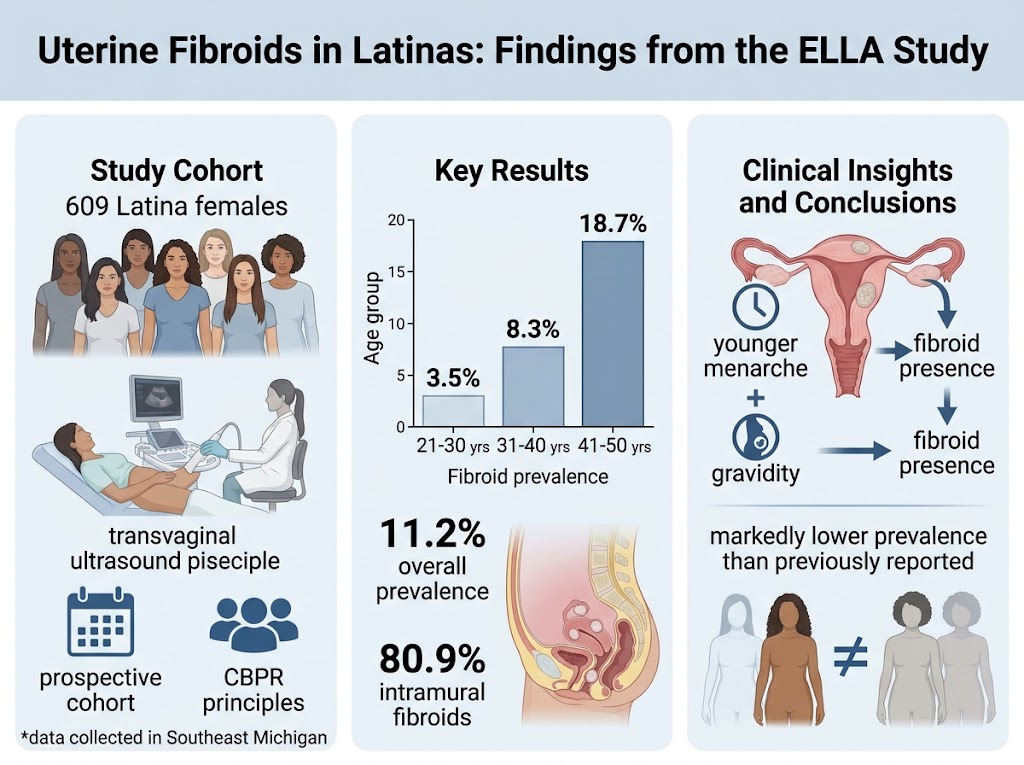
The ELLA Study was a community-based prospective cohort conducted in Southeast Michigan from October 2017 to October 2022. It recruited 621 reproductive-aged Latina females (aged 21–50) through a community health clinic and academic center using Community Based Participatory Research principles. Inclusion required self-identification as Hispanic/Latina, assigned female sex at birth, and literacy in English or Spanish. Exclusion criteria removed active pregnancy and conditions contraindicating ultrasound. Importantly, recruitment did not select based on fibroid symptomatology, enhancing the generalizability of prevalence estimates.
Fibroid Assessment
Fibroid presence and characteristics were rigorously assessed via expert-administered transvaginal ultrasounds in 609 participants (98%). The majority of fibroids were intramural (80.9%), with a mean largest diameter of 2.9 ± 1.2 cm. The study combined self-reported history with ultrasonographic data to validate fibroid status, reducing misclassification commonly present in earlier studies relying solely on self-report.
Prevalence and Demographic Correlates
Overall fibroid prevalence was 11.2% (95% CI, 8.6%-13.8%), markedly lower than published 30-70% prevalence rates in Black women and 15-30% in White women. Prevalence increased significantly with age: 3.5% in ages 21-30, 8.3% in 31-40, and 18.7% in 41-50 years (P<.001). The majority (75%) had a single fibroid; multiple fibroids were present in 25%.
Reproductive and Hormonal Factors
Logistic regression models adjusted for confounders revealed inverse associations of fibroid presence with age at menarche (adjusted odds ratio [aOR] 0.84; 95% CI, 0.72-0.99) and gravidity (aOR 0.80; 95% CI, 0.66-0.97), suggesting earlier menarche and higher gravidity are associated with lower fibroid risk in this population. Parity showed no statistically significant association (aOR 0.85; 95% CI, 0.68-1.07).
Comparisons with Other Populations
The ELLA findings contrast with prior epidemiologic data indicating substantially higher fibroid prevalence in Black women, but also somewhat lower rates than that noted in many White cohorts. These differences may reflect genetic, environmental, or sociocultural factors, including acculturation, lifestyle, diet, and healthcare access. Precise mechanisms remain to be elucidated.
Methodological Strengths and Limitations
Strengths include prospective design, community engagement enhancing representativeness, rigorous ultrasound-based fibroid ascertainment, and comprehensive characterization of demographic and reproductive factors. Limitations involve regional specificity (Southeast Michigan), which may limit external generalizability to diverse Latina subpopulations across the US; lack of data on fibroid symptoms or severity impact; and the observational design precluding causal inference.
Expert Commentary
The ELLA Study addresses a critical gap by providing robust prevalence data of uterine fibroids in Latina women using gold-standard imaging confirmation. The findings contradict some prior indirect or self-reported studies suggesting higher Latina fibroid prevalence, implying potential overestimations in earlier literature. The observed age-related rise in fibroid prevalence aligns with established fibroid natural history.
The inverse association with younger menarche and gravidity is intriguing and warrants further mechanistic investigation. Traditional views recognize that earlier menarche represents prolonged estrogen exposure, potentially increasing fibroid risk; however, in this cohort, earlier menarche correlates with reduced fibroid presence, suggesting ethnic-specific biological interactions or confounding reproductive behaviors. Gravidity’s protective effect aligns with known parity-related reductions in fibroid risk, though parity itself did not reach significance here.
Future research should focus on longitudinal tracking of fibroid development, evaluating the influences of acculturation, genetic admixture, environmental exposures, and metabolic profiles, such as adiposity, which the ELLA Study was positioned to explore. Integration with mechanistic molecular studies leveraging biopsies or biomarkers may yield insights into ethnic disparities in fibroid pathogenesis. Additionally, assessing the clinical burden, symptomatology, and health-related quality of life impacts in Latina women with fibroids remains an essential unmet need.
This study informs clinical practice by contextualizing fibroid risk among Latina patients, guiding screening considerations, and emphasizing culturally sensitive patient counseling. It further underscores the importance of diverse cohorts in gynecologic research to refine risk stratification and therapeutic approaches.
Conclusion
The ELLA Study presents crucial epidemiologic insights demonstrating that the prevalence of uterine fibroids among Latina women of reproductive age in Southeast Michigan is lower than previously reported and substantially below rates observed in Black and White women. Fibroid prevalence increases with advancing age and is inversely associated with earlier menarche and greater gravidity. These findings prompt reassessment of fibroid epidemiology in Latina populations and highlight the necessity for additional research to unravel underlying biological, environmental, and sociocultural determinants. Enhanced understanding will foster equitable, precise gynecologic care tailored to ethnically diverse populations.
References
- Marsh EE, Jean DA, Jiang C, Valbuena F, Harlow SD, Neff L, Carnethon M, Wegienka G, Baird DD. Uterine fibroids in Latinas: findings from the Environment, Leiomyomas, Latinas, and Adiposity Study. Am J Obstet Gynecol. 2026 Apr 7;235(4):859-868. PMID: 41956310.