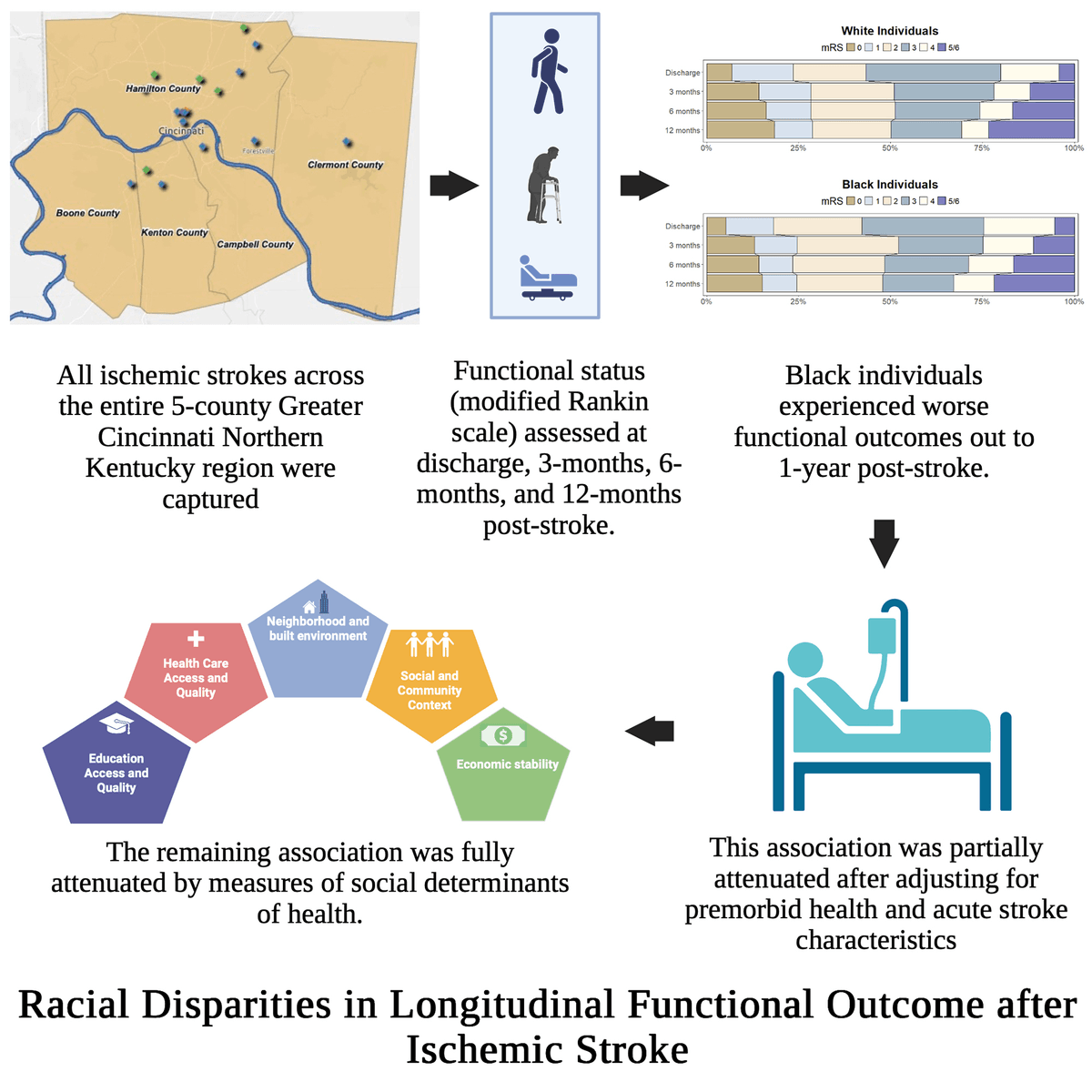
Black individuals experience worse functional outcomes after ischemic stroke from discharge through 12 months.
Stroke severity and premorbid health partially explain the racial disparities in recovery.
Social determinants of health fully attenuate the association between Black race and poor functional recovery.
Intervening on social determinants during the recovery period may reduce outcome disparities.
Study Background
Stroke remains a leading cause of disability and mortality globally, with ischemic stroke comprising the majority of cases. In the United States, a pronounced racial disparity exists not only in stroke incidence but also possibly in recovery trajectories, with Black Americans disproportionately affected. Understanding whether and how functional outcomes differ longitudinally by race is critical to addressing health inequities and tailoring interventions that optimize recovery and quality of life post-stroke. Prior research has established higher stroke incidence and mortality among Black individuals; however, data on long-term functional recovery and its determinants have been limited and inconsistent. This study sought to clarify racial disparities in functional outcomes after acute ischemic stroke over a 12-month period.
Study Design
This retrospective cohort study was conducted within the Greater Cincinnati Northern Kentucky region, capturing all incident acute ischemic stroke events over 18 months from July 2019 to December 2020. Inclusion criteria encompassed adult patients surviving the index ischemic stroke. Functional outcomes were measured using the modified Rankin Scale (mRS), a validated tool ranging from 0 (no symptoms) to 6 (death), at discharge and at 3, 6, and 12 months post-stroke. The primary exposure was self-identified Black race.
Statistical analysis employed mixed-effects ordinal regression modeling to assess the association between race and longitudinal mRS scores, adjusting sequentially for confounders: (1) demographic factors (age, sex, time since stroke), (2) initial stroke severity and acute management, (3) premorbid health status, and (4) social determinants of health. The study also conducted sensitivity analyses excluding recurrent stroke events and tested for interactions between race and time since stroke.
Key Findings
The study included 2,796 acute ischemic stroke patients, with a mean age of 69.0 years; 31% were Black and 52% female. Among these, 2,537 survivors (32% Black) were analyzed longitudinally.
Initial unadjusted analyses demonstrated that Black race was strongly associated with worse functional outcomes over 12 months post-stroke, with a cumulative odds ratio (cOR) of 2.61 (95% CI, 1.89–3.60). This relationship persisted even after excluding patients with recurrent strokes (cOR 2.69 [95% CI, 1.92–3.78]).
Subsequent adjustments revealed that stroke severity and acute stroke management accounted for a considerable portion of this disparity, attenuating the association to a cOR of 1.92 (95% CI, 1.43–2.60). Further adjustment for premorbid health characteristics—including coexisting diseases and baseline functional status—reduced the association to cOR 1.43 (95% CI, 1.09–1.87).
Importantly, after controlling for social determinants of health—factors such as socioeconomic status, education, access to care, and support networks—the association between Black race and poor functional outcome was fully attenuated (cOR 1.09, 95% CI, 0.80–1.47), indicating that social determinants substantially mediate stroke recovery disparities.
No significant interaction was observed between race and time since stroke, suggesting that the racial gap in functional recovery is consistent from discharge through one year.
Expert Commentary
This comprehensive population-based analysis confirms that Black patients endure a disproportionately heavier burden of disability after ischemic stroke, starting at hospital discharge and persisting through the first year. The sequential modeling approach skillfully delineates how clinical factors including stroke severity and premorbid health partially but not completely explain disparities.
Most notably, the full attenuation of racial disparities after accounting for social determinants substantiates the profound influence of socioeconomic and environmental context on recovery. Social determinants often encapsulate barriers such as reduced access to rehabilitation, inadequate social support, financial stressors, and neighborhood-level disparities that impede optimal recovery.
These findings align with extant literature underscoring social determinants as prime drivers of health inequities. The absence of interaction with time suggests that early intervention addressing social factors might be critical to mitigating long-term disparities.
Limitations include the retrospective design, potential residual confounding, and regional specificity which may limit generalizability. Nonetheless, this study’s large cohort and exhaustive adjustment models lend robust evidence to the role of social determinants.
Future research should explore targeted social and rehabilitative interventions during acute and subacute phases post-stroke to improve equity in outcomes. Additionally, integration of detailed data on access to care and rehabilitation services may enhance understanding.
Conclusion
The study compellingly demonstrates enduring racial disparities in functional recovery after ischemic stroke, largely driven by initial stroke severity, premorbid health, and critically, social determinants of health. These results emphasize the need for healthcare systems and policymakers to prioritize social determinants as modifiable targets to improve stroke recovery equity. Addressing these factors during the recovery period offers a promising avenue to close the gap in stroke-related disability between Black and White populations.
Funding and ClinicalTrials.gov
Not reported in the source abstract.
References
1. Robinson DJ, Sucharew H, Ding L, et al. Racial Disparities in Longitudinal Functional Outcome After Ischemic Stroke. Stroke. 2026 Oct 19. PMID: 42895019.