Highlight
- Once-weekly oral islatravir-lenacapavir is noninferior to daily bictegravir-emtricitabine-tenofovir alafenamide in maintaining HIV-1 viral suppression at 48 weeks.
- Long-acting, less frequent dosing regimens may alleviate adherence challenges common with daily HIV therapy.
- The study enrolled a diverse population including women, older adults, and racial/ethnic minorities, supporting generalizability.
- Safety and tolerability profiles were comparable between the weekly oral regimen and daily therapy, with low rates of treatment discontinuations.
Study Background
Human immunodeficiency virus type 1 (HIV-1) infection remains a global health challenge despite substantial advances in antiretroviral therapy (ART). Modern once-daily single-tablet regimens (STRs) have revolutionized HIV management by simplifying treatment and enhancing viral suppression durability. However, adherence to daily oral medication continues to be a barrier for many patients, potentially compromising virologic control and increasing the risk of resistance and transmission. Long-acting antiretroviral agents, particularly those enabling less frequent dosing, have emerged as attractive alternatives to conventional daily therapy by reducing pill burden and improving patient convenience. Injectable formulations have shown promise but are limited by administration logistics and patient preference. Consequently, long-acting oral formulations represent an important therapeutic frontier, offering the dual benefits of convenience and ease of administration. Islatravir (ISL), a nucleoside reverse transcriptase translocation inhibitor, and lenacapavir (LEN), a capsid inhibitor, are two potent antiretroviral agents with long half-lives supporting once-weekly oral dosing. The combination of ISL and LEN offers a novel, potent dual mechanism for inhibiting HIV-1 replication, and their feasibility as a weekly oral regimen warranted evaluation in a rigorously designed clinical trial.Study Design
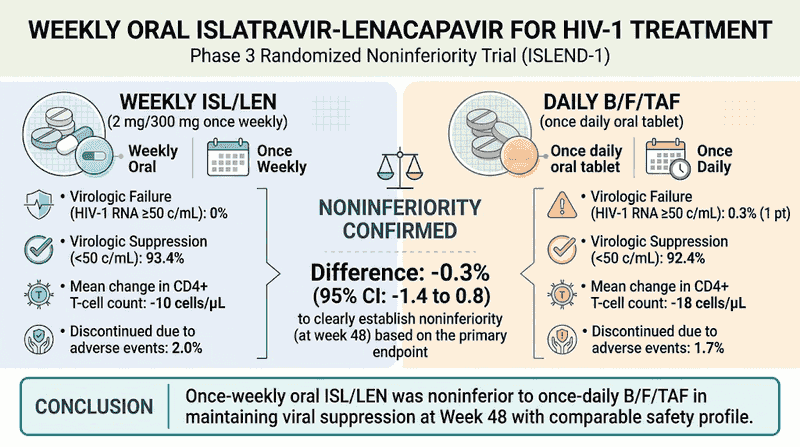
This multinational, phase 3, randomized, double-blind, active-controlled, noninferiority trial (ISLEND-1) was conducted across 12 countries. It enrolled adults with confirmed HIV-1 infection who had been virologically suppressed (HIV-1 RNA <50 copies/mL) on once-daily bictegravir-emtricitabine-tenofovir alafenamide (B/F/TAF) for at least 6 months before screening. Participants were randomly assigned 1:1 to switch either to once-weekly oral ISL/LEN (2 mg/300 mg) plus placebo daily tablets or to continue daily B/F/TAF plus weekly placebo capsules for 96 weeks. The primary endpoint was the proportion of participants with confirmed virologic failure, defined as HIV-1 RNA ≥50 copies/mL at week 48 based on the FDA snapshot algorithm. The noninferiority margin was set at 4 percentage points. The study also measured changes in CD4+ T-cell counts, safety and tolerability outcomes, including adverse events leading to treatment discontinuation, and serious adverse events. The trial’s population was demographically diverse, with 21% women, 31% Black, 26% Hispanic/Latine, and 15% aged 65 years or older.Key Findings
A total of 607 participants were randomized: 304 to ISL/LEN and 303 to B/F/TAF. At week 48, no participants in the ISL/LEN group and one participant (0.3%) in the B/F/TAF group had HIV-1 RNA levels ≥50 copies/mL, indicating viral rebound. The difference in virologic failure rates was -0.3 percentage points (95.002% CI: -1.4 to 0.8), comfortably meeting the prespecified noninferiority criterion. Viral suppression (<50 copies/mL) rates were high and similar between groups: 93.4% in the ISL/LEN arm and 92.4% in the B/F/TAF arm (difference 1.0 percentage point; 95% CI -3.2 to 5.2). These results affirm that switching to weekly ISL/LEN maintains viral suppression equivalently to continuing daily B/F/TAF. Immunologic parameters showed small, nonclinically significant mean decreases in CD4+ T-cell counts (-10 cells/μL ISL/LEN versus -18 cells/μL B/F/TAF), with a least-squares mean difference of 12 cells/μL (95% CI -16 to 39), supporting comparable immunologic stability. Safety profiles were favorable and comparable: adverse-event-related discontinuations were 2.0% for ISL/LEN and 1.7% for B/F/TAF, and serious adverse events occurred in 5.3% and 4.6%, respectively. The long-acting oral regimen was generally well tolerated without unexpected safety signals after 48 weeks.Expert Commentary
This landmark trial addresses a critical unmet need in HIV treatment by providing Level 1 evidence that a once-weekly oral regimen can sustain viral suppression in virologically suppressed persons living with HIV (PLWH). The use of two novel agents with complementary mechanisms expands the armamentarium of long-acting therapies beyond injectables, which may not be acceptable or convenient for all patients. The broad inclusion of women, older adults, and racial minorities enhances the generalizability of findings across populations often underrepresented in clinical trials. The demonstration of noninferiority with a robust margin and rigorous methodology supports the clinical equivalence of switching to ISL/LEN. Limitations include the relatively short duration of the interim analysis at 48 weeks compared to the planned 96 weeks and the exclusion of certain populations with comorbidities or prior resistance mutations. Future data on longer-term safety, resistance emergence, and patient-reported outcomes will be valuable in guiding clinical implementation. Mechanistically, the dual action on reverse transcriptase translocation and capsid assembly may confer strong antiviral potency and high barriers to resistance, a promising feature for maintaining durable suppression in diverse clinical settings.Conclusion
The ISLEND-1 phase 3 trial robustly demonstrates that once-weekly oral islatravir-lenacapavir is noninferior to the current daily standard-of-care B/F/TAF regimen in maintaining virologic suppression in adults with controlled HIV-1 infection. This novel regimen offers a potentially transformative option for reducing treatment burden and enhancing adherence, which remains a cornerstone of successful HIV management. Further follow-up and real-world studies will help delineate the long-term clinical value and optimal integration of this therapy into individualized ART strategies.Funding and ClinicalTrials.gov Registration
This study was funded by Gilead Sciences and Merck Sharp and Dohme. The clinical trial is registered under ClinicalTrials.gov number NCT06630286.References
- Rockstroh JK, Ramgopal MN, Curran Fàbregas A, et al. Phase 3 Trial of Weekly Oral Islatravir-Lenacapavir for HIV-1 Treatment. N Engl J Med. 2026;395(13):1299-1309. PMID: 42525925.