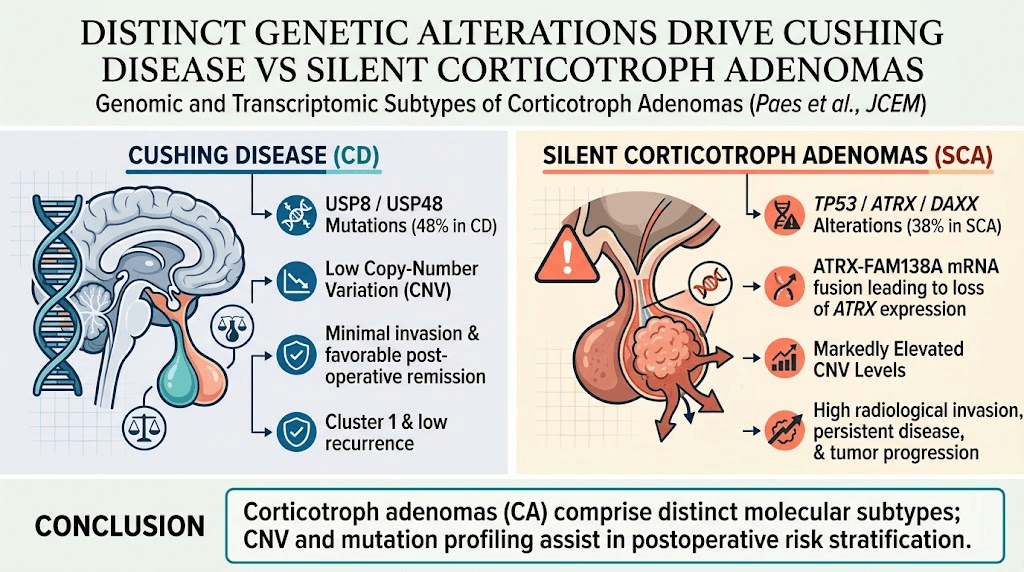
USP8/USP48 mutations are prevalent in Cushing disease tumors, associated with low copy-number variation and favorable postoperative outcomes.
TP53/ATRX/DAXX mutations define a subset of silent corticotroph adenomas exhibiting high genomic instability and aggressive clinical features.
Copy-number variation levels correlate strongly with tumor invasiveness and prognosis, highlighting utility for postoperative risk stratification.
Study Background
Corticotroph adenomas (CAs) are pituitary tumors originating from corticotroph cells that secrete adrenocorticotropic hormone (ACTH). These tumors manifest in two clinical phenotypes: functioning corticotroph adenomas causing Cushing disease (CD), characterized by overt hypercortisolism, and silent corticotroph adenomas (SCAs), which do not produce clinical signs of hormone excess but tend to be larger and more aggressive. Despite these stark clinical differences, the molecular mechanisms driving divergent tumor behavior and aggressiveness have remained unclear. Understanding the genomic and transcriptomic underpinnings of these adenomas could refine diagnostic precision, prognostic prediction, and therapeutic strategies.
Study Design
This comprehensive molecular study analyzed 38 corticotroph tumors from 34 patients, including both CD and SCA cases. The tumors underwent whole-exome sequencing to identify somatic mutations, copy-number variation (CNV) analysis to evaluate chromosomal instability, and mRNA sequencing to profile transcriptomic alterations. Molecular data were integrated with detailed clinical features, radiological imaging, and pathological characteristics to construct a multidimensional understanding of tumor biology and behavior.
Key Findings
The study revealed distinct genomic alterations segregating CD and SCA tumors. Among 21 CD tumors analyzed, 10 (48%) harbored mutations in the USP8 or USP48 genes. These mutations correlated with lower levels of CNV, less invasive tumor phenotypes on imaging, and favorable postoperative remission rates. This subgroup of CD tumors clustered together transcriptomically, confirming their molecular homogeneity and low-risk profile.
Conversely, five of 13 SCAs exhibited mutations in TP53, ATRX, or DAXX. These tumors demonstrated significantly higher CNV burden, indicating marked genomic instability. Clinically, these tumors tended to be larger, radiologically invasive, and associated with persistent or recurrent disease. Notably, transcriptome analysis identified a novel ATRX-FAM138A fusion transcript in an aggressive tumor, resulting in ATRX expression loss—a finding with potential biological and therapeutic implications.
Unsupervised transcriptome clustering delineated four distinct molecular clusters:
– Cluster 1: Enriched for USP8/USP48-mutant CD tumors with low CNV and minimal recurrence.
– Cluster 2: A mix of CD and SCA tumors with intermediate CNV and nonaggressive behavior.
– Cluster 3: USP8 wild-type CD tumors with heterogeneous but generally indolent courses.
– Cluster 4: High CNV tumors enriched for TP53/ATRX/DAXX mutations, demonstrating greatest invasiveness, persistent disease, and recurrence.
Overall, a higher CNV burden was statistically significantly associated with more aggressive clinical parameters across the cohort, supporting CNV assessment as a potential prognostic biomarker.
Expert Commentary
This study sheds light on the molecular heterogeneity underlying corticotroph adenoma clinical phenotypes, advancing understanding beyond histopathology and hormone secretion profiles. The identification of USP8/USP48 mutations in CD aligns with prior knowledge that these mutations enhance epidermal growth factor receptor pathway signaling, leading to ACTH hypersecretion with relatively benign tumor behavior. In contrast, the link between TP53/ATRX/DAXX mutations and genomic instability provides a mechanistic basis for aggressive silent corticotroph adenomas.
The novel ATRX-FAM138A fusion highlights the role of chromatin remodeling dysregulation in tumor aggressiveness and could be a target for future investigation. Moreover, the integration of CNV and mutation profiling could enable improved postoperative risk stratification, guiding surgical and adjuvant treatment decisions. However, the relatively small sample size and retrospective nature warrant confirmation in larger prospective cohorts.
Conclusion
Corticotroph adenomas comprise biologically distinct molecular subtypes correlating strongly with their divergent clinical behavior. USP8/USP48-mutant functioning adenomas represent a low-risk group with stable genomes and good postoperative outcomes. In contrast, TP53/ATRX/DAXX-mutant silent corticotroph adenomas exhibit marked genomic instability, aggressive clinical features, and poorer prognosis. Copy-number variation analysis combined with targeted mutation profiling holds promise as a novel approach for personalized postoperative risk assessment, potentially refining management algorithms for these complex pituitary tumors. Ongoing research should elucidate targeted therapies tailored to these molecular subtypes to improve patient outcomes.
Funding and Clinical Trials
The research was supported by grants and institutional funding pertinent to neuroendocrine tumor research. No clinical trial registration was reported in association with this molecular characterization study.
References
1. Paes T, Zhang Q, Borges CO, Mohan DR, Vaz V, Soares BS, Carroll RS, Kaiser UB, Smith TR, Bi WL, Meredith D, Lerario AM, Abreu AP. Distinct genetic alterations drive Cushing disease vs silent corticotroph adenomas. J Clin Endocrinol Metab. 2026;111(11):3062-3074. doi:10.1210/clinem/dgab123