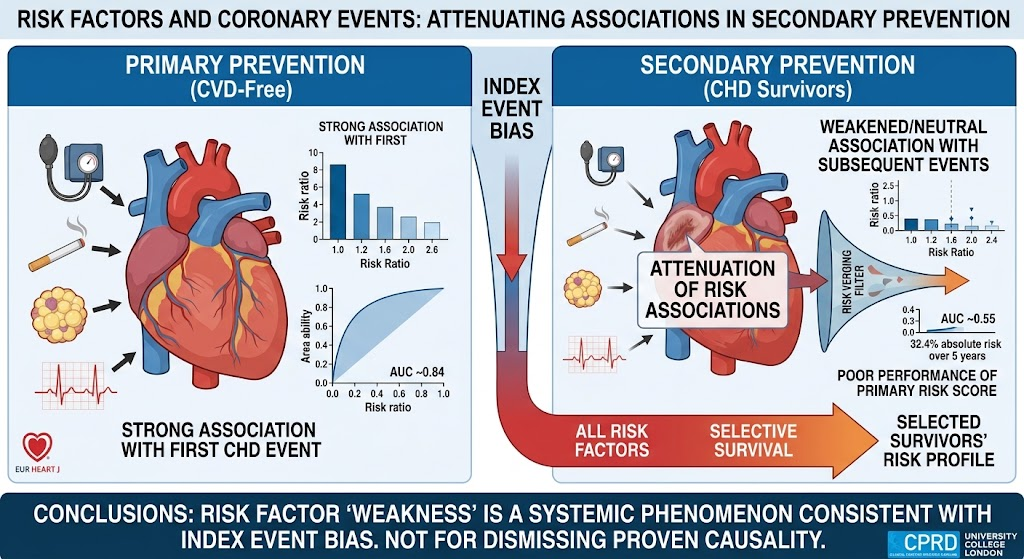
Risk factor associations for subsequent coronary events are systematically weaker compared to first events, a phenomenon attributed to index event bias.
A 10-year primary prevention risk model performs well for first coronary events but poorly predicts recurrent events after initial coronary heart disease (CHD).
Some traditional risk factors exhibit paradoxical or neutral associations post-first event, complicating risk interpretation in secondary prevention.
Findings caution against deprioritizing established therapies, such as LDL cholesterol lowering, based on attenuated risk factor associations in CHD survivors.