Highlight
- Tozorakimab, an anti-interleukin-33 monoclonal antibody, significantly reduces moderate or severe COPD exacerbations compared to placebo.
- The therapeutic benefit was consistent in both former smokers and the overall COPD population, including current smokers.
- The safety profile of tozorakimab was comparable to placebo over 52 weeks of treatment.
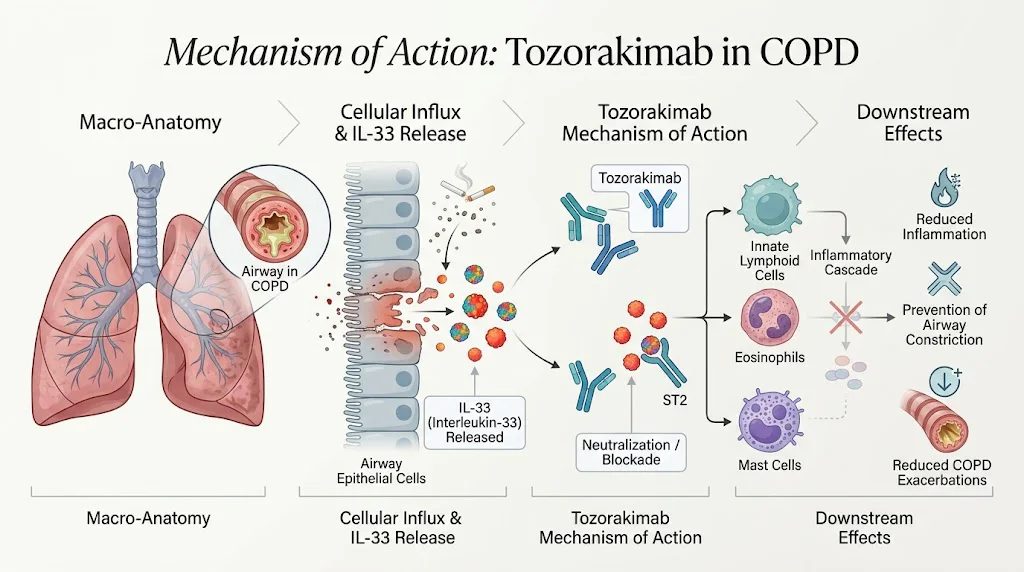
- This represents a novel mechanism of action targeting IL-33 signaling implicated in COPD pathogenesis.
Study Background
Chronic obstructive pulmonary disease (COPD) is a progressive respiratory disorder characterized by airflow limitation and persistent respiratory symptoms. COPD exacerbations, defined as acute worsening of respiratory symptoms requiring additional treatment, significantly contribute to morbidity, mortality, health care utilization, and reduced quality of life. Despite advances in maintenance inhaled therapies, a substantial proportion of patients continue to experience exacerbations, underscoring an unmet medical need for novel treatments. Emerging evidence has implicated dysregulated interleukin-33 (IL-33) signaling as a key inflammatory mediator in COPD exacerbations. IL-33 is an alarmin cytokine released in response to airway epithelial damage that activates immune responses contributing to airway inflammation. Thus, targeted inhibition of IL-33 is a promising therapeutic strategy.Study Design
The efficacy and safety of tozorakimab, a monoclonal antibody that inhibits IL-33 activity, were evaluated in two replicate phase 3 randomized, double-blind, placebo-controlled trials named OBERON and TITANIA. Both trials enrolled adult patients with COPD who were either current or former smokers, had a history of at least one exacerbation requiring treatment in the previous year, and were receiving stable standard-of-care inhaled maintenance therapy. There was no requirement for specific blood eosinophil counts, broadening the applicability of the results. Participants were randomly assigned to receive add-on subcutaneous tozorakimab 300 mg or matching placebo every 4 weeks for 52 weeks. The primary endpoint was the annualized rate of moderate or severe exacerbations in former smokers over 52 weeks. The key secondary endpoint examined the annualized rate of moderate or severe exacerbations in the overall study population (current and former smokers). Safety outcomes were also systematically assessed.Key Findings
The OBERON trial included 877 patients (446 receiving tozorakimab, 431 placebo), and TITANIA comprised 873 patients (438 tozorakimab, 435 placebo). Both trials demonstrated a significant reduction in the rate of moderate or severe exacerbations among former smokers treated with tozorakimab. In OBERON, former smokers in the tozorakimab arm experienced 1.34 events annually compared to 1.90 events with placebo, a rate ratio of 0.71 (95% CI, 0.57 to 0.88; P=0.002). TITANIA showed similar results with 1.37 events versus 2.07, yielding a rate ratio of 0.66 (95% CI, 0.55 to 0.80; P<0.001). Analyzing the overall population, including current smokers, tozorakimab also led to consistent and statistically significant reductions. In OBERON, the annualized exacerbation rates were 1.41 for tozorakimab and 2.00 for placebo (rate ratio 0.70; 95% CI, 0.58 to 0.85; P<0.001). In TITANIA, rates were 1.44 versus 2.03 (rate ratio 0.71; 95% CI, 0.59 to 0.84; P<0.001). Regarding safety, adverse events occurred at similar frequencies between tozorakimab and placebo groups: 70.4% vs. 77.2% in OBERON and 80.1% vs. 79.8% in TITANIA, indicating that tozorakimab was generally well tolerated over one year of therapy.Expert Commentary
The replication of consistent efficacy in two large phase 3 trials strengthens the credibility of these findings. Targeting IL-33 represents a biologically rational approach, intervening upstream in the inflammatory cascade that drives COPD exacerbations. Unlike some prior targeted therapies requiring eosinophil stratification, tozorakimab showed benefit in a broad COPD population. Limitations include the exclusion of patients with very severe disease or other comorbidities and the focus on a one-year treatment period; long-term outcomes and effects on disease progression require further study. The generalizability to diverse ethnic groups and real-world settings should also be confirmed. Nonetheless, these results may influence future COPD management guidelines by introducing IL-33 modulation as a novel add-on therapeutic option, especially for patients at high risk of exacerbations despite standard inhaled therapy.Conclusion
Tozorakimab significantly lowers the frequency of moderate or severe COPD exacerbations when added to standard inhaled maintenance treatment, benefitting both former and current smokers. It demonstrates a favorable safety profile and addresses an unmet need in COPD care through a novel mechanism targeting IL-33 cytokine signaling. Further research should evaluate long-term benefits and integration into clinical practice.Funding and ClinicalTrials.gov
These studies were funded by AstraZeneca. The clinical trials are registered under NCT05166889 (OBERON) and NCT05158387 (TITANIA).References
1. Sciurba FC, et al. Tozorakimab to Prevent COPD Exacerbations. N Engl J Med. 2026 Sep 8;395(17):1703-1716. PMID: 42708515. 2. Agusti A, et al. Global strategy for the diagnosis, management, and prevention of chronic obstructive pulmonary disease. 2023 Report. GOLD; 2023. 3. Ortega HG, et al. Targeting cytokines in chronic obstructive pulmonary disease: A new frontier. Am J Respir Crit Care Med. 2022;205(9):1011-1023.Specialty calculators
For clinical reference; use professional judgment.