Introduction
Obesity affects over 40% of adults in the United States and remains a critical public health concern due to its association with numerous chronic diseases, including diabetes, cardiovascular disease, and certain cancers. Despite the availability of many weight management programs, participation rates remain low, particularly among veterans, a population with unique health challenges and a high prevalence of obesity.This article presents findings from the EMBER trial, a hybrid type 1 randomized controlled trial investigating whether a brief, self-guided motivational tool could increase veterans’ participation in weight management programs offered through the Veterans Health Administration (VA). The study aimed to assess both the effectiveness and initial implementation feasibility of this intervention to inform future broader use.
Background and Rationale
Obesity prevalence among US adults has steadily increased, yet engagement with weight management services remains suboptimal. Studies show that motivational interventions that promote autonomous decision-making and self-efficacy can enhance behavior change but often require significant clinician involvement or resources.The EMBER tool was designed as a self-directed digital or paper resource to help individuals decide if they want to lose weight, consider participating in available programs, and, if so, develop a personalized action plan. This approach could reduce barriers like limited access to coaching and increased demand on healthcare providers by empowering users directly.
Study Design and Methods
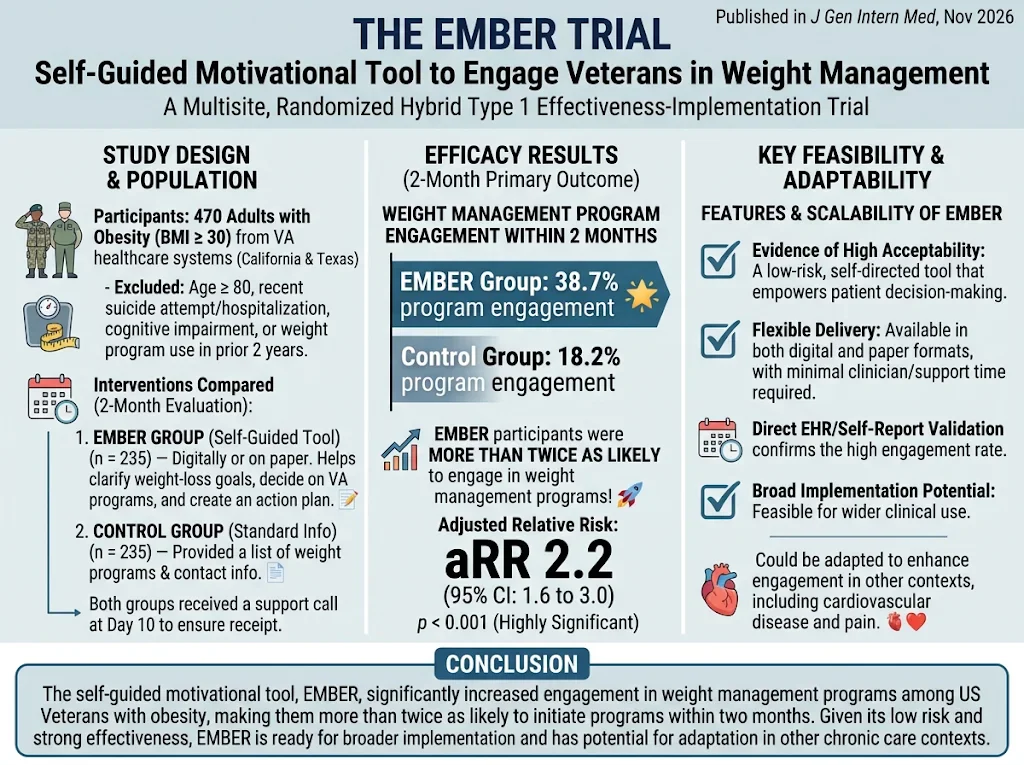
The EMBER trial was conducted at two VA healthcare systems in California and Texas. Participants were a randomized sample of 470 veterans under age 80, with a body mass index (BMI) of at least 30 kg/m2 and no use of weight management programs in the previous two years. The study excluded those with recent suicide attempts, hospitalizations within 30 days, or cognitive impairment to ensure safety and the ability to engage independently.Participants were randomized into two groups:
- EMBER Intervention Group: Received the self-directed motivational tool, available digitally and on paper. This tool guided them through decisions about weight loss desire, considering VA weight management programs, and making a personalized engagement plan.
- Control Group: Provided only with a list of available weight management programs and contact information, without additional guidance tools.
Data collection occurred at baseline, 2 months, and 6 months by assessors unaware of group assignments. The primary outcome was any engagement in a weight management program within 2 months, measured via electronic health records and participant self-report.
Key Results
At 2-month follow-up, veterans in the EMBER group were more than twice as likely to engage in any weight management program compared to controls (38.7% vs. 18.2%). This corresponded to an adjusted relative risk of 2.2 with high statistical significance (p < 0.001).This substantial increase demonstrates the tool’s effectiveness in motivating veterans to initiate weight management activities, a crucial first step in addressing obesity-related health risks.
Discussion
The EMBER trial illustrates how a low-intensity, self-guided motivational tool can significantly enhance initiation of weight management programs among veterans—a group that often faces access challenges and competing health priorities.The tool’s flexibility—available both digitally and on paper—supports diverse preferences and capabilities, potentially increasing its reach. The brief support call serves to reinforce engagement without overburdening clinical staff.
Given the low risk, ease of dissemination, and demonstrated impact, EMBER could be scaled up across VA systems and adapted for other chronic health conditions such as cardiovascular disease and chronic pain management. Future research should explore longer-term outcomes, clinical efficacy on weight loss and comorbidity improvement, and integration with digital health infrastructures.
Conclusion
The EMBER trial provides robust evidence that a brief self-directed motivational tool can double engagement with weight management programs among veterans within a short timeframe. This approach addresses a major gap in obesity care by empowering individuals to take actionable steps toward healthier lifestyles with minimal resource demands.As obesity continues to challenge veterans’ health and healthcare systems, such innovative interventions offer promising pathways to enhance participation, improve clinical outcomes, and ultimately reduce the burden of obesity-related diseases.
Trial Registration
ClinicalTrials.gov Identifier: NCT05424081References
Breland JY, Frayne SM, Raikov I, Shanahan BT, Maguen S, Timko C, Fletcher TL. The EMBER Trial: A Hybrid Type 1 Randomized Clinical Trial of a Self-Guided Motivational Tool to Engage Veterans in Weight Management. Journal of General Internal Medicine. 2026 Nov 11. PMID: 43015565.Specialty calculators
For clinical reference; use professional judgment.