Highlight
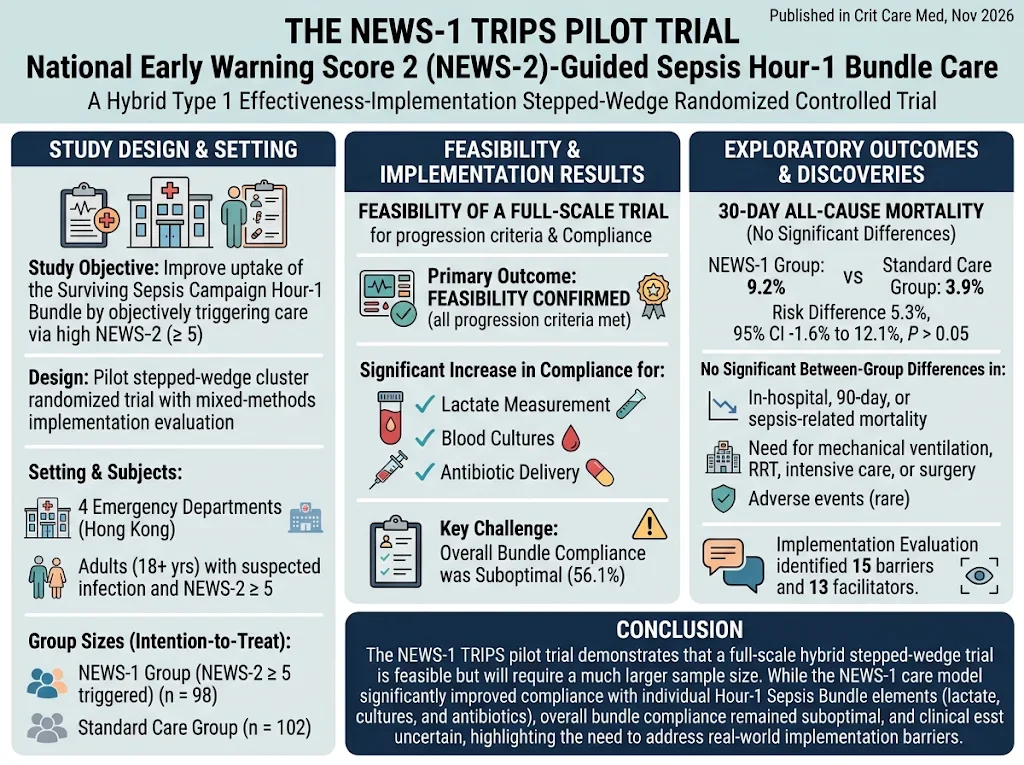
- The NEWS-2 score (≥5) was used to objectively trigger the Surviving Sepsis Campaign Hour-1 Bundle in emergency settings.
- The hybrid type 1 stepped-wedge trial demonstrated feasibility for a larger definitive study despite challenges in full bundle compliance.
- Implementation efforts increased compliance with key interventions such as lactate testing, blood cultures, and timely antibiotics.
- Preliminary effectiveness analysis showed no significant mortality or major clinical outcome differences but confirmed low adverse event rates.
Study Background
Sepsis remains a critical global health challenge, causing substantial morbidity, mortality, and healthcare burden. Prompt recognition and early interventions, such as those encapsulated in the Surviving Sepsis Campaign Hour-1 Bundle, have been associated with improved outcomes. However, timely and consistent implementation in busy emergency departments (EDs) is often hindered by challenges in early identification and variable clinician uptake. The National Early Warning Score 2 (NEWS-2), a well-validated aggregate physiological score, has shown promise as an early and objective tool for detecting patient deterioration, including sepsis. Integrating NEWS-2 as a trigger for initiating the Hour-1 bundle could standardize care and potentially improve sepsis outcomes.
Study Design
This pilot study utilized a hybrid type 1 effectiveness-implementation design, combining a stepped-wedge cluster randomized controlled trial with a mixed-methods implementation evaluation. Conducted across four Hong Kong EDs, the trial enrolled adult patients (≥18 years) with suspected infection, hospitalized, and with a high NEWS-2 score (≥5) indicative of clinical deterioration or potential sepsis.
The intervention was objective activation of the Surviving Sepsis Campaign Hour-1 Bundle triggered by NEWS-2 ≥5, compared to standard care. The Hour-1 bundle components included prompt lactate measurement, obtaining blood cultures, timely antibiotic administration, and fluid resuscitation as clinically appropriate. The trial’s primary focus was feasibility of conducting a full-scale hybrid trial assessed by 14 progression criteria encompassing recruitment, adherence, safety, and data completeness. Secondary outcomes included preliminary estimates of clinical effectiveness— notably 30-day all-cause mortality, other mortality endpoints, need for advanced organ support, and adverse events.
Implementation was evaluated using staff focus group interviews and anonymous surveys framed by the Reach, Effectiveness, Adoption, Implementation, and Maintenance (RE-AIM) model, identifying barriers and facilitators influencing adoption.
Key Findings
Feasibility and Implementation: All but one progression criterion were met, confirming feasibility of conducting a larger definitive trial. Notably, overall compliance with the full Hour-1 bundle remained suboptimal at 56.1%, driven largely by challenges in completing all bundle components timely. However, during the intervention phases, compliance with individual bundle elements—lactate measurement, blood cultures, and antibiotic administration—increased significantly versus standard care, suggesting the NEWS-2 guided trigger facilitated timely care processes.
Effectiveness Outcomes: The exploratory intention-to-treat analysis showed no statistically significant difference in 30-day all-cause mortality between NEWS-1 guided care (9.2%) and control (3.9%) groups. The estimated absolute risk difference of 5.3% (95% CI -1.6% to 12.1%) lacked statistical significance, likely due to limited sample size in this pilot. Similarly, no significant differences emerged across secondary clinical outcomes including in-hospital mortality, 90-day all-cause or sepsis-related mortality, requirements for mechanical ventilation, renal replacement therapy, ICU admission, surgery, ventilator-free days, or adverse events.
Safety: Adverse events were rare, underscoring the potential safety of deploying NEWS-2-based alarm-triggered sepsis bundles.
Implementation Insights: Qualitative and survey data identified fifteen barriers and thirteen facilitators impacting intervention adoption. Barriers included workflow disruptions, alert fatigue, competing priorities, and staff training gaps. Facilitators comprised leadership support, perceived clinical relevance, accessible protocols, and interprofessional collaboration.
Expert Commentary
The NEWS-1 TRIPS pilot study provides valuable early insights into integrating an objective physiological scoring system as a trigger for sepsis bundle activation in a real-world ED setting. Although the pilot was not powered to demonstrate mortality benefit, improved process compliance supports the potential value of this approach. Consistent with prior literature, logistical challenges in rapid bundle execution emphasize the complexity of translating guidelines into practice.
Experts advocate that future larger trials should consider incorporating adaptive implementation strategies tailored to specific institutional contexts to overcome identified barriers. The hybrid effectiveness-implementation design used here is exemplary, as it simultaneously assesses clinical outcomes and real-world adoption challenges critical for pragmatic utility. The absence of increased adverse events mitigates concerns about potential harms from earlier aggressive interventions triggered by NEWS-2, although vigilant monitoring remains warranted.
Limitations include single-region study in Hong Kong EDs, which may limit generalizability globally, and the modest sample size inherent to a pilot trial. Nonetheless, it establishes groundwork justifying larger confirmatory studies with enhanced sample sizes and multi-center diversity.
Conclusion
The NEWS-1 TRIPS pilot trial demonstrated feasibility for conducting a large-scale hybrid trial employing NEWS-2 to objectively trigger the Surviving Sepsis Campaign Hour-1 Bundle in emergency departments. Early evidence showed increased adherence to key sepsis intervention components without excess adverse events, though overall bundle compliance requires improvement.
Effectiveness in reducing mortality or critical organ support remains uncertain, highlighting the need for larger trials sufficiently powered to detect clinically meaningful differences. Importantly, addressing identified implementation barriers and leveraging facilitators will be essential for successful translation into routine practice. Integrating real-world implementation science with clinical effectiveness evaluation offers a promising paradigm to improve sepsis care delivery and outcomes.
Funding and ClinicalTrials.gov Registration
The study was conducted with institutional support in Hong Kong hospitals. Specific funding sources were not detailed in the pilot publication. The trial registration is not reported here but should be sought for full protocol details and future updates.
References
- Rhodes A, Evans LE, Alhazzani W, et al. Surviving Sepsis Campaign: International Guidelines for Management of Sepsis and Septic Shock: 2016. Critical Care Medicine. 2017;45(3):486-552.
- Royal College of Physicians. National Early Warning Score (NEWS) 2: Standardising the assessment of acute-illness severity in the NHS. Updated report 2017.
- Lam RPK, Hung KKC, Lui CT, et al. National Early Warning Score 2-Guided Sepsis Hour-1 Bundle Care for Adults With Suspected Sepsis in the Emergency Department: A Hybrid Type 1 Effectiveness-Implementation Stepped-Wedge Randomized Controlled Trial Pilot Study (NEWS-1 TRIPS). Crit Care Med. 2026 Nov 12. PMID: 43018426.
- Powell BJ, Waltz TJ, Chinman MJ, et al. A Refined Compilation of Implementation Strategies: Results from the Expert Recommendations for Implementing Change (ERIC) Project. Implementation Science. 2015;10:21.
Specialty calculators
For clinical reference; use professional judgment.