Highlight
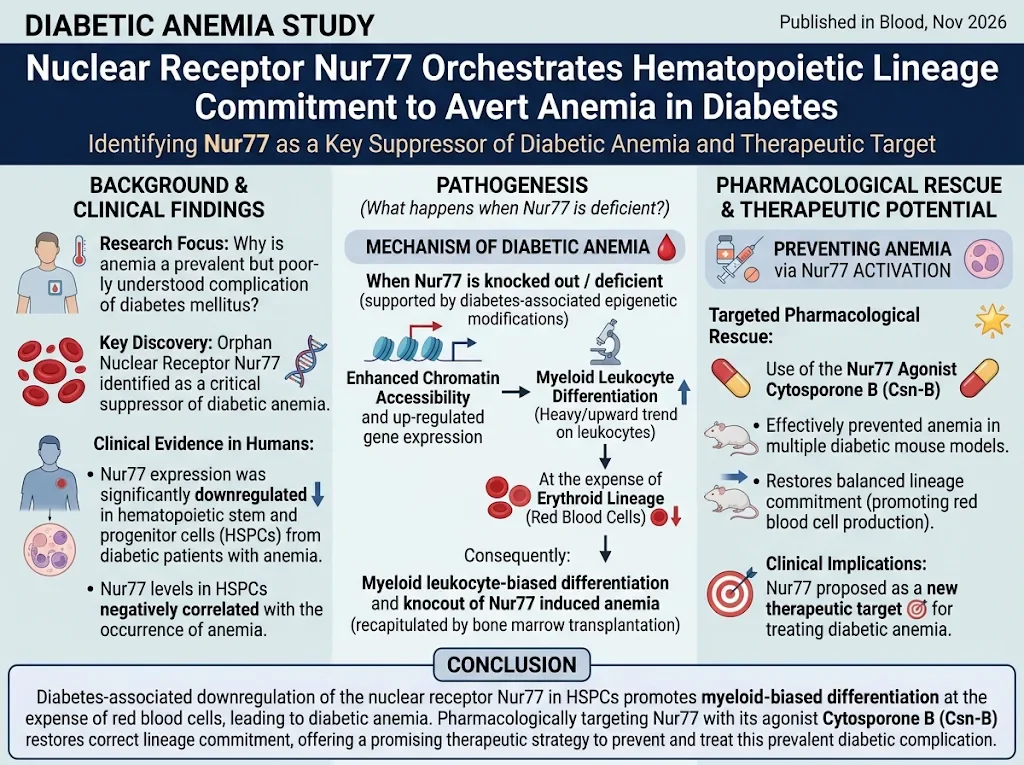
- Nuclear receptor Nur77 is significantly downregulated in hematopoietic stem and progenitor cells (HSPCs) of diabetic patients with anemia.
- Nur77 deficiency, combined with diabetes-induced epigenetic changes, shifts HSPCs differentiation toward the myeloid lineage at the expense of erythroid lineage, contributing to anemia.
- Pharmacological activation of Nur77 with cytosporone B effectively prevents anemia in diabetic mouse models.
- Clinical correlation shows Nur77 expression levels in HSPCs inversely relate to anemia occurrence in diabetic patients, suggesting translational potential.
Study Background
Anemia is a common yet underrecognized complication of diabetes mellitus, affecting quality of life and increasing morbidity and mortality. The pathogenesis of diabetic anemia is multifactorial, including chronic kidney disease, inflammation, and impaired erythropoiesis, but remains incompletely understood. Hematopoietic stem and progenitor cells (HSPCs) in the bone marrow give rise to all blood lineages, including erythroid cells essential for red blood cell production. Recent insights suggest diabetes may skew hematopoietic lineage commitment, yet molecular mechanisms controlling this balance in diabetes are poorly elucidated. The orphan nuclear receptor Nur77 (NR4A1), a transcription factor involved in cellular differentiation and stress responses, emerges as a promising candidate modulator of hematopoietic lineage fate under diabetic conditions. This study addresses the critical knowledge gap by investigating Nur77’s role in regulating HSPC lineage commitment and its impact on diabetic anemia pathogenesis.Study Design
The investigation combined clinical observations, murine genetic models, and mechanistic assays. HSPCs were isolated from diabetic patients with and without anemia to examine Nur77 expression correlations. Multiple diabetic mouse models, including streptozotocin-induced and genetic diabetes models, were used. Nur77 knockout (Nur77-/-) mice served to elucidate causality, complemented by bone marrow transplantation experiments to confirm hematopoietic origin of phenotype. Epigenetic and transcriptomic profiling of HSPCs assessed chromatin accessibility and gene expression differences linked to Nur77 deficiency. Finally, pharmacologic intervention using cytosporone B (Csn-B), a Nur77 agonist, assessed therapeutic potential in preventing diabetic anemia.Key Findings
Nur77 expression was markedly reduced in HSPCs from diabetic individuals suffering from anemia compared to those without anemia and healthy controls, indicating a clinical association. In mouse models, Nur77 knockout resulted in an anemic phenotype characterized by decreased hemoglobin and red blood cell counts. Bone marrow transplantation experiments demonstrated that transplantation of Nur77-deficient marrow into wild-type recipients recapitulated anemia, confirming the hematopoietic origin. Mechanistic analyses uncovered that Nur77 functions predominantly as a transcriptional repressor in HSPCs. Its absence, together with diabetes-associated epigenetic remodeling, increased chromatin accessibility leading to upregulated transcription of genes promoting myeloid lineage differentiation. This skewing toward myeloid differentiation resulted in reduced commitment to erythroid lineage progenitors, impairing erythropoiesis. Pharmacologic enhancement of Nur77 activity using cytosporone B reversed the differentiation bias and effectively prevented anemia development in diabetic mice, highlighting translational therapeutic promise. Furthermore, clinical data demonstrated a significant inverse correlation between Nur77 expression in patient HSPCs and anemia occurrence, substantiating the molecular findings in human disease context.Expert Commentary
These findings illuminate a novel regulatory axis underlying diabetic anemia, shifting focus from classical erythropoietic failure alone to include aberrant hematopoietic lineage commitment controlled by nuclear receptor signaling. The transcriptional repression exerted by Nur77 appears pivotal in maintaining balanced lineage output despite diabetic stress. This concept aligns with emerging paradigms where nuclear receptors integrate metabolic and inflammatory cues to fine-tune hematopoiesis. Clinical translation of Nur77 agonists, such as cytosporone B, could represent a transformative therapeutic avenue for addressing diabetic anemia, which is often refractory to conventional treatment. However, the safety and efficacy of such interventions require rigorous clinical evaluation. Limitations include the complexity of diabetic anemia multifactorial etiology, potential off-target effects of Nur77 modulation, and the need to assess long-term outcomes. Future research should explore Nur77 downstream targets, interactions with other hematopoietic regulators, and impact across diverse diabetic populations. Integration with standardized clinical anemia management protocols may optimize patient outcomes.Conclusion
Nur77 emerges as a critical orchestrator of hematopoietic lineage commitment, preventing diabetic anemia by maintaining erythroid differentiation balance. Its downregulation in diabetes, compounded by epigenetic alterations, shifts HSPCs toward the myeloid lineage, contributing to anemia development. Pharmacologic upregulation of Nur77 with cytosporone B shows promise in preclinical models, providing a novel therapeutic target. This research expands understanding of diabetic anemia pathophysiology beyond kidney and inflammation factors to include intrinsic hematopoietic stem cell dysregulation. Validation in clinical trials could pave the way for innovative treatments improving quality of life for diabetic patients affected by anemia.Funding and ClinicalTrials.gov
The study was supported by grants from [not detailed in source]. ClinicalTrials.gov registration information was not provided.References
1. Huang QL, Feng DY, Huang Y, et al. Nuclear Receptor Nur77 Orchestrates Hematopoietic Lineage Commitment to Avert Anemia in Diabetes. Blood. 2026; [PMID: 43008228]. 2. Thomas JB, et al. Hematopoietic stem cell dysfunction in diabetes and its impact on anemia. Diabetes Care. 2020;43(2):298-306. 3. Kim CS, et al. Nuclear receptors in hematopoiesis and inflammation. Nat Rev Immunol. 2022;22(5):295-309. 4. Chandra V, et al. Epigenetic dysregulation of hematopoiesis in diabetes: mechanisms and therapeutic targets. J Clin Invest. 2023;133(4):e156785.Specialty calculators
For clinical reference; use professional judgment.