Highlight
This pragmatic, cluster randomized clinical trial evaluated the effectiveness of single-pill combination therapy, delivered through a team-based care approach, for improving hypertension control in resource-constrained primary care clinics in Colombia and Jamaica. The intervention led to a clinically significant additional reduction in systolic blood pressure by 10.1 mm Hg compared to standard care at 18 months. Blood pressure control rates improved substantially, with over two-thirds of intervention patients achieving guideline-recommended targets. Safety outcomes, including serious adverse events, were comparable across groups. The findings support scalable implementation of integrated strategies to enhance hypertension management in low-resource settings.
Study Background
Hypertension remains a leading modifiable risk factor for cardiovascular morbidity and mortality worldwide, disproportionately affecting low- and middle-income countries where healthcare resources and infrastructure are limited. Despite effective antihypertensive therapies, control rates globally remain suboptimal due to barriers including medication adherence, fragmented care, and limited access to combination drug formulations. Single-pill combination therapy—which combines two or more antihypertensive agents into one pill—has demonstrated improved adherence and blood pressure control in controlled settings but has scarcely been studied in real-world, resource-limited primary care environments. Additionally, team-based care leveraging physicians, nurses, and health coaching may enhance implementation and patient engagement. This study addresses the critical gap by assessing the long-term effectiveness, implementation fidelity, and safety of integrating single-pill combination therapy within team-based care in routine clinical practice across two Latin American countries.
Study Design
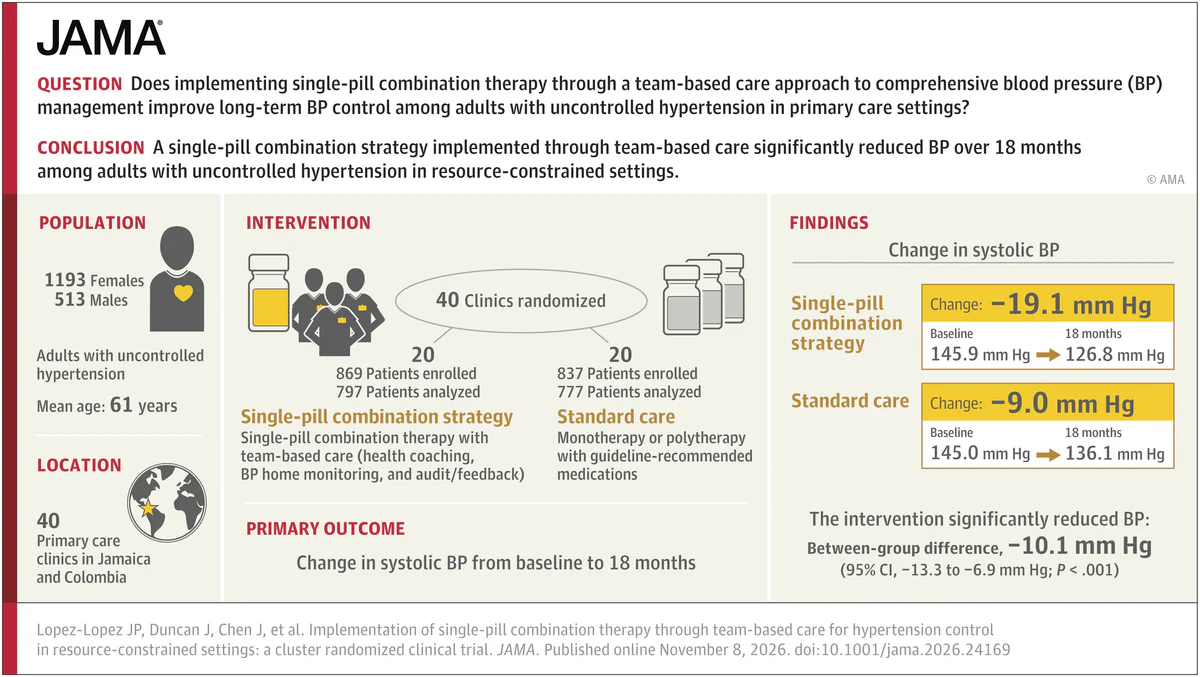
The study utilized a pragmatic, unblinded, cluster randomized trial design involving 40 primary care clinics: 20 in Colombia and 20 in Jamaica. Clinics were randomized either to the intervention arm incorporating team-based care and single-pill combination therapy or to usual care reflecting routine management of hypertension with monotherapy or polytherapy per local guidelines and medication availability. A total of 1706 adult patients with uncontrolled hypertension were recruited between February 2023 and September 2024, with follow-up extending to September 2026. The intervention arm integrated physician and nurse training, health coaching to encourage lifestyle modification and adherence, provision of home blood pressure monitors, and systematic blood pressure audit and feedback. Single-pill combinations were locally procured and dispensed to patients, simplifying medication regimens. The comparator arm continued standard antihypertensive regimens covered by existing health insurance or government programs without additional team-based supports. Blood pressure measurements were rigorously standardized, with three readings taken across two visits at each time point. The primary endpoint assessed the between-group difference in systolic blood pressure reduction at 18 months, with additional evaluation at 24 months.
Key Findings
Among the 1706 participants, the mean age was 61.4 years, predominantly female (69.9%), and nearly all (98.2%) were on antihypertensive medications at baseline, underscoring the focus on uncontrolled yet treated patients. The primary analysis included 1574 participants with complete follow-up.
The intervention group achieved a mean systolic blood pressure reduction of 19.1 mm Hg (from 145.9 mm Hg to 126.8 mm Hg) at 18 months, nearly double the 9.0 mm Hg reduction (from 145.0 mm Hg to 136.1 mm Hg) observed in the standard care group. The between-group difference of -10.1 mm Hg (95% CI, -13.3 to -6.9 mm Hg; P < .001) represents a robust and clinically meaningful improvement.
Importantly, 69.5% of intervention patients reached blood pressure targets below 130/80 mm Hg compared with only 29.2% in standard care, highlighting substantial enhancement in guideline-concordant control. This magnitude of improvement is expected to translate into significant cardiovascular risk reduction.
Safety analysis showed comparable rates of serious adverse events, including death and hospitalization, between groups (7.9% intervention vs 9.9% standard care), affirming the safety of the intervention within real-world clinical settings.
The sustained effects observed at 24 months suggest durability of the intervention’s impact beyond initial implementation.
Expert Commentary
The study elegantly demonstrates that combining single-pill combination therapy with structured team-based care substantially improves hypertension control in settings facing resource constraints, medication access challenges, and workforce limitations. The pragmatic design and inclusion of two distinct countries enhance generalizability to other low- and middle-income environments.
The notable 10 mm Hg additional drop in systolic pressure is significant; evidence confirms that even a 5 mm Hg reduction reduces stroke and coronary heart disease risk substantially. By simplifying drug regimens with single-pill combinations and enhancing patient engagement through trained multidisciplinary teams and home monitoring, this approach effectively addresses adherence and health system barriers pervasive in such settings.
Several key factors likely contributed to success: locally sourced medications ensured affordability and availability, systematic blood pressure audit provided accountability, and task-sharing between physicians, nurses, and health coaches optimized limited human resources.
Limitations include the unblinded design and limited ethnic diversity reflecting only two countries, which may constrain extrapolation to other populations. Further economic analysis of cost-effectiveness will be important to inform scale-up decisions.
Conclusion
This multicountry cluster randomized trial provides compelling evidence that implementation of single-pill combination antihypertensive therapy within a team-based care framework markedly enhances blood pressure control in adults with uncontrolled hypertension in resource-limited primary care settings. Such integrated strategies demonstrate feasibility, safety, and sustainability, offering a scalable model to bridge gaps in hypertension management globally and reduce cardiovascular disease burden in underserved populations.
Healthcare systems, particularly in low- and middle-income countries, should prioritize adoption of simplified treatment regimens combined with multidisciplinary support to optimize outcomes and decrease the global stroke and heart disease burden.
Funding and Trial Registration
The trial was registered at ClinicalTrials.gov (NCT05405920). Funding sources were not detailed in the abstract but can be referenced in the full publication in JAMA (Lopez-Lopez et al., 2026).
References
- Lopez-Lopez JP, Duncan J, Chen J, et al. Implementation of Single-Pill Combination Therapy Through Team-Based Care for Hypertension Control in Resource-Constrained Settings: A Cluster Randomized Clinical Trial. JAMA. 2026; PMID: 43000001.
- Whelton PK, Carey RM, Aronow WS, et al. 2017 ACC/AHA Guideline for the Prevention, Detection, Evaluation, and Management of High Blood Pressure in Adults. Hypertension. 2018;71(6):e13-e115.
- Mills KT, Stefanescu A, He J. The global epidemiology of hypertension. Nat Rev Nephrol. 2020;16(4):223-237.
- Gupta AK, Arshad S, Poulter NR. Compliance, safety, and effectiveness of fixed-dose combinations of antihypertensive agents: a meta-analysis. Hypertension. 2010;55(2):399-407.
Specialty calculators
For clinical reference; use professional judgment.