Highlight
1. Tarlatamab, a bispecific T-cell engager targeting DLL3 and CD3, combined with durvalumab, significantly extends overall survival in extensive-stage small-cell lung cancer (ES-SCLC) as maintenance therapy.
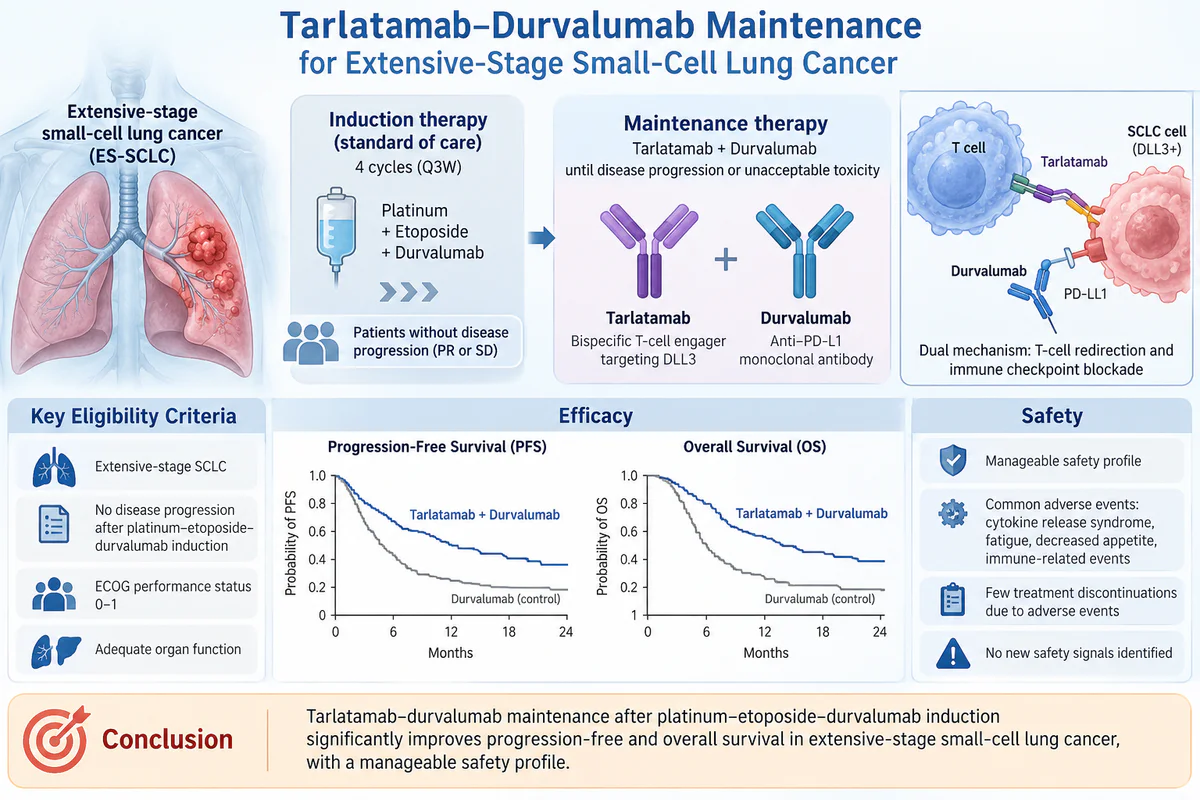
2. Median overall survival nearly doubled to 21.1 months versus 12.7 months with durvalumab alone.
3. Median progression-free survival improved substantially to 7.4 months compared to 1.9 months in the control arm.
4. Treatment was associated with manageable safety, including mostly low-grade cytokine release syndrome.
Study Background
Small-cell lung cancer (SCLC) is a highly aggressive neuroendocrine carcinoma characterized by rapid growth, early metastasis, and poor prognosis. Extensive-stage disease (ES-SCLC) constitutes approximately two-thirds of newly diagnosed cases and carries median overall survival historically limited to 12–13 months despite platinum-based chemotherapy combined with immune checkpoint inhibitors such as PD-L1 inhibitors.
Maintenance therapy strategies after initial chemoimmunotherapy aim to sustain remission, delay progression, and improve survival; however, durable responses are rare, and new treatment options are urgently needed.
Tarlatamab is a bispecific T-cell engager that binds delta-like ligand 3 (DLL3), a tumor-selective antigen overexpressed in SCLC, and CD3 on T cells, redirecting cytotoxic T cells to tumor cells. Early-phase studies indicated promising efficacy as a second-line treatment, prompting investigation of its role in the maintenance setting combined with durvalumab.
Study Design
The DeLLphi-305 trial (NCT06211036) is a multinational, open-label, phase 3 randomized controlled trial evaluating tarlatamab plus durvalumab versus durvalumab alone as first-line maintenance therapy in patients with ES-SCLC who achieved disease control following initial chemoimmunotherapy.
A total of 563 eligible patients were randomized 1:1 to receive either tarlatamab-durvalumab (282 patients) or durvalumab alone (281 patients). Maintenance treatment began after initial remission without progression. The primary endpoint was overall survival (OS) measured from maintenance therapy initiation. Progression-free survival (PFS) was a key secondary endpoint. Safety and adverse events, including immune-related events like cytokine release syndrome (CRS), were monitored.
Key Findings
At a median follow-up of approximately 16 months, the addition of tarlatamab to durvalumab yielded a significant survival benefit:
- The median overall survival was 21.1 months (95% CI, 20.8 to could not be estimated) with tarlatamab-durvalumab, compared to 12.7 months (95% CI, 11.2 to 14.8) with durvalumab alone, corresponding to a hazard ratio (HR) for death of 0.42 (95% CI, 0.32 to 0.54; P<0.001). This reflects a 58% relative risk reduction in mortality.
- Median progression-free survival improved markedly to 7.4 months (95% CI, 5.6 to 9.1) with tarlatamab-durvalumab vs 1.9 months (95% CI, 1.9 to 2.0) with durvalumab alone, with an HR for disease progression or death of 0.34 (95% CI, 0.28 to 0.42; P<0.001).
Safety analysis revealed that 46.8% of patients receiving the combination experienced grade 3 or higher adverse events versus 40.6% in the durvalumab-only group. Cytokine release syndrome, predominantly grade 1 or 2, occurred in nearly half of patients treated with tarlatamab-durvalumab but was generally manageable.
No unexpected safety signals emerged, supporting the regimen’s tolerability in this population.
Expert Commentary
The DeLLphi-305 trial represents a significant advancement in the management of ES-SCLC, where treatment options beyond initial chemoimmunotherapy are limited and prognosis remains poor.
By targeting DLL3, a marker preferentially expressed on SCLC cells, tarlatamab harnesses the immune system to directly kill tumor cells, providing a biologically plausible mechanism underpinning these improved outcomes. The combination with durvalumab, a PD-L1 checkpoint inhibitor, may synergistically enhance antitumor immunity.
While efficacy outcomes are compelling, the substantial incidence of cytokine release syndrome, albeit mostly low grade, warrants vigilant monitoring and management protocols in clinical practice. Longer follow-up data will be valuable to assess durability of responses and longer-term safety.
These results may prompt reconsideration of maintenance treatment paradigms in ES-SCLC, though accessibility, cost, and patient selection factors remain to be defined. Further real-world studies and subgroup analyses could clarify the impact across diverse patient subsets.
Conclusion
Tarlatamab combined with durvalumab as maintenance therapy after first-line chemoimmunotherapy significantly improves overall and progression-free survival compared to durvalumab alone in patients with extensive-stage small-cell lung cancer.
This study marks an important clinical milestone offering a novel, targeted immune-based maintenance strategy capable of nearly doubling median survival. Integration into treatment guidelines and routine practice could meaningfully change the prognosis of this challenging malignancy.
Funding and ClinicalTrials.gov
This trial was funded by Amgen and AstraZeneca. Clinical trial registry: NCT06211036.
References
- Pérol M, Yoshida T, Ahn MJ, et al. Tarlatamab-Durvalumab Maintenance for Extensive-Stage Small-Cell Lung Cancer. N Engl J Med. 2026 Oct 24;[Epub ahead of print]. PMID: 42929702.
- Van Meerbeeck JP, Fennell DA, De Ruysscher DK. Small-cell lung cancer. Lancet. 2011 Sep 3;378(9804):1741-55.
- Horn L, Mansfield AS, Szczęsna A, et al. First-Line Atezolizumab plus Chemotherapy in Extensive-Stage Small-Cell Lung Cancer. N Engl J Med. 2018;379(23):2220-2229.
Specialty calculators
For clinical reference; use professional judgment.