Highlight
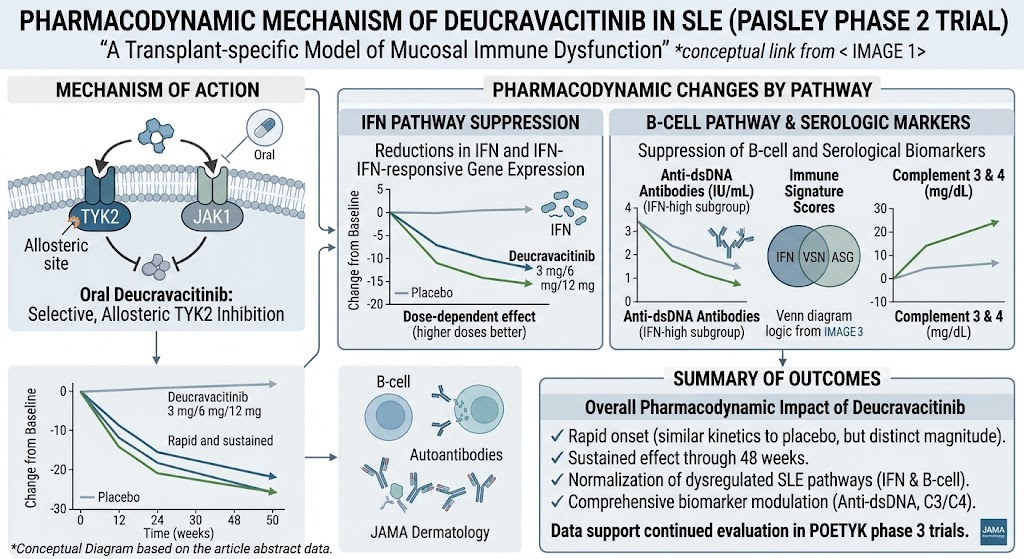
– Deucravacitinib, a selective oral TYK2 inhibitor, reduces interferon signaling and B-cell related biomarkers in SLE.
– Treatment results in rapid and sustained normalization of serological biomarkers including complement proteins and anti-dsDNA antibodies.
– Pharmacodynamic findings support deucravacitinib’s ongoing evaluation in phase 3 clinical trials for SLE.
– These biomarker changes align with targeting pathogenic immune pathways implicated in lupus pathogenesis.
Study Background and Disease Burden
Systemic lupus erythematosus (SLE) is a complex, chronic autoimmune disease characterized by multisystem inflammation and heterogeneous clinical manifestations. It predominantly affects women of childbearing age and is associated with substantial morbidity and increased mortality. Despite improvements in survival over past decades, many patients experience active disease flares, organ damage accrual, and limited therapeutic options with acceptable safety profiles. Central to SLE pathogenesis is dysregulated immune signaling, particularly overactivation of type I interferon (IFN) pathways and aberrant B-cell responses driving autoantibody production. Current therapies often entail broad immunosuppression, which can incur risks of infection and toxicity. Thus, there remains an unmet need for targeted treatments that modulate specific immune pathways implicated in SLE with improved safety and efficacy.
Study Design
The PAISLEY trial was a phase 2, randomized, placebo-controlled study evaluating the pharmacodynamics of deucravacitinib in patients with active SLE. Deucravacitinib is an oral, selective tyrosine kinase 2 (TYK2) inhibitor targeting intracellular signaling pathways critical for type I IFN, interleukin (IL)-12, and IL-23 receptor engagement. The study enrolled 363 patients with active SLE. Various biomarker assessments were conducted, including whole-blood transcript profiling of 51 immune-related genes using chemical ligation-dependent probe amplification assays, measurement of serum proteins and autoantibodies by immunoassays, and blood cell subset analyses via clinical laboratory methods. Up to 60 demographically matched healthy volunteers served as controls for baseline biomarker comparisons. The analyses presented were descriptive, focusing on biomarker modulation induced by deucravacitinib versus placebo.
Key Findings
At baseline, patients with SLE exhibited significant immune dysregulation compared to healthy volunteers, with 42 genes and 75 serum proteins differentially expressed. Key pathways involved included interferon signaling and B-cell activation.
Deucravacitinib treatment led to rapid and sustained pharmacodynamic effects, notably:
– Reduction in circulating interferon levels and decreased expression of interferon-inducible genes and proteins.
– Downregulation of B-cell pathway markers, reflecting reduced aberrant B-cell activity.
– Increase in complement proteins C3 and C4, which are typically decreased in active lupus due to consumption.
– Decreased anti-double-stranded DNA (anti-dsDNA) antibody titers observed in patients with high baseline interferon signatures.
The suppression of the interferon signature score was evident in both interferon-high and interferon-low subgroups, underscoring the broad immunomodulatory effect of TYK2 inhibition across heterogeneous SLE patient populations.
These biomarker changes were consistent with the mechanistic action of TYK2 inhibition, blocking intracellular pathways downstream of type I IFN and cytokine receptors involved in SLE pathogenesis. Importantly, the modulation of these biomarkers suggested that deucravacitinib may mitigate key drivers of inflammation and autoimmunity in SLE.
Expert Commentary
The PAISLEY trial’s pharmacodynamic data provide compelling evidence that specifically targeting TYK2 can attenuate pathogenic immune signals in SLE. Type I interferon hyperactivity is a well-established contributor to lupus pathogenesis and treatment resistance, and deucravacitinib’s capacity to reduce this signature represents a promising therapeutic mechanism.
Additionally, the observed normalization of complement levels and reduction of anti-dsDNA antibodies potentially indicate improvements in clinically relevant disease activity correlates. These findings are congruent with the current understanding that interferon-driven B-cell activation is central to autoantibody-mediated tissue damage in lupus.
However, as a phase 2 pharmacodynamic study, this trial does not directly assess clinical efficacy or long-term safety, which are critical for evaluation in ongoing phase 3 trials (POETYK SLE-1 and SLE-2). Patient heterogeneity in SLE and the complexity of immune pathways necessitate further investigation to clarify the full therapeutic potential and optimal patient subgroups for TYK2 inhibitors.
Limitations include the descriptive nature of analyses and lack of functional immune cell assays to elucidate direct cellular effects besides biomarker changes. Nonetheless, these data enhance the biological plausibility of TYK2 inhibition as a promising targeted treatment in SLE.
Conclusion
Deucravacitinib demonstrates robust pharmacodynamic activity in suppressing interferon signaling and modulating key immune pathways involved in systemic lupus erythematosus pathogenesis. The reductions in interferon-response biomarkers, B-cell activation markers, and autoantibodies alongside normalization of complement proteins underscore its potential as a novel targeted therapy for active SLE. These results support the rationale for continued development and evaluation of deucravacitinib in pivotal phase 3 clinical trials, which will determine its efficacy, safety, and place in the therapeutic landscape for lupus patients.
The emerging paradigm aiming at precision targeting of aberrant cytokine signaling in SLE holds promise for improving outcomes while minimizing immunosuppression-associated risks. Further research is warranted to integrate biomarker-driven approaches with clinical outcomes to optimize patient management in this complex autoimmune disease.
Funding and Clinical Trials Registration
The PAISLEY trial was supported by the developers of deucravacitinib with clinical trials registered under NCT05617677 (POETYK SLE-1) and NCT05620407 (POETYK SLE-2), which are ongoing phase 3 studies evaluating the efficacy and safety of deucravacitinib in patients with systemic lupus erythematosus.
References
1. Kahlenberg JM, Wu C, Vital E, Catlett IM, Crow MK, Sanz I, et al. Pharmacodynamic analysis of TYK2 inhibition by deucravacitinib: results from the phase 2 PAISLEY SLE trial in patients with active systemic lupus erythematosus. Ann Rheum Dis. 2026 Aug 27; PMID: 42660739.
2. Tsokos GC. Systemic lupus erythematosus. N Engl J Med. 2011;365(22):2110-21.
3. Wallace DJ. The lupus business—current approaches and new directions. Nat Rev Rheumatol. 2017;13(9):542-54.
4. O’Shea JJ, Gadina M, Schreiber RD. Cytokine signaling in 2002: new surprises in the Jak/Stat pathway. Cell. 2002;109 Suppl:S121-31.