Highlights
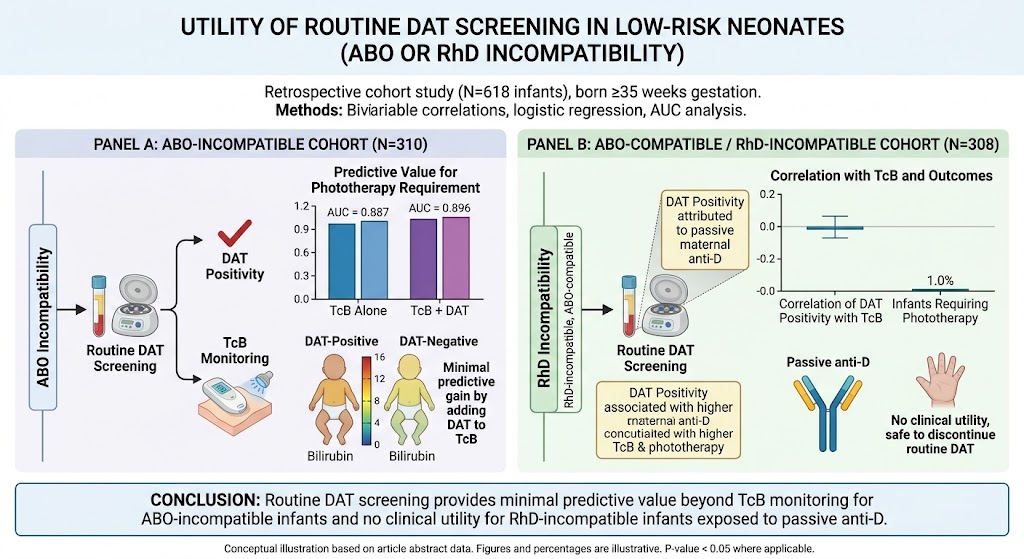
- Routine direct antiglobulin testing (DAT) in ABO-incompatible neonates adds minimal predictive value beyond noninvasive transcutaneous bilirubin (TcB) monitoring for phototherapy need.
- In RhD-incompatible but ABO-compatible neonates exposed only to passive maternal anti-D antibodies, DAT positivity is common but clinically not predictive of hyperbilirubinemia or treatment requirement.
- Maternal antibody screening remains critical; DAT should be reserved for cases with incomplete maternal immunization history or clinical suspicion of hemolysis.
- These findings align with the 2022 American Academy of Pediatrics guidelines, which advocate for selective rather than routine DAT use in low-risk neonates, optimizing laboratory resource utilization.
Background
Isoimmune hemolytic disease of the fetus and newborn (HDFN) is primarily caused by blood group incompatibilities, most commonly ABO and RhD antigen differences between mother and infant. Historically, routine screening of neonates using the direct antiglobulin test (DAT) has been employed to detect antibody-coated erythrocytes indicative of hemolysis risk. Early identification is crucial because hemolysis can lead to significant hyperbilirubinemia requiring phototherapy or more intensive interventions like exchange transfusions.
However, advancements in prophylaxis—most notably the widespread use of antenatal anti-D immunoglobulin—and enhanced, noninvasive bilirubin monitoring techniques such as transcutaneous bilirubinometry have transformed neonatal jaundice management. These advances prompt a critical reappraisal of the routine use of DAT screening in low-risk populations, particularly term or near-term neonates born to non-alloimmunized mothers.
Key Content
Clinical Utility of DAT in ABO-Incompatible Neonates
The 2026 study by Tsai et al. evaluated 310 ABO-incompatible neonates at ≥35 weeks gestation and found that although DAT positivity correlated with higher transcutaneous bilirubin levels and increased phototherapy frequency, the predictive performance of TcB alone was robust (AUC=0.887). Integrating DAT results produced only a marginal incremental benefit (AUC=0.896), suggesting limited additional clinical utility for routine DAT screening when reliable TcB monitoring is established.
Supporting earlier observational data, neonates with positive DAT tended to have higher maternal anti-A and anti-B IgG titers measured by sensitive column agglutination techniques, which correlate with neonatal hyperbilirubinemia severity and treatment needs. For instance, a 2025 prospective study demonstrated maternal antibody titers as predictive markers for hemolytic severity, with higher titers linked to increased risks of phototherapy and exchange transfusion. This underscores the importance of maternal immunohematologic assessment over blanket neonatal DAT screening.
Moreover, a seminal study from 2002 identified that early serum bilirubin values at six hours of life effectively predict subsequent significant hyperbilirubinemia and severe ABO hemolytic disease, with DAT positivity serving as a useful but not standalone marker. These findings reinforce a neonatal bilirubin-centric approach to risk stratification.
DAT in ABO-Compatible, RhD-Incompatible Neonates
For RhD-incompatible neonates whose mothers lack active alloimmunization but have received anti-D prophylaxis, Tsai et al. reported a 14% rate of DAT positivity attributable to passive maternal anti-D antibodies without associated elevated bilirubin levels or phototherapy requirement (only 1% needed treatment). This aligns with epidemiologic data indicating that routine DAT screening in this context lacks clinical yield.
Population studies prior to routine antenatal anti-D prophylaxis implementation demonstrated higher alloimmunization rates with clinical HDFN consequences, including phototherapy and exchange transfusions. However, modern prophylaxis programs have markedly reduced meaningful anti-D alloimmunization incidence, resulting in fewer cases requiring intensive neonatal intervention and questioning the necessity for routine DAT in this group.
Broader Clinical and Laboratory Context
Other integral clinical observations pertain to gestational age, with some evidence suggesting that more immature infants may experience longer phototherapy durations despite comparable incompatibility profiles. Phototherapy duration differences between ABO-incompatible, RhD-incompatible, and combined incompatibility cases highlight a gradient of hemolytic severity corresponding to immunological etiologies.
Novel predictive algorithms beyond DAT and bilirubin measurements, such as the ‘Çapa index’ combining cord blood carboxyhemoglobin and bilirubin levels, have been explored to better predict phototherapy necessity in neonates with hemolytic risk factors; however, these are not yet standard clinical tools but underscore evolving diagnostics.
Expert Commentary
The accumulation of evidence convincingly supports a shift from routine universal neonatal DAT screening among low-risk populations—specifically mature ABO-incompatible and RhD-incompatible but non-alloimmunized infants—towards more selective strategies guided chiefly by bilirubin monitoring and maternal immunohematologic history.
These insights inform the 2022 American Academy of Pediatrics clinical practice guidelines advocating discontinuing routine DAT screening in these low-risk groups while emphasizing the indispensability of comprehensive maternal antibody screening. DAT remains essential when maternal serologic data is incomplete or missing, or when clinical signs suggest hemolysis.
Mechanistically, the limited utility of DAT in these contexts stems from its inability to discriminate between clinically significant immune hemolysis and benign passive antibody presence, particularly following prophylactic anti-D administration. Noninvasive bilirubin monitoring and early serum bilirubin levels offer safer, cost-effective, and more direct measures of hemolytic consequences.
Challenges to guideline implementation include institutional inertia, variability in laboratory capabilities, and clinician reliance on established testing paradigms. Educating neonatal care teams about the nuanced interpretation of DAT results, integrating bilirubin-centric algorithms, and enhancing maternal-fetal immunohematologic communication are pivotal.
Conclusion
Routine DAT screening in low-risk, mature neonates with ABO or RhD incompatibility confers minimal added clinical benefit beyond accurate early bilirubin assessment and maternal antibody surveillance. The marginal increment in predictive accuracy when combining DAT with TcB does not justify continued universal application, particularly given resource considerations and risks of overdiagnosis.
Future directions include refining risk stratification tools incorporating maternal antibody titers, advancing noninvasive hyperbilirubinemia prediction indices, and continued epidemiologic surveillance to validate guideline safety. Optimizing neonatal jaundice management requires balancing vigilant identification of genuine hemolytic disease against avoidance of unnecessary laboratory testing and interventions.
References
- Tsai TL, Ma T, Nester T. Utility of DAT in Low-Risk Neonates with ABO or RhD Incompatibility. Pediatrics. 2026 Aug 26; PMID: 42642037. https://pubmed.ncbi.nlm.nih.gov/42642037/
- Rajesh S, Hariharan S, et al. Comparison of anti-A and anti-B isoagglutinin titers by conventional tube and column agglutination technique in O Rh-D positive mothers and their impact on neonatal outcomes. Transfus Apher Sci. 2025 Aug;64(4):104170. PMID: 40466358.
- Çapa Kaya G et al. Severe hyperbilirubinemia prediction in neonates using a newly developed cord blood index (Çapa index): a promising tool. Medicine (Baltimore). 2025 May 16;104(20):e42516. PMID: 40388773.
- Koc B et al. Hyperbilirubinemia in neonates with blood group incompatibilities – A bane or a boon for the management. Transfus Clin Biol. 2025 Feb;32(1):82-86. PMID: 39814259.
- Shehata MA et al. The spectrum of ABO haemolytic disease of the fetus and newborn in neonates born to group O mothers. Vox Sang. 2022 Sep;117(9):1112-20. PMID: 35667836.
- Thorsteinsdottir S et al. Rhesus D alloimmunization in pregnancy from 1996 to 2015 in Iceland: a nation-wide population study prior to routine antenatal anti-D prophylaxis. Transfusion. 2020 Jan;60(1):175-183. PMID: 31850521.
- Maisels MJ et al. An early (sixth-hour) serum bilirubin measurement is useful in predicting the development of significant hyperbilirubinemia and severe ABO hemolytic disease. Pediatrics. 2002 Apr;109(4):e53. PMID: 11927726.