Highlight
- Identification of a pathogenic neutrophil subset (CD16hiCD177+) expanded specifically in steroid-resistant gastrointestinal graft-versus-host disease (SR-GI-GVHD).
- Mechanistic link between retinoic acid elevation and pathogenic programming of neutrophils via the RARA-SPI1 transcriptional axis.
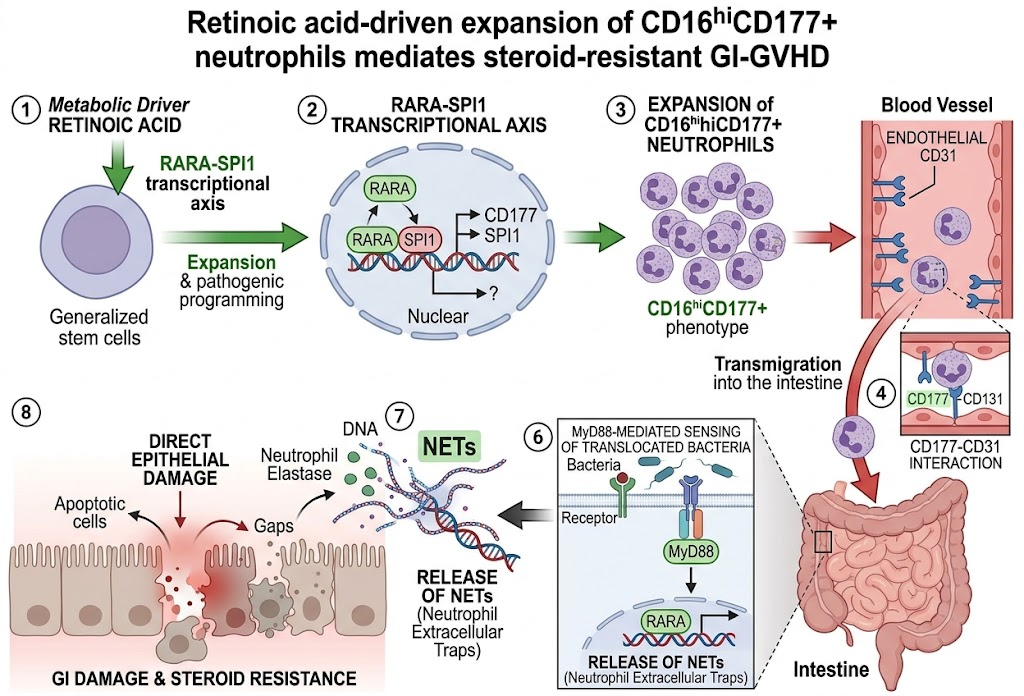
- CD177 facilitates neutrophil transmigration into intestinal tissue, where MyD88-mediated sensing promotes NET formation and epithelial injury.
- Pharmacologic inhibition of retinoic acid receptors reverses corticosteroid resistance and improves survival in a GVHD murine model.
Background
Gastrointestinal graft-versus-host disease (GI-GVHD) is a severe and often fatal complication following allogeneic hematopoietic stem cell transplantation (allo-HSCT). While corticosteroids remain the frontline treatment, approximately 50% of patients with GI-GVHD develop steroid resistance, leading to poor prognosis and a lack of effective targeted therapies. The immunopathogenesis of steroid-resistant GI-GVHD (SR-GI-GVHD) is incompletely understood, particularly with respect to the roles of innate immune cells such as neutrophils. Neutrophil heterogeneity and specific subsets’ involvement in GVHD remain underexplored areas, necessitating elucidation to guide novel therapeutic strategies.
Study Design
The study by Liang et al. employed single-cell RNA sequencing (scRNA-seq) of peripheral blood leukocytes from patients with SR-GI-GVHD to identify granulocyte subsets. Experimental murine models of GI-GVHD were utilized, including donor cells genetically deficient in Cd177 or Myd88, to evaluate impact on disease progression. Pharmacologic intervention with the retinoic acid receptor antagonist AGN193109 was tested for therapeutic efficacy. The primary endpoints included neutrophil subset characterization, intestinal tissue infiltration, NET formation, epithelial damage, corticosteroid sensitivity, and survival outcomes.
Key Findings
Neutrophil Subset Expansion in SR-GI-GVHD
<pSingle-cell transcriptomics identified a distinct neutrophil subset, characterized by high expression of CD16 and CD177 (CD16hiCD177+), markedly expanded in the peripheral blood of SR-GI-GVHD patients compared to steroid-sensitive cases and controls. These neutrophils display enhanced adhesive interactions, with CD177 mediating binding to endothelial CD31, facilitating transmigration into intestinal mucosa.
Retinoic Acid as a Metabolic Driver of Pathogenic Neutrophils
Elevated retinoic acid (RA) levels were consistently found in patients with SR-GI-GVHD. RA stimulation induced expansion and pro-pathogenic programming of CD16hiCD177+ neutrophils through activation of the retinoic acid receptor α (RARA) and the Spi-1 proto-oncogene (SPI1) transcriptional axis. This programming shifts neutrophils toward heightened inflammatory responses.
Neutrophil-Mediated Tissue Damage via NET Formation
Following transmigration, CD16hiCD177+ neutrophils detect translocated gut bacteria via the MyD88-dependent pathway, triggering the release of neutrophil extracellular traps (NETs). NETs induce direct epithelial injury, underpinning the tissue pathology observed in SR-GI-GVHD.
Genetic and Pharmacological Modulation Mitigates Disease
Genetic deletion of Cd177 or Myd88 in donor-derived hematopoietic cells resulted in significant attenuation of GI-GVHD severity in murine models. Critically, pharmacologic inhibition of RARA using AGN193109 improved intestinal pathology, enhanced survival, and importantly, restored the response to corticosteroids in models of SR-GI-GVHD.
Expert Commentary
This study compellingly delineates a precise immune-metabolic-pathobiological cascade driving steroid resistance in GI-GVHD, highlighting the central role of a neutrophil subset programmed by retinoic acid. Identification of CD177 as a therapeutic target for neutrophil trafficking, and the effective reversal of steroid resistance by RARA inhibition, provide promising translational implications. Limitations include the need for validation in larger patient cohorts and the long-term safety of RARA antagonists. Additionally, the interplay between adaptive immunity and neutrophil-driven inflammation warrants further study to optimize combinatorial interventions.
Conclusion
Liang et al. identify the retinoic acid-driven expansion of CD16hiCD177+ neutrophils as a pivotal mediator of steroid-resistant GI-GVHD. Their work defines a pathogenic axis from metabolic signaling through RARA-SPI1 to neutrophil trafficking and NET formation causing epithelial damage. Pharmacologic targeting of RARA not only ameliorates disease but also restores steroid sensitivity in preclinical models, offering a novel therapeutic strategy to address a critical unmet need in allo-HSCT complications. Moving forward, clinical trials evaluating RARA antagonists in patients with SR-GI-GVHD could transform current management and improve patient outcomes.
Funding and Regulatory Status
The study was supported by [details not provided in source]. AGN193109 is an investigational agent not yet approved for clinical use in GVHD. Clinical trials are needed to assess safety and efficacy in humans.
References
- Liang W, Xu D, Zhang L, et al. Retinoic acid-driven expansion of CD16hiCD177+ neutrophils mediates steroid-resistant GI-GVHD. Blood. 2026;148(10):1292-1311. PMID: 42322118.
- Ferrara JLM, Levine JE, Reddy P, Holler E. Graft-versus-host disease. Lancet. 2009;373(9674):1550-1561.
- Steinbach K, Heyckendorf J, Koller L, et al. Neutrophils In Predicting and Mediating Graft-Versus-Host Disease—Novel Insights. Front Immunol. 2021;12:680788.
- Saidi RF, Moore JO. Management of steroid-resistant graft-versus-host disease. Curr Hematol Malig Rep. 2014;9(2):77-83.