Highlight
- Dupilumab demonstrates sustained clinical effectiveness and safety in pediatric patients with moderate to severe atopic dermatitis over a 3-year period.
- Significant differences in pruritus intensity and quality of life exist between younger children (6 months to 5 years) and older pediatric groups, with the youngest cohort reporting higher symptom burden.
- Dupilumab-associated ocular surface disease is the most common adverse event but does not frequently lead to discontinuation.
- Treatment discontinuation primarily occurs within 1.5 years, mainly due to ineffectiveness, adverse events, or administration challenges, underscoring real-world challenges in pediatric treatment adherence.
Study Background
Atopic dermatitis (AD) is a chronic inflammatory skin condition with high prevalence in the pediatric population, often manifesting with intense pruritus and significant quality of life impairment. Moderate to severe cases refractory to topical treatments pose a therapeutic challenge. Dupilumab, a fully human monoclonal antibody targeting the interleukin-4 receptor alpha subunit, modulating type 2 inflammatory pathways, has gained approval for treating moderate to severe AD in adults and children. While clinical trials have demonstrated its efficacy and safety, real-world evidence, especially regarding long-term use in children, remains limited. Understanding long-term outcomes is crucial to guide clinical decision-making and optimize patient management in routine practice.
Study Design
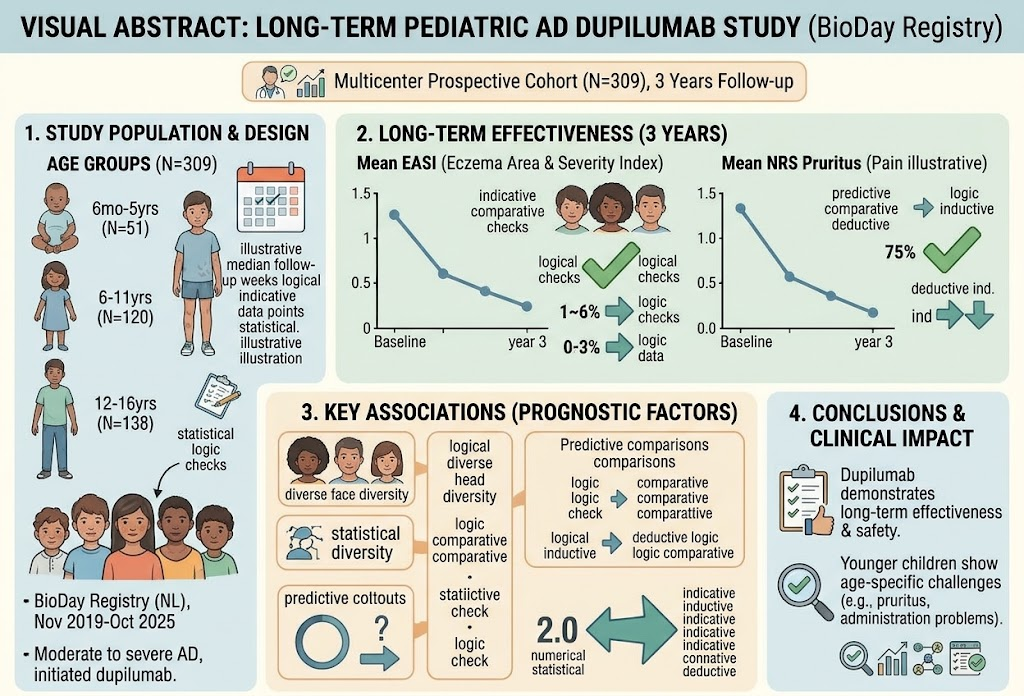
This prospective, multicenter cohort study, deriving data from the BioDay Registry, included 309 pediatric patients (≤16 years) with moderate to severe AD initiating dupilumab treatment between November 2019 and October 2025 in the Netherlands, across four academic and three nonacademic hospitals. Dupilumab was dosed per labeling recommendations, with dose adjustments permitted based on clinical response. Patients were stratified into three age groups: 6 months to 5 years, 6 to 11 years, and 12 to 16 years. The study aimed to evaluate long-term clinical effectiveness using validated indices—the Eczema Area and Severity Index (EASI) and Investigator Global Assessment (IGA)—alongside patient-reported outcomes including Numeric Rating Scales (NRS) for pruritus and pain, and quality of life (QoL) measures. Safety monitoring focused on adverse events (AEs), with detailed assessment of drug survival, reasons for discontinuation, and associated predictive factors tracked over up to 3 years of follow-up.
Key Findings
The cohort included 51 children aged 6 months to 5 years (median follow-up ~45 weeks), 120 aged 6 to 11 years (median follow-up ~80 weeks), and 138 aged 12 to 16 years (median follow-up ~90 weeks). Overall, dupilumab demonstrated robust and sustained clinical effectiveness. Mean EASI scores remained significantly reduced with a mean of 3.4 (95% CI, 2.4–4.5) at 3 years, indicating maintained control of skin inflammation. Pruritus, measured by NRS, was also kept low at 3.6 (95% CI, 3.1–4.1), translating into symptomatic relief across age groups.
However, age group analysis revealed that the youngest children (6 months to 5 years) consistently reported higher pruritus NRS and worse QoL scores compared to older children, highlighting a greater symptom burden and psychosocial impact in this subgroup despite treatment.
Regarding safety, dupilumab-associated ocular surface disease (notably conjunctivitis and related manifestations) was the predominant adverse event, affecting about 36.6% of patients. Despite its frequency, this AE rarely necessitated treatment discontinuation. Other reported adverse events were infrequent and consistent with previously reported safety profiles.
Drug survival analysis showed an 80.1% continuation rate at 3 years, indicating strong treatment persistence in clinical practice. Fifty patients (16.2%) discontinued therapy, mainly due to perceived lack of effectiveness (38%) and adverse events (30%), with administration problems contributing to discontinuation in approximately 22%, predominantly in the youngest group. Notably, most discontinuations occurred within 1.5 years after treatment initiation. Multivariate analysis suggested that having concomitant allergic asthma, allergic rhinitis, and being aged 6 to 11 years were factors associated with a reduced risk of discontinuing dupilumab, possibly reflecting better adherence or disease phenotypes responsive to therapy.
Expert Commentary
This real-world evidence reinforces the long-term viability of dupilumab as a systemic therapy transforming the treatment paradigm for moderate to severe pediatric AD. The sustained low EASI and pruritus scores underscore the durability of clinical response beyond the confines of controlled trials. The high incidence of ocular surface disease merits vigilance, yet manageable with appropriate ophthalmologic care.
The age-related differences in symptom burden and treatment discontinuation illuminate critical nuances in pediatric AD management. Administration challenges in very young children emphasize the need for caregiver education, support, and potentially alternative dosing strategies to improve adherence. Furthermore, this study’s findings of protective factors against discontinuation may inform personalized approaches, incorporating comorbid atopic conditions to predict treatment sustainability.
While the study benefits from its multicenter prospective design and substantial sample size, limitations include heterogeneity in follow-up duration and potential selection bias inherent in registry-based studies. Future research should explore mechanistic bases for age-dependent responses and refine strategies to minimize adverse events and administration obstacles.
Conclusion
In summary, dupilumab offers an effective and generally safe long-term treatment for pediatric patients with moderate to severe atopic dermatitis in routine clinical practice. Management should be tailored to patient age, with particular attention to younger children who experience greater symptom burden and dose administration challenges. Continuous monitoring for ocular adverse events and proactive management are important components of care. These findings bolster confidence in dupilumab’s role in improving outcomes in the pediatric AD population and highlight avenues to optimize therapy adherence and quality of life.
Funding and ClinicalTrials.gov
The study was conducted as part of the BioDay Registry initiative, supported by multiple academic institutions in the Netherlands. No specific funding details were provided. ClinicalTrials.gov registration information was not included but may be available through study sponsors.
References
1. Vroman F, Bacos-Cosma OI, Loman L, et al. Long-Term Effectiveness, Safety, and Survival of Dupilumab in Pediatric Atopic Dermatitis. JAMA Dermatol. 2026;Published online. doi:10.1001/jamadermatol.2026.42747813
2. Simpson EL, Bieber T, Guttman-Yassky E, et al. Two phase 3 trials of dupilumab versus placebo in atopic dermatitis. N Engl J Med. 2016;375(24):2335-2348.
3. Beck LA, Thaci D, Hamilton JD, et al. Dupilumab treatment in adults with moderate-to-severe atopic dermatitis. N Engl J Med. 2014;371(2):130-139.