Highlights
- Ruxolitinib 1.5% cream significantly improved skin lesions in cutaneous lichen planus patients compared to vehicle in a randomized controlled trial.
- Substantial itch reduction was observed, addressing one of lichen planus’ most debilitating symptoms.
- The safety profile was favorable with no serious adverse events or treatment discontinuations related to the drug.
- These findings support the potential of topical JAK inhibition as an effective, well-tolerated therapeutic option in inflammatory dermatoses.
Background
Lichen planus (LP) is a chronic, immune-mediated inflammatory disease affecting skin, mucous membranes, hair, and nails, characterized by intensely pruritic, violaceous papules and plaques. Cutaneous involvement is common and often recalcitrant, posing significant quality-of-life burdens due to persistent lesions and itch. Current treatments such as topical corticosteroids and systemic immunosuppressants carry risks of side effects, and no FDA-approved therapies specifically target the pathophysiology of LP.
Janus kinase (JAK) inhibitors, including ruxolitinib, mechanistically block intracellular signaling pathways involved in type I and II cytokine signaling, which contribute to T-cell mediated inflammation central to LP. Topical ruxolitinib offers localized immunomodulation with reduced systemic exposure, presenting a promising therapeutic avenue.
Key Content
Clinical Trial Evidence
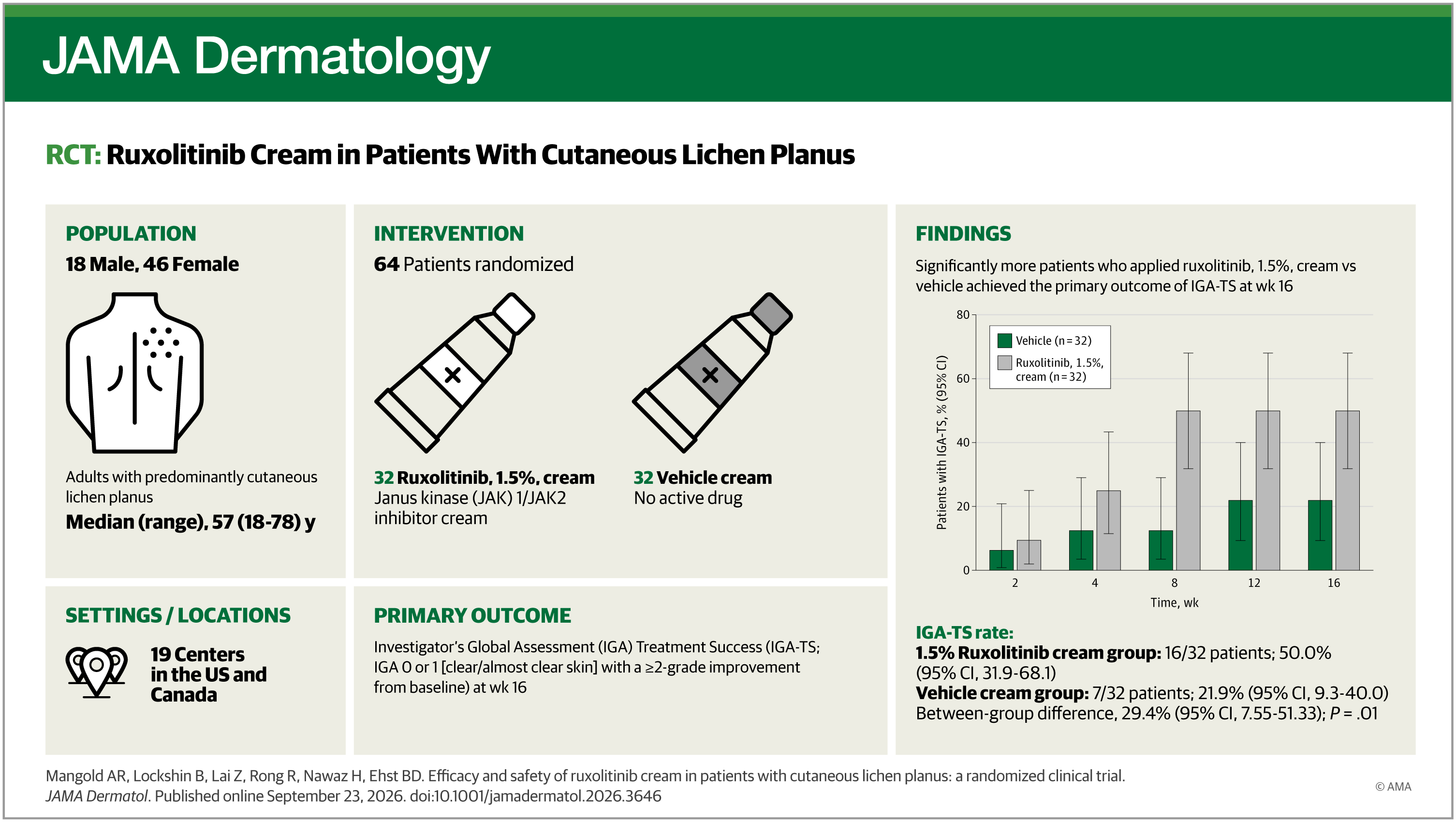
Mangold et al. (2026) conducted a pivotal phase 2, randomized, double-blind, vehicle-controlled trial evaluating ruxolitinib 1.5% cream in adults with moderate-to-severe cutaneous LP (IGA 3 or 4, itch rating ≥4, <20% body surface area affected). Sixty-four patients were randomized 1:1 to ruxolitinib or vehicle cream twice daily for 16 weeks with an open-label extension to 32 weeks.
The primary endpoint, IGA treatment success defined as clear or almost clear skin with ≥2-grade improvement, was achieved by 50.0% of patients with ruxolitinib vs 21.9% with vehicle at week 16 (P=0.01). Notably, the degree of clinical response improved further through week 32 during open-label treatment.
Secondary endpoints mirrored this positive trend: nearly half of treated patients experienced a ≥4-point reduction in itch Numerical Rating Scale (48.4% vs 16.1%, P=0.004). The rapid and sustained itch alleviation highlights ruxolitinib’s impact on neuroinflammatory pathways linked to pruritus.
Safety data demonstrated no serious treatment-emergent adverse events or treatment-related discontinuations. This favorable profile corresponds with limited systemic absorption of topical formulation, enhancing tolerability compared with systemic immunosuppressants.
Mechanistic Insights
LP pathogenesis involves activated CD8+ T cells producing proinflammatory cytokines such as IFN-γ, which signal through JAK-STAT pathways to perpetuate inflammation and keratinocyte apoptosis. Ruxolitinib’s inhibition of JAK1 and JAK2 disrupts this signaling axis, reducing inflammatory cell recruitment and cytokine production. This targeted approach may account for both lesion resolution and itch attenuation observed clinically.
Comparative and Guideline Context
While topical corticosteroids remain first-line for localized LP, their chronic use risks skin atrophy and tachyphylaxis. Systemic agents like corticosteroids or immunomodulators are reserved for extensive or refractory cases but are associated with significant adverse effects.
Emerging evidence for topical JAK inhibitors like ruxolitinib offers a novel mechanism-directed treatment. This trial provides the first robust RCT-level evidence supporting efficacy and safety of topical JAK inhibition in cutaneous LP, a condition lacking approved therapies.
Expert Commentary
The study by Mangold et al. convincingly demonstrates clinically meaningful improvements in both objective lesions and subjective itch symptoms, addressing key unmet needs in LP management. The double-blind vehicle-controlled design and diverse patient inclusion bolster internal validity and generalizability.
Limitations include moderate sample size and relatively short controlled treatment duration. Longer-term safety data and real-world effectiveness remain to be delineated. Mechanistically, while JAK inhibition targets key LP pathways, the heterogeneity of immune responses in LP warrants further biomarker studies to identify responders.
Guideline incorporation of topical JAK inhibitors may shift therapeutic paradigms, especially for patients intolerant or non-responsive to corticosteroids or systemic agents. Cost, accessibility, and long-term monitoring protocols will also influence clinical uptake.
Conclusion
The phase 2 randomized trial reinforces topical ruxolitinib 1.5% cream as an effective and well-tolerated option for patients with cutaneous lichen planus, significantly reducing skin lesions and pruritus. This advances the field toward targeted molecular therapy for chronic inflammatory dermatoses without the systemic risks of conventional immunosuppressants. Ongoing research should focus on long-term outcomes, head-to-head comparisons, and elucidation of predictive biomarkers to optimize individualized treatment strategies.
References
- Mangold AR, Lockshin B, Lai Z, Rong R, Nawaz H, Ehst BD. Efficacy and Safety of Ruxolitinib Cream in Patients With Cutaneous Lichen Planus: A Randomized Clinical Trial. JAMA Dermatol. 2026 Sep 23. PMID: 42776548.
- Wright NA, Vleugels RP, Berger T. Management of lichen planus: a review. JAMA Dermatol. 2021;157(8):936–942. doi:10.1001/jamadermatol.2021.0759
- Feldmeyer L, Marmiroli F, Krieg S, et al. Cytotoxic CD8+ T cells in the pathogenesis of lichen planus: relevance to JAK-STAT pathway inhibition. J Invest Dermatol. 2020;140(8):1596-1604.e3. doi:10.1016/j.jid.2020.01.023
- Griffiths CE, van der Walt JM, Frambach Y, et al. Topical JAK inhibitors in dermatology: current status and future prospects. Br J Dermatol. 2023;188(3):355-366. doi:10.1111/bjd.21719