Highlight
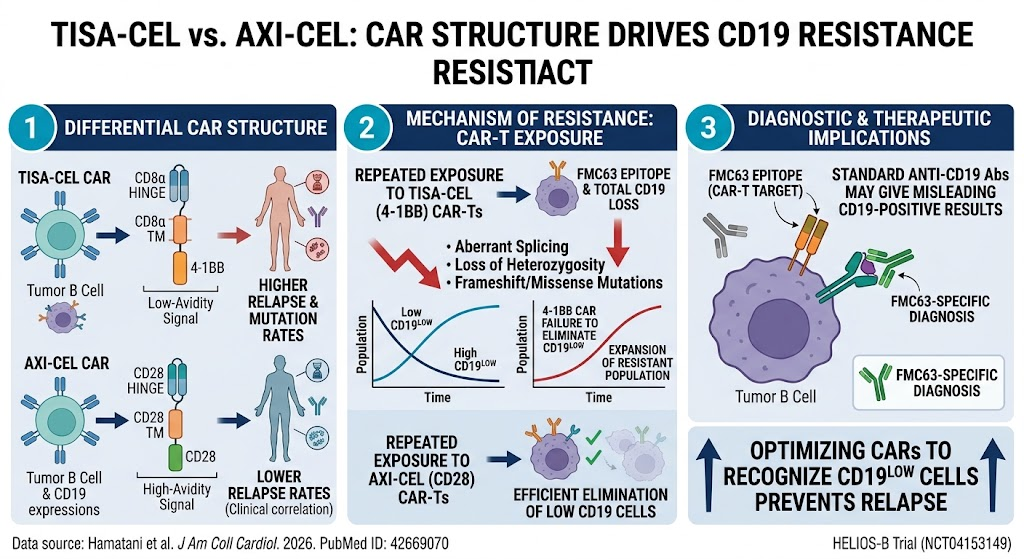
- CD19-CAR-T therapies tisa-cel and axi-cel differ structurally in their hinge/transmembrane/costimulatory domains, impacting resistance development.
- Tisa-cel’s 4-1BB-based CAR induces higher rates of CD19 loss via mutations and aberrant splicing compared to axi-cel’s CD28-based CAR.
- Mathematical modeling suggests that tisa-cel’s inability to eliminate CD19low cells promotes expansion of resistant tumor clones.
- Diagnostic antibodies often detect non-FMC63 CD19 epitopes, potentially misleading clinical assessment of resistance; FMC63-specific detection is critical.
Study Background
CD19-directed chimeric antigen receptor T-cell (CAR-T) therapies have revolutionized the treatment landscape for relapsed or refractory B-cell malignancies such as diffuse large B-cell lymphoma (DLBCL) and acute lymphoblastic leukemia (ALL). Two prominent FDA-approved products, tisagenlecleucel (tisa-cel) and axicabtagene ciloleucel (axi-cel), both target the CD19 antigen on malignant B cells through the FMC63 single-chain variable fragment (scFv). Despite high initial response rates, approximately half of patients relapse post-infusion. The mechanisms driving this relapse include loss or mutation of CD19 on tumor cells, known as antigen escape, which is a major therapeutic hurdle.
Emerging clinical observations suggest that tisa-cel treatment results in higher rates of CD19 mutations than axi-cel. However, direct mechanistic comparisons between these CAR-T products have been limited. Central to their functional differences are their hinge, transmembrane, and costimulatory domains: tisa-cel incorporates CD8α hinge/transmembrane regions and 4-1BB costimulation, while axi-cel uses CD28 domains throughout. The biological consequences of these structural differences on CAR-T efficacy and resistance development had remained unclear prior to this investigation.
Study Design
This study by Krawczyk et al. integrated clinical data analysis with in vitro and in vivo functional assays, molecular profiling, and mathematical modeling to explore how CAR structure influences resistance to CD19-CAR-T therapy. The investigators compared repeated exposures of tumor B cells to CD19-4-1BB-based CAR-T cells (mimicking tisa-cel) versus CD19-CD28-based CAR-T cells (mimicking axi-cel), focusing on the development of CD19 protein loss, genetic alterations in CD19, and related splicing variants.
Clinical samples from patients treated with tisa-cel and axi-cel were examined for CD19 mutations, loss of heterozygosity, and protein expression patterns using FMC63-specific reagents. Functional assays tested cytotoxicity against target cells expressing varying levels of CD19. Mathematical modeling simulated the expansion dynamics of resistant CD19low populations under selective pressure from different CAR-T cell types.
Key Findings
Repeated exposure to CD19-4-1BB CAR-T cells induced significant loss of both the total CD19 protein and specifically the FMC63 epitope on tumor B cells, which was not observed with CD19-CD28 CAR-T cells. This indicates that the 4-1BB costimulatory domain contributes to selective pressure favoring CD19 antigen escape.
Molecular analyses revealed that resistance to 4-1BB CAR-T therapy correlates with aberrant splicing events in CD19 transcripts, loss of heterozygosity at the CD19 locus, and frameshift or missense mutations specifically in exons encoding the FMC63 epitope. These alterations collectively diminish CAR-T recognition and cytotoxicity.
Mathematical modeling supported these findings by showing that CD19-4-1BB CAR-T cells are less effective at eradicating CD19low tumor cells, allowing resistant clones to expand and promote relapse. Conversely, CD28-based CAR-T cells exhibited superior elimination of low antigen-density cells, potentially explaining their lower observed mutation rates clinically.
Moreover, the study highlighted a diagnostic pitfall: many standard anti-CD19 monoclonal antibodies recognize epitopes outside the FMC63 binding region, which may yield false-negative results for antigen loss and complicate clinical assessments of CAR-T resistance. The authors emphasize the need for FMC63-specific diagnostic tools to accurately monitor resistance development and guide therapeutic decisions.
Expert Commentary
This rigorous study provides valuable mechanistic insights into how CAR structural design fundamentally influences tumor escape dynamics in CD19-CAR-T therapy. It explains a long-standing clinical observation of differential mutation rates between tisa-cel and axi-cel-treated patients through the lens of costimulatory domain biology and tumor antigen recognition.
While 4-1BB costimulation is known for its association with enhanced CAR-T persistence and a potentially better safety profile, these benefits may come at the cost of suboptimal targeting of CD19low malignant clones. On the other hand, CD28-based CARs may exert more potent immediate cytotoxicity against heterogeneous antigen expression but may be associated with different toxicity profiles.
Limitations of the current work include in vitro modeling constraints and the complexity of applying mathematical simulations to the diverse in vivo tumor microenvironments encountered in patients. Nonetheless, these findings underscore the necessity for improved CAR designs that enhance recognition of CD19low or variant antigens and refine diagnostic strategies for antigen escape surveillance.
Conclusion and Future Directions
The study by Krawczyk et al. delineates how differences in CAR hinge, transmembrane, and costimulatory domains between tisa-cel and axi-cel critically influence the emergence of CD19 antigen loss-mediated resistance in B-cell malignancies. Optimizing CAR structures to better target CD19low cells may reduce relapse rates by preventing expansion of resistant clones.
Clinically, these findings advocate for the standardized use of FMC63 epitope-specific diagnostic tools to accurately characterize CD19 status post-therapy, facilitating timely therapeutic interventions. Future CAR-T development should prioritize engineering antigen recognition modules and costimulation domains that balance durability and breadth of tumor targeting.
Overall, this work advances our understanding of resistance mechanisms and offers a roadmap for enhancing the durability of CD19-CAR-T treatments which have become a cornerstone of hematologic oncology.
Reference
Krawczyk M, Fidyt K, Fernandez-Fuentes N, Winiarski T, Pepek M, Bousquets-Muñoz P, Puente XS, Gutiérrez-Fernández A, Davis J, Owczarek D, Graczyk-Jarzynka A, Sanz-Galarreta P, Menendez P, Szumera-Ciećkiewicz A, Benard E, Wälchli S, Thomas-Tikhonenko A, Pérez-García VM, Galán-Gómez V, Escudero López A, Delgado EI, Minguillón J, Pérez-Martínez A, Winiarska M. Tisa-cel and axi-cel CAR structure influences the development of resistance to CD19-CAR-T therapy. Leukemia. 2026 Aug 27. doi: 10.1038/s41375-026-03081-3. Epub ahead of print. PMID: 42660975.