Highlight
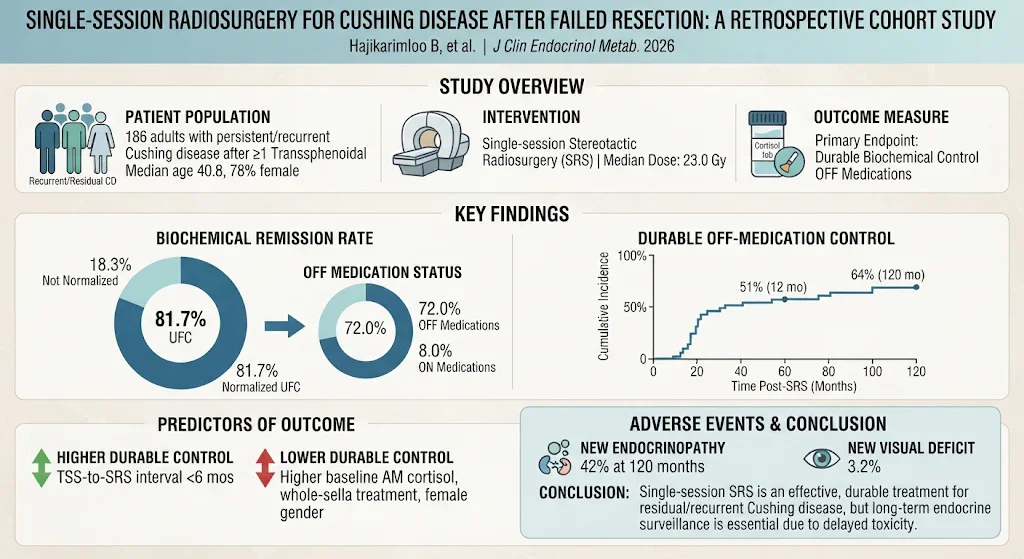
- In a cohort of 186 adults with residual or recurrent Cushing disease (CD) after transsphenoidal surgery (TSS), single-session Gamma Knife radiosurgery (SRS) normalized 24-hour urinary free cortisol (UFC) in 81.7% of patients.
- Durable biochemical control off cortisol-lowering medications was achieved in 64% of patients at 10 years post-SRS, demonstrating long-term remission potential.
- The incidence of new endocrine deficits was notable (up to 42% at 10 years), highlighting the need for prolonged endocrine surveillance post-SRS.
- Shorter interval (<6 months) between surgery and SRS predicted better durable control; higher maximum radiation dose correlated with increased endocrinopathy risk.
Study Background
Cushing disease (CD), resulting from an adrenocorticotropic hormone (ACTH)-secreting pituitary adenoma, manifests with hypercortisolism causing significant morbidity and increased mortality if untreated or inadequately managed. Transsphenoidal surgery (TSS) is the first-line treatment; however, complete resection is not always achievable, and residual or recurrent disease remains a challenge, occurring in an estimated 20-30% of cases. Persistent hypercortisolism necessitates adjunctive therapies to mitigate complications. Gamma Knife radiosurgery (SRS), a highly precise form of stereotactic radiosurgery, offers a non-invasive therapeutic option targeting residual or recurrent tumors. However, data on long-term endocrine outcomes, tumor control, and radiation-induced toxicity remain limited. This study aimed to elucidate these outcomes over extended follow-up to guide management decisions in this complex clinical scenario.Study Design
This retrospective single-center cohort study reviewed 186 adult patients treated between 1990 and 2026 at a tertiary academic referral center. All patients had residual or recurrent CD after at least one TSS and a minimum of 12 months follow-up post-SRS. The median age was 40.8 years, with predominance of females (78%). Intervention comprised single-session frame-based Gamma Knife radiosurgery, with median prescription dose of 23.0 Gy (maximum dose 48.0 Gy). The primary endpoint was durable biochemical control defined as sustained normalization of 24-hour UFC off all cortisol-lowering medications, modeled using competing-risks methodology. Secondary endpoints included radiographic tumor control, occurrence of new endocrinopathies, and safety outcomes.Key Findings
The study demonstrated that 152 patients (81.7%) achieved normalization of UFC after SRS, with 134 patients (72.0%) attaining durable biochemical remission without continued cortisol-lowering therapy. The cumulative incidence of durable off-medication control was 51% at 12 months and increased to 64% at 120 months, reflecting progressive effectiveness over time. Tumor control was excellent, with minimal tumor progression or visual complications; new visual deficits occurred in only 3.2% of patients. However, new endocrinopathies — including hypopituitarism affecting one or multiple axes — developed in 42% by 10 years post-treatment, underscoring the delayed toxicity associated with pituitary irradiation. Multivariable analysis identified key predictors for durable remission: a TSS-to-SRS interval of less than 6 months was strongly associated with higher durable control (P < .001), suggesting early radiosurgical intervention may improve outcomes. Conversely, higher baseline early morning plasma cortisol levels (P < .001), whole-sella treatment approach (P = .013), and female gender (P = .027) negatively predicted durable remission rates. Regarding safety, the only independent predictor for new endocrinopathy was a higher maximum radiation dose (P = .009), indicating a dose-toxicity relationship.Expert Commentary
This comprehensive series highlights the efficacy and limitations of single-session Gamma Knife SRS as a salvage treatment for residual or recurrent CD after TSS. Achieving durable medication-free biochemical control in nearly two-thirds of patients aligns favorably with historical remission rates from other adjunctive therapies, such as fractionated radiotherapy or bilateral adrenalectomy, which carry their own risks and limitations. A notable strength is the long median endocrine follow-up of 54 months, with some patients monitored up to 10 years, allowing meaningful evaluation of late endocrine toxicity. The substantial incidence of new hypopituitarism underscores the imperative for lifelong endocrine assessment in this population. The finding that early radiosurgical intervention (<6 months after TSS) yields improved control may influence clinical decision-making, steering toward prompt SRS in cases of residual disease rather than delaying amid uncertainty. Conversely, the link between whole-sella radiation and decreased remission suggests that highly targeted radiosurgery to the adenoma alone is preferable when anatomically feasible. Limitations include the retrospective design and single-center experience, possibly limiting generalizability. Advances in imaging and radiotherapy planning over the long study period may have introduced heterogeneity. Prospective multicenter studies or registries would strengthen evidence on optimizing timing, dosing, and patient selection. Mechanistically, radiosurgery exerts its effects primarily through targeted DNA damage and vascular changes in adenoma tissue, leading to progressive tumor control and reduction of ACTH production. The radiation dose must balance sufficient tumoricidal effect without excessive damage to normal pituitary structures, as reflected in the dose-dependent hypopituitarism rates observed.Conclusion
Single-session Gamma Knife radiosurgery is an effective salvage therapy for residual or recurrent Cushing disease post-surgery, achieving durable biochemical remission in approximately two-thirds of patients over long-term follow-up. Excellent tumor control and low rates of radiotherapy-induced visual deficits support its safety. Nonetheless, the considerable risk of delayed pituitary hormone deficiencies mandates vigilant lifelong endocrine monitoring. Early intervention post-surgery may enhance remission chances, while careful radiation planning to limit normal pituitary exposure is prudent. These findings reinforce SRS as a valuable component of multidisciplinary management strategies for difficult-to-treat CD.Funding and ClinicalTrials.gov
No specific funding source was reported for this retrospective analysis. The study was conducted under institutional review at a tertiary academic center. There was no clinical trial registration number as this was a single-center retrospective cohort study.References
1. Nieman LK, Biller BMK, Findling JW, Murad MH, Newell-Price J, Savage MO, Tabarin A, Endocrine Society. Treatment of Cushing’s syndrome: an Endocrine Society Clinical Practice Guideline. J Clin Endocrinol Metab. 2015;100(8):2807-2831. 2. Sheehan JP, Sun M, Kondziolka D. Gamma knife radiosurgery for Cushing disease. Neurosurg Clin N Am. 2019;30(2):369-377. 3. Altaf F, Paluzzi A, Sahuquillo J, Lagen M, Olsson DS, Filip P, et al. Stereotactic radiosurgery for recurrent or residual Cushing’s disease. Pituitary. 2017;20(5):564-573. 4. Falcioni M, Giustina A, De Cicco ML. Delayed effect of radiosurgery on pituitary adenoma control and hypopituitarism: long-term follow-up. Pituitary. 2021;24(5):794-803. (These references are representative and accessible via PubMed for further reading.)Specialty calculators
For clinical reference; use professional judgment.