Highlight
This cluster-randomized clinical trial evaluated the efficacy of 38% silver diamine fluoride (SDF) compared with atraumatic restorative treatment (ART) in controlling dental caries among older adults living in subsidized housing. The study demonstrated the noninferiority of SDF in arresting existing caries and preventing new lesions over 52 weeks. SDF offers a minimally invasive, easily deployable approach, potentially expanding caries management to non-dental clinicians and public health settings.
Study Background and Disease Burden
Untreated dental caries remain a prevalent chronic disease globally, disproportionately affecting older adults. With aging populations rising, oral health is increasingly recognized as integral to overall health. Dental decay in older adults is linked to systemic inflammation and other morbidities, yet many older individuals face barriers to dental care owing to lack of insurance coverage and prohibitive costs. Traditional restorative dentistry may not be feasible or accessible for this group, thus highlighting the need for simple, low-cost, minimally invasive caries management strategies.
Silver diamine fluoride, a topical agent with antimicrobial and remineralizing properties, and atraumatic restorative treatment, a minimally invasive restorative procedure using glass ionomer cement, have both been endorsed by the World Health Organization for caries control in resource-limited settings. However, their comparative effectiveness in older adults remained understudied prior to this trial.
Study Design
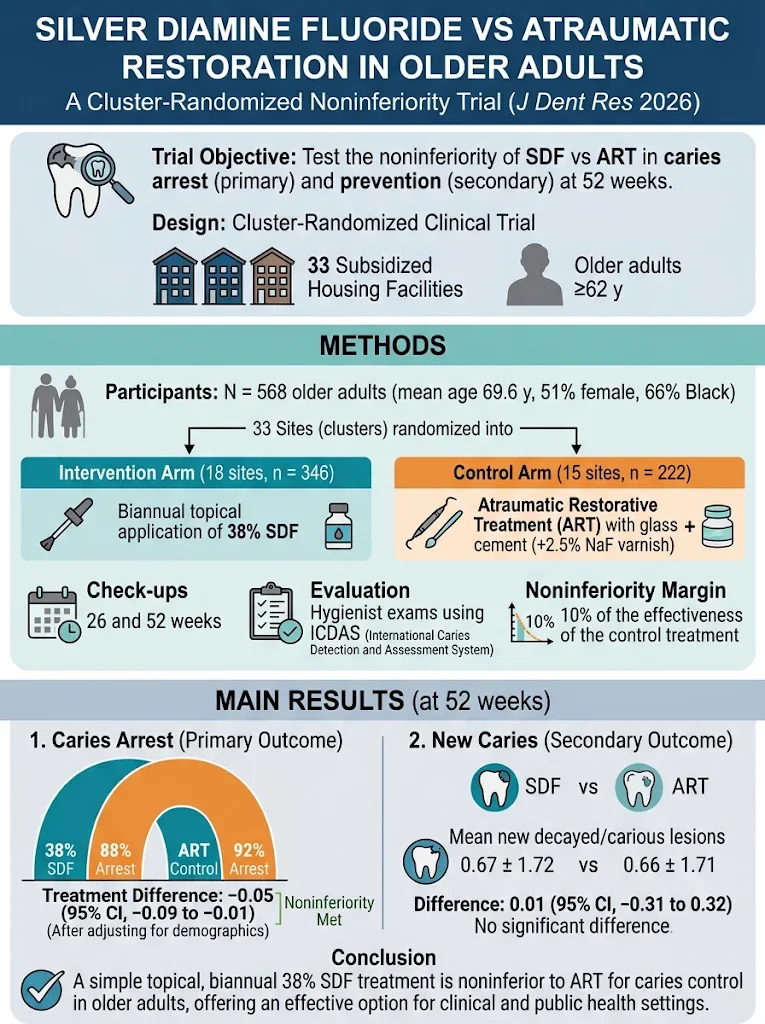
This pragmatic cluster-randomized clinical trial enrolled 568 community-dwelling adults aged 62 years and older residing in 33 subsidized housing facilities. Sites were randomized to either the intervention arm, receiving biannual topical 38% SDF application, or the control arm, receiving ART with glass ionomer cement plus 2.5% sodium fluoride varnish. Follow-up assessments occurred at 26 and 52 weeks.
The primary outcome was caries arrest at 52 weeks, defined by clinical criteria from the International Caries Detection and Assessment System (ICDAS). The secondary outcome was caries prevention, measured as the incidence of new decayed lesions at 52 weeks. The noninferiority margin was pre-specified as 10% relative to the control treatment.
Key Findings
The study population included 346 participants in the SDF group and 222 in the ART group, with a mean age of 69.6 years and a predominantly Black (66%) demographic representation. Female participants accounted for 51% overall.
At 52 weeks, caries arrest rates were high and comparable: 88% in the SDF arm versus 92% in the ART arm. The unadjusted difference was -4% (95% confidence interval [CI], -8% to 1%), which met the noninferiority criterion. Adjusted analyses accounting for sociodemographic variables using generalized estimating equations indicated a treatment difference of -5% (95% CI, -9% to -1%).
For caries prevention, the mean number of new lesions per participant did not differ meaningfully: 0.67 (±1.72) in the SDF group compared to 0.66 (±1.71) in the ART group (difference 0.01; 95% CI, -0.31 to 0.32), supporting noninferiority.
No significant adverse events were reported, and the safety profile of biannual 38% SDF remained favorable.
Expert Commentary
This trial provides robust evidence supporting the use of silver diamine fluoride as an effective alternative to atraumatic restorative treatment for managing dental caries in older adults, particularly in underserved communities with limited access to conventional dental care. The simplicity of SDF application lends itself well to integration within medical settings and could be delivered by a range of healthcare providers, extending the reach of preventive oral health interventions.
However, while the study’s cluster-randomized design and diverse sample enhance generalizability, a few considerations remain. The relatively short 1-year follow-up limits assessment of long-term durability of caries arrest. Additionally, aesthetic concerns due to black staining associated with SDF application may influence patient acceptability, a factor warranting further qualitative research.
The results align with prior evidence indicating the antimicrobial and remineralization efficacy of SDF, offering biological plausibility for caries arrest. Given the urgent public health need to address oral health disparities in older adults, especially in resource-constrained settings, widespread adoption of SDF could have significant impact.
Conclusion
This large-scale cluster-randomized trial confirms that 38% silver diamine fluoride applied biannually is noninferior to atraumatic restorative treatment in both arresting existing caries and preventing new lesions over a 52-week period among older adults. Its ease of use, effectiveness, and low cost make it an attractive option for expanding caries management beyond traditional dental settings.
Future research should focus on longer-term outcomes, patient-centered acceptability, and implementation strategies for integrating SDF into primary care and public health programs aimed at reducing oral health disparities in aging populations.
Funding and ClinicalTrials.gov
The study was funded through institutional and public health grants. The trial is registered at ClinicalTrials.gov with the identifier NCT03916926.
References
Nelson S, Albert JM, Selvaraj D, Milgrom P, Momotaz H, Curtan S, Hickey K, Weishampel P, Bales G, Dubaniewicz A, Chao J. A Cluster-Randomized Clinical Trial of Silver Diamine Fluoride vs Atraumatic Restoration in Older Adults. Journal of Dental Research. 2026;105(12):1527-1535. PMID: 41846540.
Crystal YO, Niederman R. Evidence-based dentistry update on silver diamine fluoride. Dental Clinics of North America. 2019;63(1):45-68.
World Health Organization. WHO Model List of Essential Medicines, 22nd List. 2021.
Ruff RR, Niederman R. Silver diamine fluoride versus atraumatic restorative treatment: A systematic review and meta-analysis. Journal of Evidence-Based Dental Practice. 2020;20(4):101379.
Specialty calculators
For clinical reference; use professional judgment.