Highlight
Retatrutide, a novel triple-receptor agonist targeting GIP, GLP-1, and glucagon receptors, achieved unprecedented weight loss of up to 25% in adults with obesity over 80 weeks. Significant improvements were also observed in knee osteoarthritis pain and obstructive sleep apnea indices, underscoring its potential as a multipronged therapeutic for obesity and related comorbidities. The treatment demonstrated a manageable safety profile dominated by gastrointestinal adverse events.
Study Background
Obesity remains a major global health challenge due to its high prevalence and association with numerous comorbidities, including knee osteoarthritis and obstructive sleep apnea (OSA). Current medical treatments targeting obesity often yield modest weight loss and limited improvements in related conditions. Glucagon-like peptide-1 (GLP-1) receptor agonists have revolutionized obesity treatment; however, the combination of incretin hormones could provide synergistic benefits. Retatrutide is a novel peptide that simultaneously activates glucose-dependent insulinotropic polypeptide (GIP), GLP-1, and glucagon receptors, hypothesized to amplify weight reduction and improve metabolic and symptom-related outcomes more effectively than single or dual receptor agonists.
Study Design
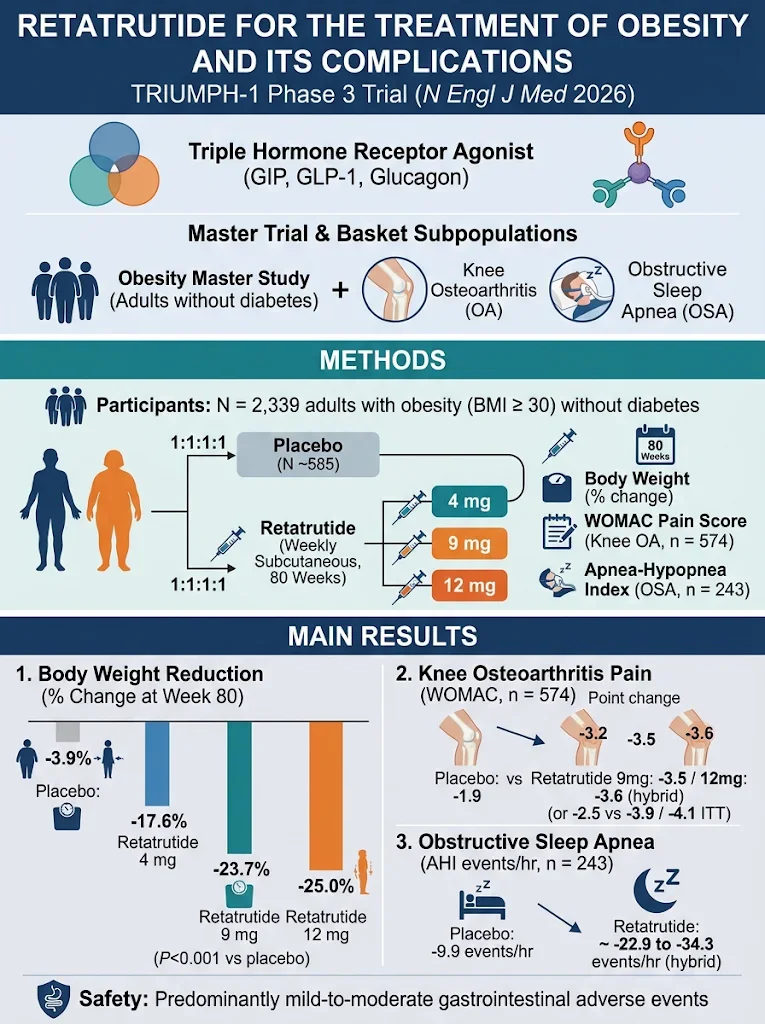
This phase 3, randomized, double-blind, placebo-controlled trial enrolled 2,339 adults with obesity (without diabetes) who received weekly subcutaneous injections of retatrutide at doses of 4 mg, 9 mg, or 12 mg, or placebo for 80 weeks. Key endpoints included percent change in body weight and changes in comorbidity-related measures: the Western Ontario and McMaster Universities Osteoarthritis Index (WOMAC) pain score for participants with knee osteoarthritis (n=574), and the apnea-hypopnea index (AHI) for participants with obstructive sleep apnea (n=243). Statistical analyses applied intention-to-treat strategies and hybrid-treatment estimands to handle intercurrent events.
Key Findings
Weight Loss: Retatrutide produced profound, dose-dependent weight reduction. Mean percent weight change was -17.6% at 4 mg, -23.7% at 9 mg, and -25.0% at 12 mg, compared to -3.9% with placebo. The differences of approximately -20 to -21 percentage points for the two higher doses were highly statistically significant (P<0.001).
Knee Osteoarthritis Pain: Among participants with knee osteoarthritis, retatrutide significantly reduced WOMAC pain scores compared with placebo. Under the hybrid estimand, pain reductions were -3.2, -3.5, and -3.6 points (out of 10) for 4 mg, 9 mg, and 12 mg doses respectively, versus -1.9 points with placebo. The differences of -1.6 and -1.8 points for the 9 mg and 12 mg doses were statistically significant (P<0.001), indicating clinically meaningful relief of joint pain correlating with weight loss.
Obstructive Sleep Apnea: Retatrutide markedly decreased AHI in participants with OSA. Changes in events per hour were -22.9, -34.3, and -31.7 for the 4 mg, 9 mg, and 12 mg groups, respectively, compared to -9.9 for placebo. The reductions for 9 mg and 12 mg doses significantly exceeded placebo by over 20 events/hour (P<0.001), suggesting substantial improvement in sleep-disordered breathing severity.
Safety Profile: The most common adverse events were gastrointestinal, a class effect consistent with GLP-1 receptor agonists and related medications. Specific details on severity or discontinuation rates were not provided but are important for clinical consideration.
Expert Commentary
The phase 3 TRIUMPH-1 trial validates retatrutide as a potent pharmacologic option for obesity, capable of inducing weight loss that rivals bariatric surgery outcomes and offering concomitant benefits for disabling comorbidities such as osteoarthritis and obstructive sleep apnea. The triple receptor agonism leverages multiple metabolic pathways, enhancing efficacy beyond currently approved agents.
Limitations include the trial’s exclusion of patients with diabetes, leaving efficacy and safety in this substantial group unexamined. Long-term safety, tolerability, and effects on cardiovascular and metabolic endpoints also warrant further study. Additionally, gastrointestinal side effects will need management strategies to optimize adherence.
Mechanistically, the GIP receptor agonism may augment insulin sensitivity and appetite suppression, GLP-1 receptor activation enhances glycemic control and satiety, and glucagon receptor engagement promotes energy expenditure, collectively explaining the robust weight and symptom improvements.
Conclusion
Retatrutide emerges as a transformative pharmacotherapy in obesity management, demonstrating substantial weight loss and symptomatic improvement in knee osteoarthritis and obstructive sleep apnea over 80 weeks. These findings offer hope for more effective integrated treatment approaches for obesity and its debilitating complications. Further investigations into broader populations, long-term outcomes, and comparative effectiveness are needed to position retatrutide in clinical practice.
Funding and Clinical Trials Registry
This study was funded by Eli Lilly and Company. The trial identifier is TRIUMPH-1, registered on ClinicalTrials.gov under number NCT05929066.
References
- Jastreboff AM et al. Retatrutide, a Triple Hormone Receptor Agonist, for Treatment of Obesity. N Engl J Med. 2026 Sep 29;395(18):1781-1793. PMID: 42814954.
- Kushner RF. Obesity and comorbidities. Med Clin North Am. 2018;102(1):13-33.
- Frias JP, Nauck MA. GLP-1 receptor agonists and cardiometabolic benefits. Adv Ther. 2022;39(1):1-11.
- Davies MJ et al. Management of obesity: Position statement of ASMBS and IFSO. Obes Surg. 2022;32(3):1103–12.
Specialty calculators
For clinical reference; use professional judgment.