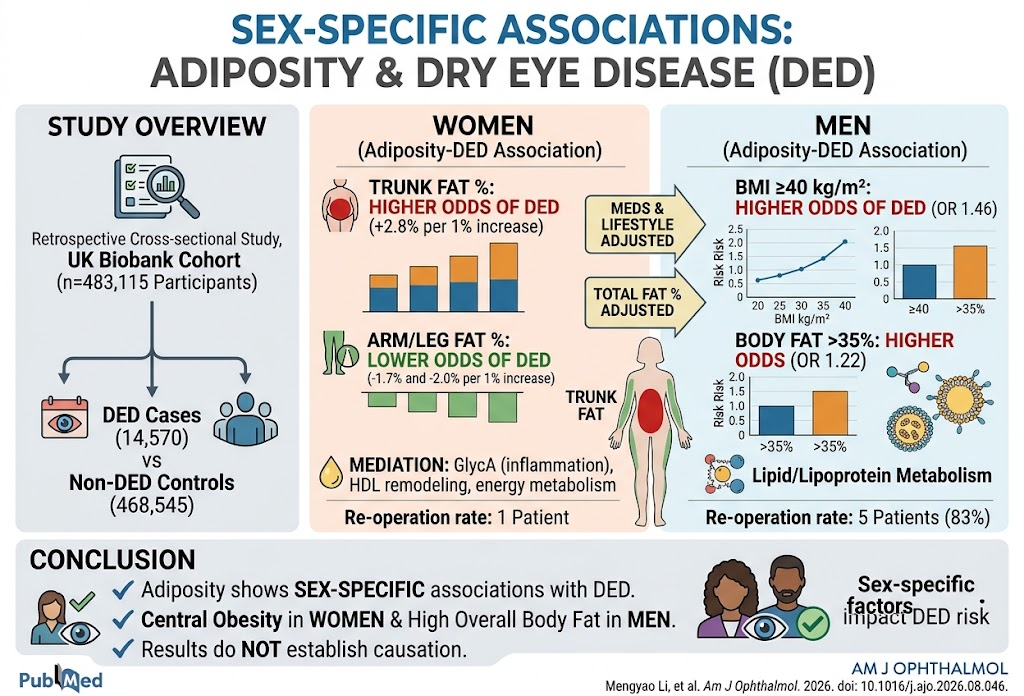
Highlight
- Central (trunk) fat percentage in women associates with higher dry eye disease (DED) odds, while limb fat inversely correlates.
- In men, severe obesity (BMI ≥40) and high total body fat percentage (>35%) increase DED odds significantly.
- Metabolomic mediation analyses reveal sex-specific metabolic pathways, highlighting inflammation and lipid metabolism in the adiposity-DED link.
- These findings affirm distinct adiposity-related risks for DED by sex but do not prove causality, underscoring importance of tailored prevention strategies.
Study Background
Dry eye disease (DED) is a chronic, multifactorial disorder of the ocular surface characterized by tear film instability and inflammation, contributing to discomfort, visual disturbance, and compromised quality of life. Worldwide, DED prevalence is estimated at 5–50%, with higher rates reported in older populations and women. Given the increasing prevalence of obesity globally, understanding the relationship between adiposity and ocular surface health is clinically relevant. Obesity, particularly central adiposity, is known to induce systemic inflammation and metabolic dysregulation, both of which could influence ocular surface pathophysiology. However, prior studies have often focused on body mass index (BMI) alone, neglecting the nuances of fat distribution and body composition differences between sexes. This study leverages a large UK Biobank dataset to explore sex-specific associations of BMI, total body fat percentage, and regional fat distribution with DED prevalence, alongside exploring metabolic mediators via nuclear magnetic resonance (NMR) metabolomics data.
Study Design
This retrospective cross-sectional study analyzed data from 483,115 participants of the UK Biobank cohort, which included 14,570 individuals identified with DED and 468,545 without DED. DED identification was comprehensive, encompassing primary care Read codes, participant self-reports, and medication prescriptions related to dry eye treatment. Adiposity parameters were assessed at baseline using anthropometric measures and bioelectrical impedance analysis, enabling quantification of BMI, total body fat percentage, and regional fat distribution (trunk, arms, legs). Multivariable logistic regression models were applied incorporating adjustments for demographic factors, metabolic indicators, medication history, and lifestyle behaviors to estimate odds ratios (ORs) for DED per unit change in adiposity measurements. Additionally, sex-stratified exploratory mediation analyses were conducted using baseline NMR metabolite profiles to investigate potential intermediary metabolic pathways linking adiposity measures with incident DED.
Key Findings
In women, after adjusting for total body fat percentage and confounders, increased central adiposity showed a statistically significant association with DED. Specifically, each 1% increment in trunk fat percentage was linked to a 2.8% increase in odds of DED (OR=1.028; 95% CI 1.015-1.040; P<0.001). Conversely, higher fat percentages in the arms and legs were protective, associated with 1.7% and 2.0% lower odds of DED, respectively. This suggests a divergent role of fat distribution whereby peripheral fat may mitigate inflammation or metabolic risk compared to central fat accumulation. Mediation analysis implicated systemic inflammation indicated by GlycA (a marker of glycoprotein acetylation), alterations in high-density lipoprotein (HDL) metabolism, and energy utilization pathways as potential mechanistic links.
Among men, severe obesity defined by BMI ≥40 kg/m² increased odds of DED by 46.1% (OR=1.461; 95% CI 1.172-1.821; P35%) was associated with a 22.4% increase in odds (OR=1.224; 95% CI 1.070-1.399; P=0.003). Unlike women, regional fat distribution showed no significant differential effects. Metabolite profiling flagged lipid and lipoprotein metabolism dysregulation as key intermediary factors, indicating that systemic lipid abnormalities may underlie obesity-related ocular surface compromise in men.
These findings underscore the importance of considering sex-specific adiposity phenotypes in evaluating DED risk and suggest potential biomarker pathways for future mechanistic and therapeutic investigations.
Expert Commentary
This large-scale biotechnology-driven analysis advances the understanding of obesity’s impact on ocular surface diseases beyond simplistic body weight metrics. The sex dimorphism observed is biologically plausible, given known hormonal influences on fat deposition patterns and metabolic functions. Central adiposity’s association with DED in women aligns with the pro-inflammatory milieu linked to visceral fat, which secretes adipokines and cytokines deleterious to lacrimal gland function and ocular surface integrity. Protective effects of peripheral fat might reflect differences in adipocyte function or metabolic buffering capacity.
In men, the predominance of total fat burden as a risk factor suggests differing inflammatory or lipid metabolic contributions to pathophysiology. Metabolomic insights into GlycA and HDL remodeling highlight systemic inflammation and altered lipid transport as potential targets for intervention.
Study limitations include its retrospective design, which limits causal inference; potential misclassification bias in DED diagnosis; and reliance on bioelectrical impedance rather than imaging for fat distribution quantification. Nonetheless, the sizeable cohort and adjustment for multiple confounders bolster the robustness of findings. Prospective longitudinal studies and mechanistic research are warranted to validate causality and uncover therapeutic opportunities.
Conclusion
This comprehensive analysis from the UK Biobank reveals that adiposity relates to dry eye disease risk in sex-specific manners: central fat deposition in women and high overall body fat in men confer increased odds. These associations are mediated by distinct metabolic and inflammatory pathways, emphasizing the complexity of systemic health effects on ocular surface disorders. Clinicians should recognize obesity’s role as a modifiable risk factor for DED and consider sex differences when formulating management plans. Future research integrating metabolomic biomarkers and targeted interventions may improve prevention and treatment of dry eye in obese populations.
Funding and ClinicalTrials.gov
The study utilized data from the UK Biobank resource under application, with no specific external funding reported. As a retrospective observational analysis using existing data, clinical trial registration was not applicable.
References
1. Li M, Li L, Liu J, et al. Central obesity in women and high overall body fat in men are associated with higher odds of dry eye disease. Am J Ophthalmol. 2026 Sep 5. PMID: 42700831.
2. Craig JP, Nichols KK, Akpek EK, et al. TFOS DEWS II Definition and Classification Report. Ocul Surf. 2017 Jul;15(3):276-283.
3. Stefanick ML, Mackey S, Sheehan M, et al. Epidemiology and pathophysiology of dry eye disease: a review. Curr Allergy Asthma Rep. 2020;20(8):35.
4. Hotamisligil GS. Inflammation and metabolic disorders. Nature. 2006;444(7121):860-7.
5. Ceciliani F, Pocacqua V. The acute phase protein alpha1-acid glycoprotein: an old member of the acute phase protein family with new perspectives. Vet Immunol Immunopathol. 2007.
6. UK Biobank: Protocol for a large-scale prospective study of 500,000 UK volunteers. 2012.
7. Chen Y, Chen X, Zeng Y, et al. Obesity and dry eye disease: a systematic review and meta-analysis. Int J Ophthalmol. 2021;14(7):1163-1173.