Highlight
- Living donor liver transplantation (LDLT) is underutilized in the U.S. due to donor safety concerns and surgical complexity.
- A new U.S. LDLT program demonstrated no donor mortality and no severe complications over 90 adult right hepatectomies.
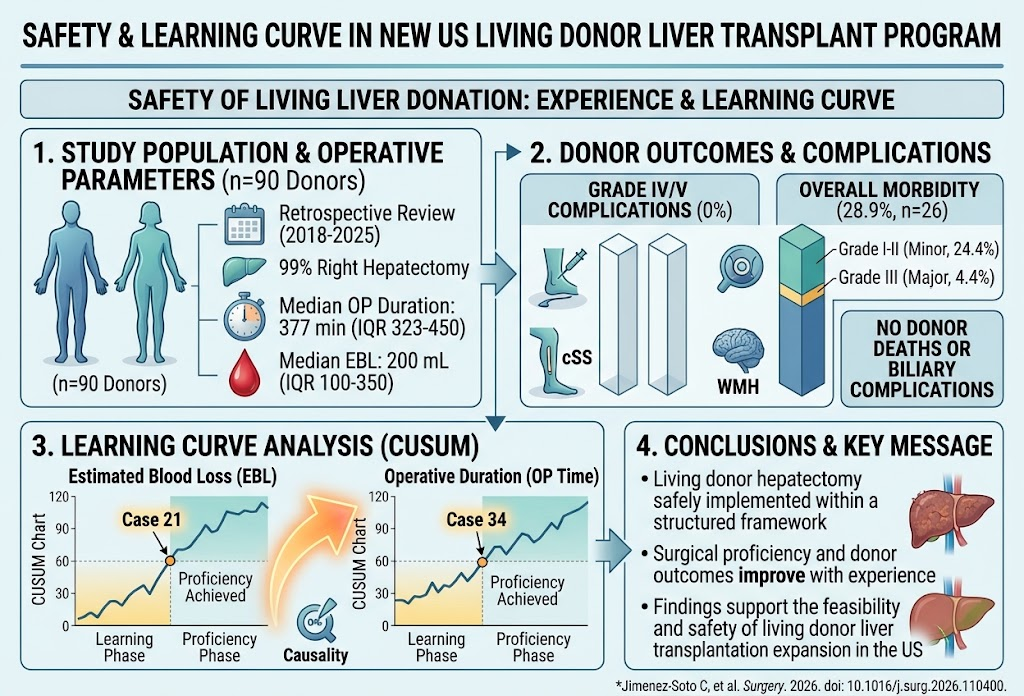
- Learning curves for operative time and blood loss improved significantly after 21 and 34 cases, respectively, highlighting the importance of experience.
- Smaller future liver remnant and early program experience were linked to posthepatectomy liver failure, mostly mild (grade A), emphasizing patient selection and program maturity.
Study Background
Living donor liver transplantation (LDLT) remains a promising yet underutilized modality in the United States for addressing end-stage liver disease, especially given the scarcity of deceased donor organs. Despite its potential to reduce waitlist mortality, adoption has lagged mainly due to concerns over donor safety and technical challenges inherent in donor hepatectomy, particularly right lobe resections. Early experiences raised fears about donor morbidity and mortality, necessitating meticulous program development and evaluation of surgical learning curves to ensure optimal outcomes for healthy donors. Contemporary U.S. data on how new LDLT programs evolve and the safety of living donors are sparse, restricting widespread expansion of this life-saving approach.
Study Design
This investigation entails a retrospective review of 90 consecutive adult living donor hepatectomies performed between February 2018 and October 2025 at a newly established LDLT program in the United States. Nearly all donors (99%) underwent right hepatectomy, the technically demanding procedure that involves resecting the right hepatic lobe for transplant. Demographic data, intraoperative variables including operative duration and estimated blood loss, and postoperative outcomes were systematically analyzed. The learning curve for the surgical program was examined utilizing cumulative sum (CUSUM) analysis to detect inflection points that signify transitions from learning to proficiency phases. Posthepatectomy liver failure (PHLF) was defined by the International Study Group of Liver Surgery (ISGLS) criteria, incorporating grades A to C based on clinical impact. Multivariable logistic regression was employed to identify independent factors associated with donor morbidity and PHLF.
Key Findings
The 90 donors had no mortality or severe (Clavien-Dindo grade IV) complications, and notably, no biliary complications—which are among the most common issues in donor hepatectomy—were observed. Overall morbidity was 28.9%, predominantly minor complications classified as Clavien-Dindo grades I-II, such as transient fevers or minor wound issues. CUSUM analysis demonstrated two pivotal case thresholds marking the surgical learning curve: after 21 cases, estimated blood loss decreased significantly, and after 34 cases, operative duration shortened, revealing increased surgical proficiency with experience.
Posthepatectomy liver failure occurred in 22% of donors, mostly mild grade A that requires no change in clinical management. Through multivariable logistic regression, two independent predictors for PHLF emerged: smaller future liver remnant volume and early phase in program experience, underscoring the critical role of careful donor selection and surgical expertise. Interestingly, no variables significantly predicted overall morbidity.
These results emphasize that with structured protocols and accumulating experience, complex right hepatectomies for living donation can be performed safely, even in newly established U.S. programs. The absence of biliary complications may reflect meticulous surgical technique and standardized perioperative care.
Expert Commentary
The findings contribute valuable contemporary U.S. data addressing lingering skepticism about safety in LDLT donor surgery, an obstacle to broader clinical adoption. The identification of clear milestones in the learning curve using CUSUM analysis provides an objective framework for program evaluation and surgeon training benchmarks. This approach aligns with international recommendations emphasizing the need for specialized centers with high procedural volume to optimize outcomes.
The study’s insight that smaller future liver remnants correlate with PHLF resonates with established principles, reinforcing the importance of advanced donor imaging and volumetric assessment during candidate selection. Given that PHLF was chiefly mild and non-life-threatening, it supports a cautious but affirming stance toward the procedure’s safety profile.
Limitations include the single-center retrospective design and predominantly right lobe grafts, which may limit generalizability. Long-term donor outcomes beyond the immediate postoperative period and quality-of-life assessments will be critical to fully appraise program impact.
Conclusion
This study substantiates that adult living donor hepatectomy, particularly right lobe procurement, can be safely introduced in new LDLT programs within the United States when implemented within a structured framework emphasizing surgical expertise and careful donor selection. Surgical proficiency and donor outcomes improve as the program matures, reflecting the learning curve’s critical role. Efforts to expand LDLT should integrate robust monitoring of operative outcomes alongside standardized donor evaluation protocols to mitigate risks.
Expanding safe living donation programs has the potential to alleviate organ shortages and reduce waitlist mortality. The current findings provide a model and reassurance for centers contemplating the initiation or growth of LDLT services in the U.S., highlighting the feasibility and crucial safety checkpoints.
Funding and Clinical Trials Registry
The study did not disclose specific funding sources or clinical trial registrations.
References
1. Jimenez-Soto C, Loszko AF, McCabe M, et al. Safety of living liver donation: Experience and learning curve at a new living donor liver transplant program in the United States. Surgery. 2026 Jun 19;197:110400. doi:10.1016/j.surg.2026.110400. PMID: 42424763.
2. International Study Group of Liver Surgery (ISGLS). Definition and grading of posthepatectomy liver failure. Surgery. 2011;149(5):713-724.
3. Lee SG. Live donor liver transplantation: Current status and future perspectives. Nat Rev Gastroenterol Hepatol. 2013 Mar;10(3):203-214.
4. Broering DC, Steinbrück K, Oldhafer KJ. Donor safety is paramount in living donor liver transplantation. Hepatobiliary Surg Nutr. 2018 Jun;7(3):172-175.
5. Gelling L, Mulligan D, Renz JF. Donor safety and surgical learning curves in living donor liver transplantation. Curr Opin Organ Transplant. 2016 Aug;21(4):371-376.