Highlight
This study evaluates a novel two-stage tracheal reconstruction strategy for patients with well-differentiated thyroid carcinoma (WDTC) complicated by tracheal invasion, offering robust functional and survival outcomes.
Key findings include a 95.9% decannulation rate and comparable functional recovery across different flap reconstructions, with a 3-year overall survival of 78.4%.
This approach is particularly effective for long-segment tracheal defects, expanding reconstructive options in advanced thyroid malignancies with airway involvement.
Study Background
Well-differentiated thyroid carcinoma (WDTC) is generally associated with excellent prognosis; however, when the tumor invades the trachea, it poses significant therapeutic challenges. Tracheal involvement by thyroid cancer complicates surgical management and is associated with increased morbidity and mortality, necessitating advanced techniques for airway reconstruction.
Long-segment tracheal defects following tumor and tracheal resection require meticulous reconstruction to restore airway integrity and function. Traditional single-stage reconstructions sometimes fail to address the complexity of large defects and may result in poor functional recovery or complications.
The need for reliable, effective repair methods that afford good decannulation rates, preserve swallowing and phonation, and provide oncologically safe margins remains unmet. This study addresses these challenges by investigating a two-stage tracheal repair technique using various flap options tailored to defect length and patient anatomy.
Study Design
This retrospective cohort included 74 patients diagnosed with WDTC who underwent surgical tumor resection combined with tracheal segment excision due to invasion.
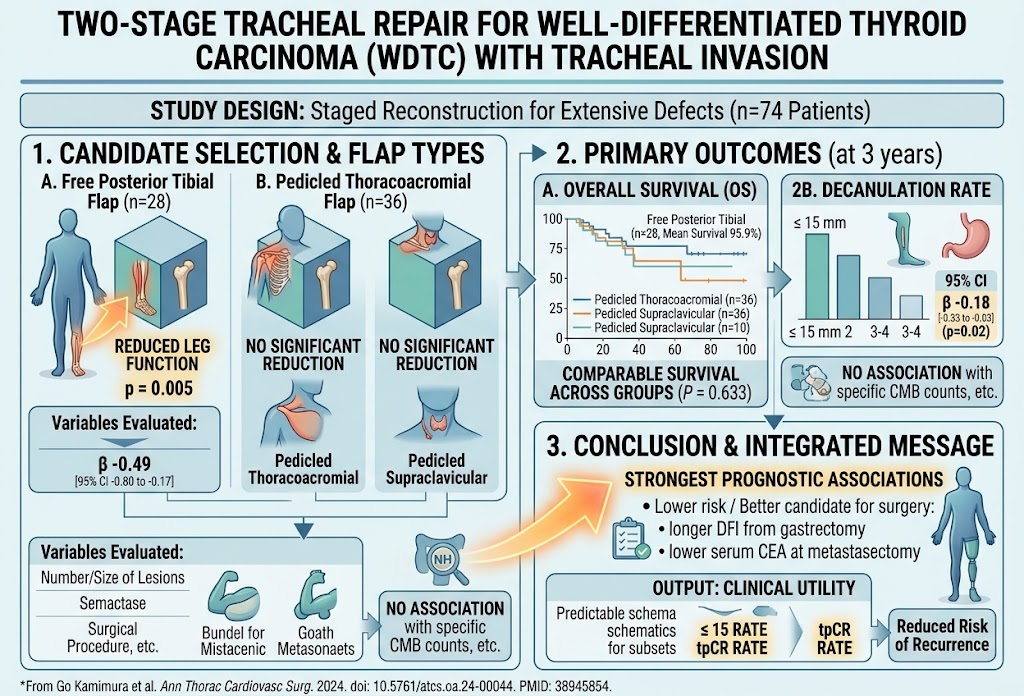
Patients received staged reconstructions using one of three flap types based on defect size and location: free posterior tibial artery perforator flap (n=28), pedicled thoracoacromial flap (n=36), or pedicled supraclavicular flap (n=10). Flap choice was primarily influenced by tracheal defect size, with free flaps utilized for larger resections.
The primary endpoints encompassed functional recovery metrics—respiratory function, swallowing, speech quality—as well as decannulation success and perioperative complications. Secondary outcomes included overall survival rates assessed over a median follow-up duration sufficient to capture intermediate-term outcomes.
Key Findings
Demographics and Defect Characteristics: Patient demographics were well matched among groups, ensuring comparability. The free posterior tibial artery flap group exhibited significantly larger tracheal defects averaging 9.14 ± 1.57 tracheal rings resected, contrasted with 5.89 ± 2.59 and 6.30 ± 1.49 rings in the pedicled thoracoacromial and supraclavicular flap groups, respectively (p<0.001).
Decannulation Rate and Functional Recovery: A high overall endotracheal tube removal rate of 95.9% was achieved, indicating successful airway restoration postoperatively with no significant differences across flap groups (p=0.533). Functional domains, including swallowing, speech, and respiratory function assessments, were comparably favorable among the three reconstruction strategies, demonstrating the versatility of the two-stage approach.
Complications: The study reported acceptable complication rates without specifying significant differences among techniques. This suggests the two-stage approach is safe across various flap types.
Survival Outcomes: The 3-year survival rate following surgery was 78.4%, with no statistically significant variance between different flap groups (p=0.633), reinforcing the oncological adequacy of the resection and reconstructive method.
Expert Commentary
The findings bolster the role of two-stage tracheal reconstruction in managing extensive tracheal defects secondary to WDTC invasion—a technically challenging clinical scenario. The use of free flaps for long-segment defects, particularly the posterior tibial artery perforator flap, offers an innovative solution combining robust vascular supply with sufficient tissue bulk for complex repairs.
The comparable functional outcomes across flap types highlight the importance of individualized reconstructive planning based on defect characteristics and patient factors, rather than the flap source alone. Moreover, interdisciplinary collaboration between head and neck surgeons, reconstructive microsurgeons, and anesthesiologists is pivotal for optimal perioperative management.
Limitations include the retrospective design and relatively short follow-up for long-term survival and late complications. Prospective studies with larger cohorts and randomized designs could better define the relative merits of flap choices and refine protocols for staged reconstruction.
Conclusion
Two-stage tracheal repair, incorporating free or pedicled flap reconstruction, constitutes a safe and effective treatment modality for patients with WDTC complicated by significant tracheal invasion. The approach demonstrated excellent decannulation success and functional rehabilitation with promising survival outcomes, even in cases involving extensive tracheal resections.
This surgical strategy expands reconstructive options and potentially improves quality of life in patients facing complex airway management challenges due to thyroid carcinoma. Future investigations should aim to elucidate long-term efficacy, refine patient selection, and integrate advances in flap technology to further enhance outcomes.
Reference
Li L, Zhang X, Ren J, Zhao P, Ma Y, Jiang Z, Ran H, Zheng Y, Lei D, Chen F, Liu J. Two-Stage Tracheal Repair for Well-Differentiated Thyroid Carcinoma With Tracheal Invasion. Laryngoscope. 2026 Sep 3. doi: 10.1002/lary.70875. Epub ahead of print. PMID: 42692997.