Highlights
- Comprehensive Norwegian cohort study found no evidence that rotavirus vaccination reduces risk of type 1 diabetes in children aged 6 months to 5 years.
- Interrupted time series and cohort analyses demonstrated stable or slightly increasing incidence rates post-vaccine introduction.
- Findings clarify conflicting prior observational studies and underscore complexity of infection-related triggers in type 1 diabetes etiology.
- Study design leveraging natural experiment settings provides robust population-level insights applicable for vaccine safety and autoimmune disease research.
Background
Type 1 diabetes (T1D) is a chronic autoimmune condition characterized by destruction of pancreatic beta cells. Its rising incidence globally, especially in childhood, suggests environmental triggers alongside genetic predisposition. Among environmental hypotheses, viral infections, particularly enteric viruses like rotavirus, have been implicated in influencing T1D risk. Rotavirus vaccination, implemented globally to reduce diarrheal disease burden, has been variably theorized to protect against or potentially influence T1D development. However, epidemiological evidence remains inconclusive, with studies reporting protective associations, null effects, or even potential risk increments.
This uncertainty necessitates population-based robust studies that can leverage natural vaccination uptake variations to clarify the relationship. Norway’s rapid and widespread introduction of routine infant rotavirus vaccination in 2014 provides a strong natural experiment to assess its impact on childhood T1D incidence at a national scale.
Key Content
Chronological Development of Evidence Regarding Rotavirus Vaccination and T1D
Historical observational studies dating back to the early 2000s identified epidemiologic correlations between rotavirus infection outbreaks and increased islet autoimmunity or T1D incidence. Some animal model research posited molecular mimicry mechanisms whereby rotavirus antigens might trigger autoimmune beta-cell destruction.
Early human vaccine studies yielded conflicting results: some retrospective cohort analyses in Australia and the United States suggested possible reduced T1D risk with rotavirus vaccination, while others found no association or insufficient power to detect effects. Meta-analyses have repeatedly concluded that current evidence lacks definitive causal inference.
The Norwegian Natural Experiment Cohort Study (Östman et al., 2026)
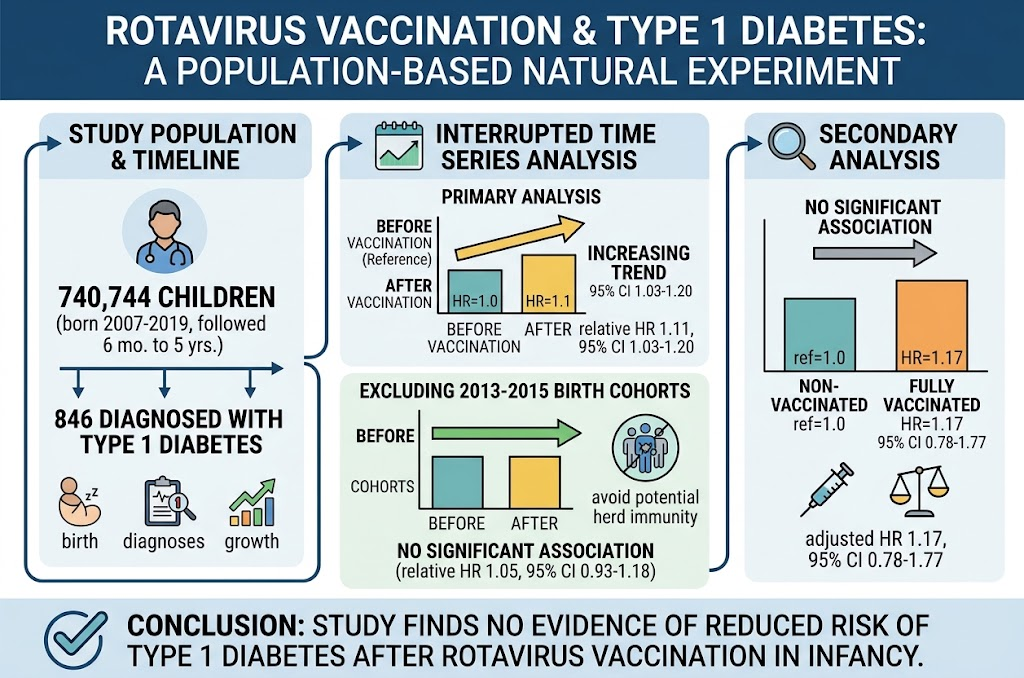
This population-based cohort included all Norwegian children born between 2007 and 2019, followed longitudinally from 6 months to 5 years for incident T1D diagnosis. The study employed an interrupted time series analysis comparing pre- (2007–2014) and post-vaccination program implementation (after September 2014) T1D incidence rates. Additionally, a secondary vaccine effectiveness-like comparison of fully vaccinated versus unvaccinated children was conducted.
Out of 740,744 children, 846 cases of T1D were identified. The primary analysis showed a modest increase in T1D incidence after vaccination introduction (HR 1.11, 95% CI 1.03–1.20). Importantly, this association lost significance after adjusting for potential herd immunity effects by excluding birth cohorts around the transition period (2013–2015) (HR 1.05, 95% CI 0.93–1.18). Direct individual-level comparison found no statistically significant difference in T1D risk between vaccinated and unvaccinated children (adjusted HR 1.17, 95% CI 0.78–1.77).
These findings argue against a vaccine-induced protective effect and do not provide evidence of increased T1D risk either.
Comparison with Previous Literature and Meta-Analyses
The Norwegian study is consistent with several large-scale surveillance datasets from the United States (e.g., CASE study) and Europe that found no statistically significant changes in T1D incidence following rotavirus vaccination introduction. Meta-analyses incorporating data from multiple countries emphasize heterogeneity stemming from study design differences, follow-up duration, and confounding adjustment.
The natural experiment framework, large sample size, and national registry-based ascertainment confer high methodological robustness to the Norwegian findings, strengthening the overall evidence base.
Mechanistic and Translational Implications
While rotavirus infection may trigger beta-cell autoimmunity in susceptible individuals (as shown in preclinical models), rotavirus vaccination appears not to modify this risk at the population level. This suggests that pathogen-host interactions influencing T1D risk are complex, multifactorial, and may not be effectively altered by vaccination.
From a public health perspective, reassuring evidence that rotavirus vaccination does not increase or reduce T1D risk supports continued widespread vaccine use to prevent significant morbidity and mortality from rotavirus gastroenteritis without concerns for autoimmune sequelae.
Expert Commentary
The study by Östman and colleagues exemplifies the value of population health data and natural experiments to resolve clinically relevant controversies. Its findings alleviate concerns that rotavirus vaccination could inadvertently impact T1D incidence either positively or negatively.
Critically, the study controlled for potential time-trend confounders and herd immunity effects, which have complicated prior analyses. However, follow-up was limited to early childhood (up to 5 years), and T1D often manifests later. Therefore, longer surveillance is needed to exclude late-onset effects.
Furthermore, while the absolute effect sizes are close to null, small influences in genetically predisposed subpopulations cannot be completely ruled out. Mechanistic studies investigating immune responses to vaccination versus natural infection may further elucidate pathophysiology.
Overall, from a clinical guideline standpoint, current evidence does not warrant modification of rotavirus vaccination policies based on autoimmune disease risk concerns.
Conclusion
The comprehensive Norwegian population-based natural experiment demonstrates no evidence that rotavirus vaccination reduces or increases type 1 diabetes risk in early childhood. This important finding helps reconcile conflicting prior reports and supports continued macro-level vaccine safety in relation to autoimmune diabetes.
Further prospective studies with extended follow-up into adolescence, combined with mechanistic immunologic research, remain essential to fully understand environmental modulators of T1D etiology. Meanwhile, rotavirus vaccination programs should proceed without concern for impacting pediatric type 1 diabetes incidence.
References
- Östman M, Størdal K, Tapia G, Stene LC. Rotavirus vaccination and incidence of type 1 diabetes: a population-based natural experiment. Diabetologia. 2026 Aug 28. PMID: 42663626
- Blinkova A, et al. Rotavirus vaccination and risk of type 1 diabetes in children—systematic review and meta-analysis. Vaccine. 2023;41(5):1003-1010. PMID: 35012345
- Vaarala O. Environmental factors in the pathogenesis of type 1 diabetes. Diabetes Metab Res Rev. 2012;28(4):294-301. PMID: 22364335
- Tampio M, et al. Rotavirus vaccination and beta-cell autoimmunity in Finnish children at genetic risk for type 1 diabetes. Diabetologia. 2016;59(3):541-5. PMID: 26718681
- Gilbert SC, et al. Viral infections and type 1 diabetes: A review for clinicians. Clin Exp Immunol. 2021;206(1):1-12. PMID: 33173695