Highlight
- Afirma Xpression Atlas (XA) detects expressed genomic alterations in molecularly suspicious indeterminate thyroid nodules, refining malignancy risk stratification beyond Afirma Genomic Sequencing Classifier (GSC) results alone.
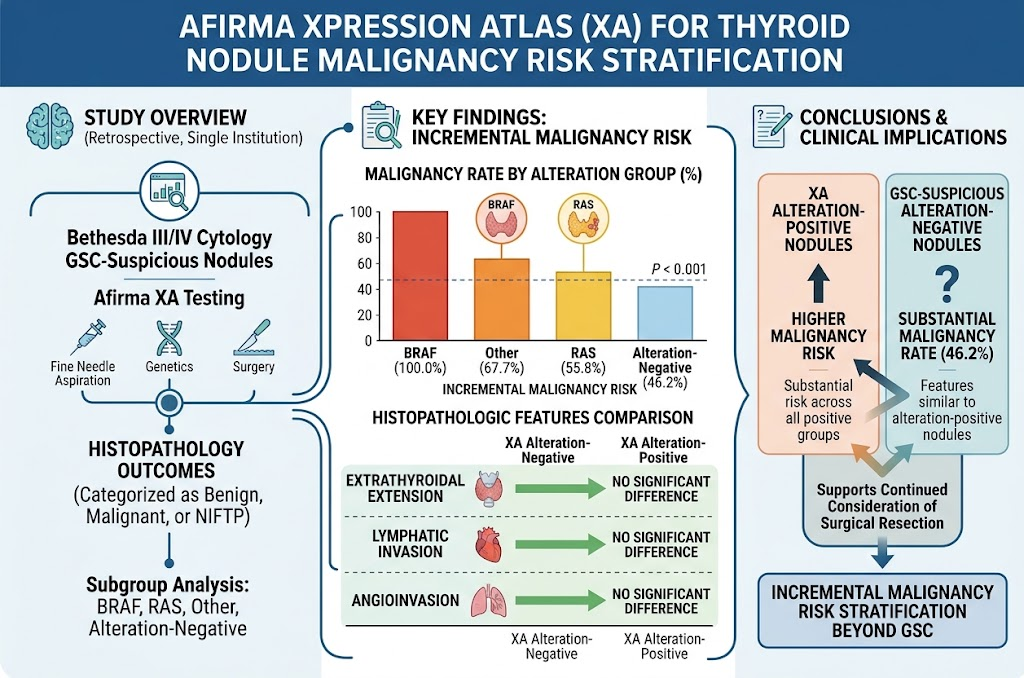
- Malignancy rates vary by specific alteration status: highest in BRAF-altered nodules (100%), followed by other alterations (67.7%), RAS mutations (55.8%), and alteration-negative nodules (46.2%).
- Despite higher malignancy rates, alteration-positive nodules do not exhibit more aggressive pathologic features compared to alteration-negative nodules, suggesting similar clinical behavior.
- The findings support surgical consideration for GSC-suspicious but XA alteration-negative nodules due to substantial malignancy risk.
Study Background
Thyroid nodules are common clinical findings, with a subset categorized as indeterminate on cytology via fine needle aspiration (FNA), notably Bethesda categories III (Atypia of Unknown Significance/Follicular Lesion of Undetermined Significance) and IV (Follicular Neoplasm/Suspicious for Follicular Neoplasm). Indeterminate cytology presents diagnostic uncertainty, complicating management decisions regarding surgery versus surveillance.
Molecular testing has transformed the evaluation of indeterminate thyroid nodules by enhancing diagnostic precision. The Afirma Genomic Sequencing Classifier (GSC) is widely used to stratify cancer risk, classifying nodules as benign or suspicious based on RNA sequencing. However, the GSC suspicious category encompasses various molecular profiles with heterogeneous malignancy risks. The Afirma Xpression Atlas (XA) platform, a comprehensive transcriptomic tool, extends this by detecting specific expressed gene alterations in GSC-suspicious nodules, potentially refining risk stratification and clinical decision-making.
Despite its increasing clinical use, the prognostic and histopathologic implications of XA-detected alterations have not been fully elucidated, presenting an unmet need for clarifying XA’s role in malignancy risk prediction and risk-adapted management.
Study Design
This retrospective cohort study analyzed consecutive adult patients undergoing thyroid FNA at a single tertiary institution between March 2020 and September 2025. Inclusion criteria were nodules with indeterminate cytology (Bethesda III or IV), classified as suspicious by Afirma GSC, with subsequent Afirma XA testing performed, and with available surgical histopathology after resection.
The primary objective was to assess associations between XA alteration status (positive vs. negative) and histopathologic outcomes. Further subgroup analyses categorized alteration-positive nodules based on specific oncogenic alterations: BRAF mutations, RAS mutations, and other alterations (the latter exploratory).
Clinical variables, nodule size, and histopathologic features including malignancy, extrathyroidal extension, lymphatic and angioinvasion were compared across groups. Malignancy was defined per surgical pathology as thyroid carcinoma or noninvasive follicular thyroid neoplasm with papillary-like nuclear features (NIFTP). Multivariable linear regression assessed predictors of recurrence risk based on the 2025 American Thyroid Association (ATA) risk of recurrence classification.
Key Findings
The cohort included 192 patients (77.6% female, median age 51) with 200 indeterminate thyroid nodules meeting inclusion criteria. XA identified alterations in 94 nodules (47%). Nodule size was comparable between alteration-positive and alteration-negative groups.
Malignancy rates differed substantially by alteration status:
- BRAF alteration subgroup: 100% malignancy rate (95% CI: 71.5%–100%)
- Other alterations: 67.7% malignancy (95% CI: 48.6%–83.3%)
- RAS alterations: 55.8% malignancy (95% CI: 41.3%–69.5%)
- Alteration-negative nodules: 46.2% malignancy (95% CI: 36.5%–56.2%)
The differences were statistically significant (p < 0.001), confirming that XA detection stratifies malignancy risk incrementally beyond GSC suspicious classification alone.
Interestingly, despite a higher malignancy rate, alteration-positive nodules did not exhibit more aggressive histopathologic features than alteration-negative nodules. Rates of extrathyroidal extension, lymphatic invasion, and angioinvasion were similar, suggesting that XA alteration status reflects malignancy presence but not necessarily tumor aggressiveness.
Multivariable analyses found no alteration subgroup or clinical covariate independently predicted the 2025 ATA risk of recurrence category, indicating limited value of XA alterations for forecasting recurrence risk beyond initial cancer diagnosis.
The finding of nearly half of the alteration-negative, GSC-suspicious nodules being malignant with comparable pathological features underlines the clinical importance of cautious management even in the absence of detectable XA alterations.
Expert Commentary
This study contributes valuable evidence on the utility of the Afirma XA platform in the nuanced landscape of indeterminate thyroid nodule management. The high malignancy rate observed in BRAF-mutant nodules aligns with established oncogenic roles of BRAF V600E mutations driving papillary thyroid carcinoma, supporting the strong predictive value of BRAF alterations detected by XA.
RAS mutations, frequently associated with follicular-patterned tumors, demonstrated intermediate malignancy rates, consistent with their known variable clinical behavior.
The “other alterations” group, while exploratory, revealed substantial malignancy prevalence, warranting further investigation into the prognostic significance of less common molecular aberrations identified by XA.
Crucially, the study underscores that XA alteration-negative nodules classified as suspicious by GSC still carry a significant cancer risk with histologic features akin to alteration-positive nodules. This challenges any over-reliance on absence of XA alterations to exclude malignancy and underlines the continued role of clinical judgment and multidisciplinary decision-making.
Limitations include retrospective design, single-institution setting, and potential selection bias with inclusion restricted to surgically resected nodules. External validation in diverse populations and prospective studies integrating XA results into clinical algorithms would strengthen applicability.
Conclusions
Afirma Xpression Atlas alteration detection refines malignancy risk stratification for indeterminate thyroid nodules beyond Afirma GSC suspicious results alone, identifying subsets with varying malignancy probabilities. The highest risk is observed in BRAF-altered nodules, supporting tailored surgical counseling.
However, the substantial malignancy prevalence and comparable histopathologic aggressiveness in alteration-negative GSC-suspicious nodules caution against dismissing surgical consideration in these cases. Thus, XA results should be integrated into a holistic clinical assessment rather than used in isolation.
Future research should investigate the impact of XA-guided management on patient outcomes, cost-effectiveness, and incorporate emerging molecular markers to optimize precision medicine approaches in thyroid nodule evaluation.
Funding and Clinicaltrials.gov
No funding details or clinical trial registration were reported in the source publication.
References
- Peng TD, Hughes EG, Kim J, et al. Afirma Xpression Atlas Alteration Status Is Associated with Malignancy Risk in Indeterminate Thyroid Nodules. Thyroid. 2026 Aug 28; PMID: 42663592.
- American Thyroid Association Guidelines for Management of Thyroid Nodules and Differentiated Thyroid Cancer, 2025 update.
- Alexander EK, Kennedy GC, Baloch ZW, et al. Preoperative Diagnosis of Benign Thyroid Nodules by Combined Molecular Testing. N Engl J Med. 2012.