Highlight
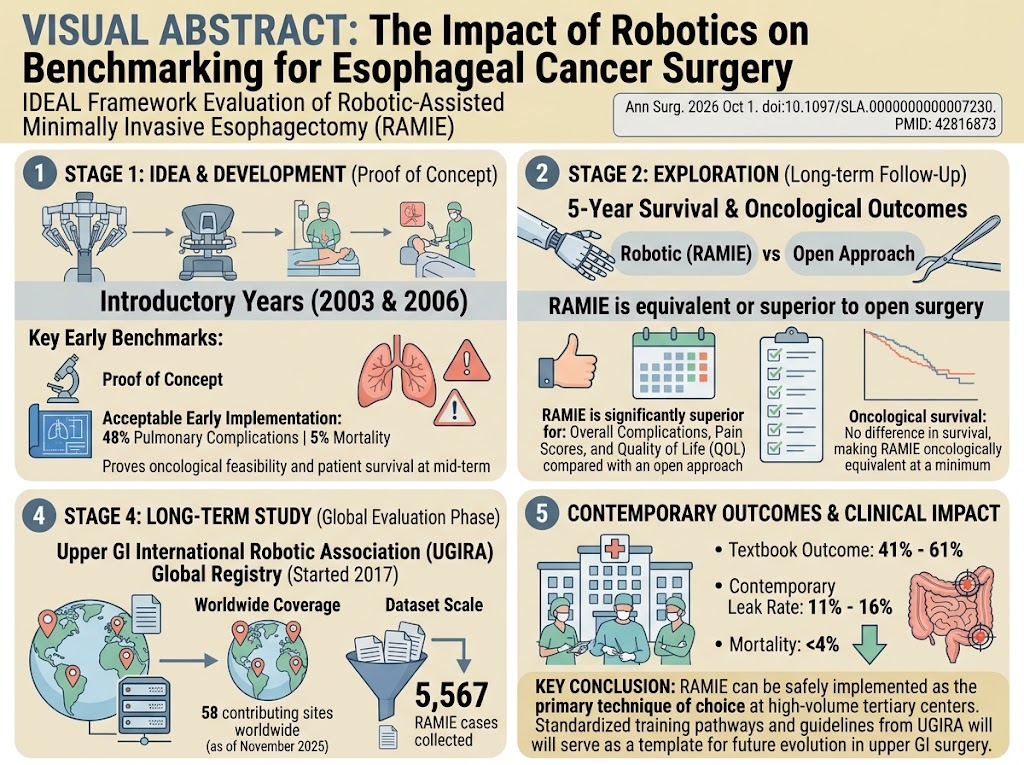
Robotic-assisted minimally invasive esophagectomy (RAMIE) has revolutionized surgical treatment for esophageal cancer, demonstrating improved postoperative outcomes and oncological equivalence compared with open surgery. The IDEAL Framework elucidates the development, evaluation, and adoption of RAMIE, culminating in international registry data from UGIRA that supports standardized training and benchmarking. RAMIE is increasingly the preferred method in Western high-volume centers.
Study Background
Esophageal cancer remains a significant global health burden with high morbidity and mortality. Traditional open esophagectomy, although potentially curative, is associated with high rates of postoperative complications, prolonged recovery, and substantial impact on patient quality of life. Minimally invasive esophagectomy emerged to reduce invasiveness, but robotic assistance offers enhanced precision, dexterity, and visualization. This surgical innovation aims to improve both functional recovery and oncological outcomes, meeting the critical unmet need for safer and more effective treatment strategies.
Study Design and Methodology
The evaluation of RAMIE employed the IDEAL Framework, a systematic five-stage model for assessing surgical innovations: Idea, Development, Exploration, Assessment, and Long-term study. Initial Stage 1 studies introduced RAMIE as a proof of concept. Stage 2 Exploration involved medium-scale studies including oncological follow-up. Stage 3 Assessment included randomized controlled trials such as the ROBOT Trial comparing RAMIE to open esophagectomy. The current Stage 4 Long-term evaluation is supported by the Upper GI International Robotic Association (UGIRA) global registry, which aggregates data across numerous centers worldwide for benchmarking and quality improvement.
Key Findings and Results
Stage 1 Trials (2003 and 2006) demonstrated feasibility of RAMIE with acceptable early outcomes, reporting a 48% pulmonary complication rate and 5% mortality, establishing initial safety benchmarks.
Stage 2 Exploration studies showed promising oncological outcomes, including a 48% five-year survival rate for locally advanced esophageal cancer, indicating oncological viability of RAMIE.
Stage 3 Assessment trials, notably the ROBOT Trial, established RAMIE’s superiority over open surgery in several domains: significantly fewer overall complications, reduced postoperative pain scores, and improved patient quality of life. Importantly, long-term survival was equivalent between RAMIE and open approaches, confirming oncological non-inferiority at minimum.
Stage 4 Long-term evaluation through the UGIRA registry, established in 2017 and encompassing 5567 RAMIE cases from 58 global sites by 2025, further affirmed the safety and efficacy of RAMIE. Contemporary data showed textbook outcome rates between 41% and 61%, anastomotic leak rates ranging from 11% to 16% based on technique, and mortality rates below 4%. These findings reflect safe implementation and growing adoption of RAMIE as a primary surgical approach in specialized tertiary centers.
Expert Commentary
The comprehensive application of the IDEAL Framework to RAMIE exemplifies structured surgical innovation assessment, balancing early enthusiasm with rigorous evaluation and long-term surveillance. The establishment of the UGIRA global registry provides an unprecedented resource for quality control, training standardization, and continuous improvement. While RAMIE showcases clear benefits, challenges remain including the need for widespread training, cost considerations, and access disparities. However, evidence to date supports the integration of robotic technology in esophageal cancer surgery as a new benchmark in optimized patient-centered care.
Conclusion
Robotic-assisted minimally invasive esophagectomy represents a significant advancement in the surgical treatment of esophageal cancer. The method has demonstrated enhanced postoperative recovery profiles, equivalent long-term oncological outcomes, and improved patient quality of life compared to traditional open surgery. The IDEAL Framework-guided pathway alongside the UGIRA global registry ensures continual assessment, facilitating the standardization and safe dissemination of RAMIE. Future research should focus on refining techniques, establishing cost-effectiveness, and expanding access to bolster this promising surgical approach’s impact on global esophageal cancer management.
Funding and Clinical Trials
No specific funding sources were noted in the analyzed study. Clinical trials such as the ROBOT Trial provide critical evidence for RAMIE evaluation protocols.
References
- Krauss DT, van der Sluis PSL, Schiffmann LM, Schlößer HA, Fuchs HF, Ruurda JP, Grimminger PP, van Hillegersberg R, Bruns CJ. The Impact of Robotics on Benchmarking Criteria for the Surgical Treatment of Esophageal Cancer in Western Centers- An Evaluation Using the IDEAL Framework. Ann Surg. 2026 Oct 1. PMID: 42816873.
- Kleibergen B, et al. IDEAL framework: guidelines for surgical innovation evaluation. Surg Innov. 2014;21(4):423-429.
- van der Sluis PC, et al. Robot-assisted minimally invasive esophagectomy versus open transthoracic esophagectomy for resectable esophageal cancer: a randomized controlled trial. Lancet. 2019;393(10174):841-848.
- Upper GI International Robotic Association (UGIRA). Global collaborative registry data. Accessed 2025.