Highlight
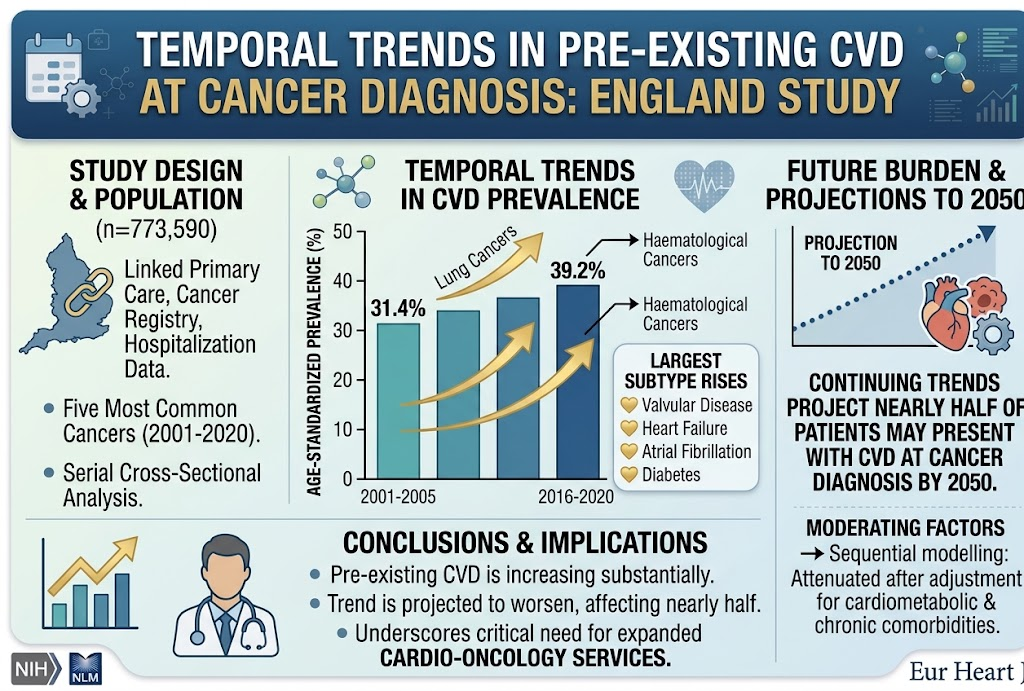
This comprehensive national study from England analyzes temporal trends in the burden of pre-existing cardiovascular disease (CVD) among patients newly diagnosed with the five most common cancers between 2001 and 2020. Findings demonstrate a marked increase in CVD prevalence at cancer diagnosis, rising from 31.4% in 2001-2005 to 39.2% in 2016-2020, with projections estimating nearly 50% of cancer patients will have concurrent CVD by 2050. The greatest increases were noted in lung and hematological cancers, with significant rises in valvular heart disease, heart failure, atrial fibrillation, and diabetes. These trends emphasize the importance of integrating cardio-oncology services to optimize treatment outcomes and survivorship care.
Study Background
Advances in oncology have significantly improved survival rates, consequently increasing the clinical importance of comorbid conditions present at cancer diagnosis. Cardiovascular disease, a leading cause of morbidity and mortality worldwide, frequently coexists with cancer due to shared risk factors such as aging, smoking, obesity, and diabetes mellitus. The presence of pre-existing CVD not only complicates cancer treatment decisions but also adversely affects prognosis and quality of life. Despite recognition of this comorbidity, longitudinal population-level data depicting how the burden of CVD at the time of cancer diagnosis has evolved, and projections for future prevalence remain scarce. Understanding these trends is essential for healthcare planning, resource allocation, and the development of tailored cardio-oncology care pathways.
Study Design
This retrospective, serial cross-sectional study utilized linked datasets, incorporating primary care records, national cancer registry data, and hospital admission records to accurately identify adults aged 18 years and older diagnosed with the five most common cancers in England (likely including breast, lung, colorectal, prostate, and hematological malignancies) over a 20-year period (2001-2020). Key outcomes measured were the annual crude and age-standardized prevalence of pre-existing CVD and related comorbidities at cancer diagnosis. Logistic regression models adjusted for patient demographics and cancer types assessed temporal trends. Sequential modeling parsed contributions of various cardiometabolic and chronic disease factors to the observed trends. Furthermore, demographic-adjusted spline models projected future CVD prevalence among newly diagnosed cancer patients through the year 2050.
Key Findings
The study identified 773,590 adult cancer patients for analysis. The age-standardized prevalence of pre-existing cardiovascular disease rose significantly from 31.4% (95% CI 31.2-31.6) during 2001-2005 to 39.2% (95% CI 39.0-39.4) in 2016-2020. The most pronounced increases occurred in patients diagnosed with lung and hematological cancers. Among cardiovascular subtypes, valvular heart diseases, heart failure, and atrial fibrillation exhibited the largest relative increases during the study period, underscoring the evolving complexities in cardiovascular profiles of cancer patients. Diabetes mellitus, often considered a cardiometabolic comorbidity, also showed marked prevalence rises, illustrating overlaps between metabolic and cardiovascular disease burdens.
Sequential regression analyses demonstrated that adjustments for cardiometabolic conditions (including diabetes, hypertension, and obesity) and other chronic illnesses attenuated—but did not fully eliminate—the upward temporal trend in CVD prevalence. This suggests that increasing cardiometabolic burden significantly drives the rise in cardiovascular disease detected at cancer diagnosis.
Projection modelling, based on ongoing demographic changes and current trend trajectories, estimates that nearly 50% of patients newly diagnosed with cancer in England will have pre-existing cardiovascular disease by 2050. This finding indicates a future healthcare landscape where cardiovascular comorbidity will be commonplace, requiring integrated, multidisciplinary oncology and cardiology care models.
Expert Commentary
The significant rise in cardiovascular disease prevalence among newly diagnosed cancer patients reflects broader epidemiologic shifts including aging populations and growing cardiometabolic risk factor burdens. The findings underscore the clinical challenge of managing dual morbidity, highlighting the need for early cardiovascular risk assessment at cancer diagnosis to guide treatment planning and minimize cardiotoxicity risks.
Cardio-oncology as an emerging subspecialty has a critical role in this context. Multidisciplinary collaboration can facilitate optimization of cancer therapies while mitigating cardiovascular risk, controlling comorbidities, and improving long-term survival and quality of life.
Limitations inherent to observational and registry-based studies apply, such as potential undercoding of some cardiovascular conditions and unmeasured confounding factors. Additionally, while the study adjusted for key variables, causal inference regarding drivers of increased CVD prevalence remains limited. The generalizability beyond England requires contextual evaluation of local healthcare systems and population characteristics.
Conclusion
This large-scale national study from England elucidates a significant and clinically relevant increase in pre-existing cardiovascular disease burden at the time of cancer diagnosis over two decades, with an alarming forecast of nearly half of cancer patients having concomitant CVD by 2050. This emerging epidemiological reality compels urgent expansion and integration of cardio-oncology services to address the complex cardiovascular needs of cancer patients, optimize therapeutic outcomes, and reduce mortality. Policymakers and clinical leaders must prioritize the development of structured screening, risk stratification, and co-management strategies to navigate this dual disease burden effectively.
Funding and Clinical Trials Registry
The original study funding details are not specified within the abstract. Clinical trial registration is not applicable as the study employed retrospective observational and projection methodologies using existing registry data.
References
- Alshahrani AA, Kontopantelis E, Morgan C, Martin GP, Ravindrarajah R, Evison M, Mamas MA. Cardiovascular disease burden at cancer diagnosis: temporal trends in a national study from England. Eur Heart J. 2026 Aug 31; PMID: 42669566.
- Russo C, Saadeh F, Marso SP. Cardiovascular comorbidities in cancer patients: emerging clinical challenges. Curr Cardiol Rep. 2021;23(9):113.
- Armenian SH, Lacchetti C, Lenihan D, et al. Prevention and Monitoring of Cardiac Dysfunction in Survivors of Adult Cancers: ASCO Clinical Practice Guideline. J Clin Oncol. 2017;35(8):893–911.
- Curigliano G, Cardinale D, Suter T, et al. Cardiovascular toxicity induced by chemotherapy, targeted agents and radiotherapy: ESMO Clinical Practice Guidelines. Ann Oncol. 2012 Oct;23 Suppl 7:vii155-66.