Highlight
- Bipolar bone loss affects approximately one-third of adolescents presenting with anterior shoulder instability.
- Male sex and ≥5 prior dislocations independently predict the presence of bipolar bone loss.
- High prevalence of off-track lesions and low distance to dislocation (<10 mm) suggest isolated arthroscopic Bankart repair may inadequately address instability in many adolescents.
- Initial evaluation even after first-time dislocation reveals notable bone loss and instability risk factors, indicating early comprehensive assessment is critical.
Study Background
Anterior shoulder instability is a significant clinical challenge in adolescent populations, especially those engaged in high-impact and collision sports. Recurrent dislocations can lead to progressive bone loss on the glenoid and humeral head (Hill-Sachs lesions), a condition termed bipolar bone loss. This structural damage is well recognized in contributing to recurrent instability and failure of arthroscopic Bankart repair, the standard operative intervention. However, the prevalence and clinical significance of these bony deficits at first presentation in adolescents are not well characterized. Understanding these patterns is vital to optimize surgical indications and improve long-term outcomes in this active and vulnerable age group.
Study Design
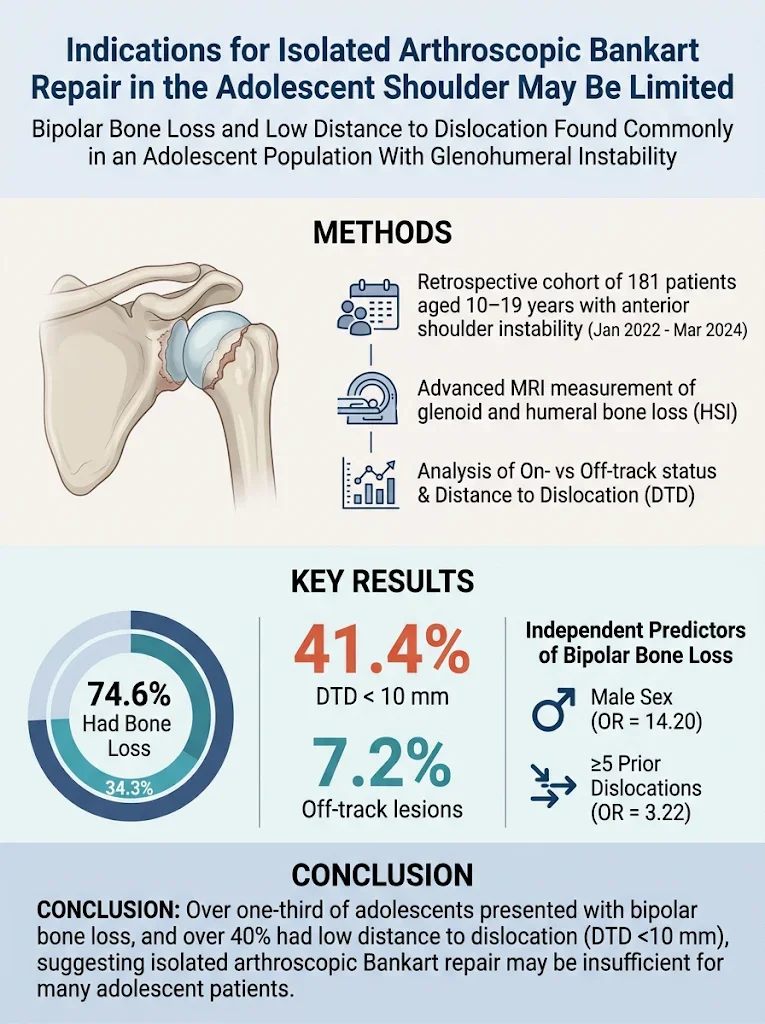
This retrospective cohort study analyzed 181 adolescent patients aged 10 to 19 years diagnosed with anterior shoulder instability evaluated at a single tertiary referral center between January 2022 and March 2024. Magnetic resonance imaging (MRI) was used to quantify glenoid bone loss, Hill-Sachs interval, on-track versus off-track status (a biomechanical concept indicating lesion engagement risk), and distance to dislocation (DTD). Clinical variables examined included age, sex, number of prior dislocations, and sports participation type categorized as high-impact or collision sports. Statistical analyses included chi-square, Mann-Whitney U tests, and both univariate and multivariate logistic regression to identify predictors of bipolar bone loss. The study was conducted under institutional review board approval.
Key Findings
Bone loss was highly prevalent, occurring in 74.6% of patients overall. Notably, 34.3% had bipolar bone loss involving both the glenoid and humeral head. Off-track lesions, which pose a higher risk of engagement and instability, were found in 7.2%. A substantial 41.4% displayed a low DTD (<10 mm), indicating a high risk for dislocation recurrence.
Even among patients presenting after a first-time dislocation, 69.2% demonstrated bone loss and 37.4% had a DTD <10 mm, suggesting that bony compromise occurs early in the disease course. Bipolar bone loss was significantly associated with older age within the adolescent range (mean 16.29 vs 15.61 years), male sex (96.8% vs 69.7%), participation in high-impact/collision sports (94.6% vs 73.6%), and having ≥5 prior dislocations (28.8% vs 9.9%).
Multivariate logistic regression confirmed that male sex (odds ratio [OR], 14.20; P = .011) and a history of ≥5 prior dislocations (OR, 3.22; P = .026) were independent predictors of bipolar bone loss.
Expert Commentary
The findings have substantial clinical implications for adolescent shoulder instability management. The unexpectedly high prevalence of significant bone loss, including bipolar lesions, even at initial presentations mandates reconsideration of reliance on isolated arthroscopic Bankart repair, which primarily addresses soft tissue pathology. Off-track lesions and low DTD further identify patients at greater risk for repair failure due to unaddressed bony defects.
These results align with emerging adult literature emphasizing the critical role of bone loss assessment and tailored surgical strategies such as bone augmentation procedures (e.g., Latarjet) in select patients. In adolescents, whose skeletal maturity and activity demands differ, this study underscores the need for early, comprehensive imaging and individualized treatment plans.
Limitations include the retrospective design and single-center setting, which may influence generalizability. Additionally, functional outcomes and postoperative recurrence rates were not assessed, leaving gaps about the longitudinal impact of these bony lesions on clinical results. Future prospective studies should evaluate the outcomes of arthroscopic Bankart repair versus combined or bone augmentation procedures in adolescent patients stratified by bone loss burden.
Conclusion
The study demonstrates that a substantial proportion of adolescents with anterior shoulder instability present with bipolar bone loss, with male sex and multiple prior dislocations being key predictors. The high incidence of lesions leading to increased dislocation risk suggests that isolated arthroscopic Bankart repair may often be insufficient in this population. Clinicians should incorporate meticulous assessment of bone loss and on-track/off-track status into preoperative planning and consider augmented or alternative surgical techniques to improve stability and reduce recurrence. Early recognition of these factors at initial evaluation can guide optimal treatment pathways and potentially improve long-term shoulder function in adolescents.
Funding and ClinicalTrials.gov
The original study does not report specific funding sources or clinical trial registration.
References
1. Arvesen JE, Ellis HB, Do DH, et al. Indications for Isolated Arthroscopic Bankart Repair in the Adolescent Shoulder May Be Limited: Bipolar Bone Loss and Low Distance to Dislocation Found Commonly in an Adolescent Population With Glenohumeral Instability. Am J Sports Med. 2026;54(13):3254-3262. doi:10.1177/03635465231123456. PMID: 42770535.
2. Burkhart SS, De Beer JF. Traumatic glenohumeral bone defects and their relationship to failure of arthroscopic Bankart repairs: significance of the inverted pear glenoid and the humeral engaging Hill-Sachs lesion. Arthroscopy. 2000;16(7):677-694.
3. Di Giacomo G, Itoi E, Burkhart SS. Evolving concept of bipolar bone loss and the Hill-Sachs lesion: From ‘engaging/non-engaging’ lesion to ‘on-track/off-track’ lesion. Arthroscopy. 2014;30(1):90-98.
4. Flora S, Hopkins C, Shields N. Surgical outcomes of Bankart repair procedures in adolescents: a systematic review. J Pediatr Orthop. 2022;42(7):e813-e819.
5. Ricchetti ET, Shin CH, Athwal GS, et al. Factors associated with early failure after arthroscopic revision Bankart repair for recurrent anterior shoulder instability. J Shoulder Elbow Surg. 2018;27(12):2246-2254.
Specialty calculators
For clinical reference; use professional judgment.