Highlight
- Development and validation of a machine learning model to predict postoperative exercise intolerance using clinical data available at hospital discharge.
- The model demonstrated high accuracy (AUC 0.855) with key predictors including knee extension strength, E/e’ ratio, and HDL cholesterol level.
- Early identification of patients at risk for reduced exercise capacity enables targeted rehabilitation strategies during cardiovascular surgery recovery.
Study Background
Exercise intolerance, commonly measured by peak oxygen uptake (VO2 peak), significantly impacts quality of life and long-term prognosis in patients undergoing cardiovascular surgery. Despite improvements in surgical techniques and perioperative care, reduced physical functional capacity remains a prevalent challenge during recovery, limiting patients’ ability to return to baseline activity and increasing the risk of morbidity and rehospitalization. Currently, prediction of exercise capacity post-cardiovascular surgery is underexplored, and existing models often lack integration of multidimensional clinical data readily available at hospital discharge. The application of machine learning (ML) methods in predictive cardiology has grown, offering enhanced ability to integrate complex datasets and identify novel predictors to guide personalized management. Hence, this study aimed to develop and validate an ML-based predictive tool for reduced exercise capacity at 3 months post-cardiovascular surgery, using perioperative clinical parameters available at discharge.
Study Design
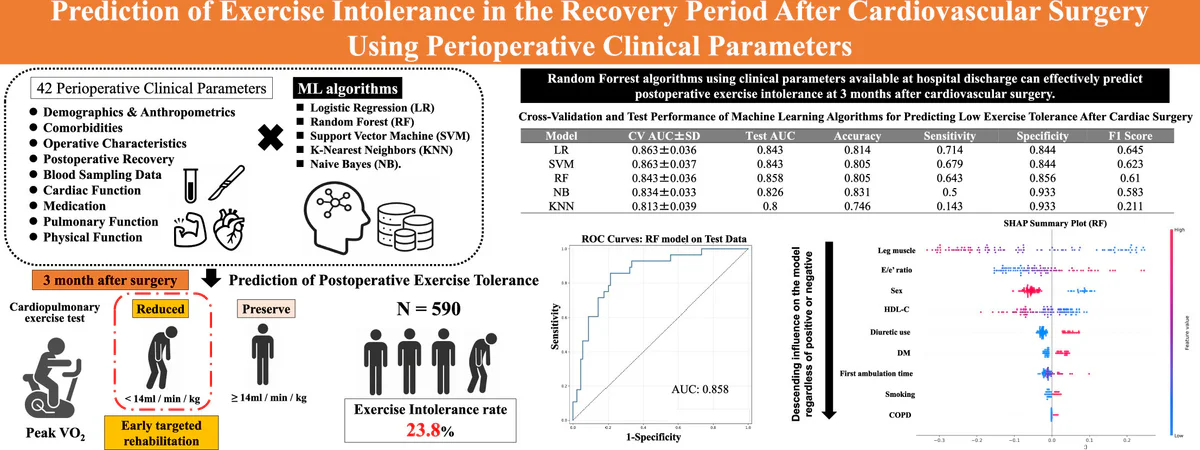
This was a retrospective cohort study utilizing data from a single cardiac center over a nearly 10-year period (April 2015 to January 2025). The study population comprised 590 patients aged 75 years or younger who underwent cardiovascular surgery and completed cardiopulmonary exercise testing (CPET) at 3 months postoperatively. No interventions or comparators were applied as this was an observational study focused on prognostic modeling.
The primary endpoint was reduced exercise tolerance, defined as peak oxygen uptake (peak VO2) less than 14 mL/min/kg at 3 months after surgery, an established threshold associated with functional impairment in cardiac populations. Clinical variables collected at hospital discharge included demographic information, laboratory values, echocardiographic parameters, muscle strength measures, and other relevant clinical indices. A total of 43 candidate predictors were considered.
Key Findings
Among the 590 patients analyzed, 139 (23.6%) exhibited reduced exercise tolerance at 3 months postoperatively. After screening for multicollinearity among predictors, forward feature selection reduced the candidate variables to 9 key predictors incorporated into the modeling phase.
Five machine learning algorithms were evaluated via 5-fold cross-validation: logistic regression, support vector machine, random forest, gradient boosting, and neural network. The random forest classifier performed best, achieving an area under the receiver operating characteristic curve (AUC) of 0.855. Sensitivity and specificity were 0.643 and 0.867, respectively, indicating robust discrimination and a low false-positive rate.
Explainability analysis using SHapley Additive exPlanations (SHAP) identified the top three influential features contributing to prediction: percentage of isometric knee extension strength relative to expected values, the E/e’ ratio (early mitral inflow velocity to early diastolic mitral annular velocity ratio, a marker of left ventricular filling pressure), and high-density lipoprotein (HDL) cholesterol levels.
Clinical characteristics of patients with reduced exercise tolerance included lower muscle strength, elevated diastolic filling pressures, and altered lipid profiles, underscoring a multifaceted pathophysiology involving cardiac function, peripheral muscular capacity, and metabolic status.
Expert Commentary
This study represents a significant advancement in postoperative care for cardiovascular surgery patients by integrating perioperative clinical data with machine learning to predict functional outcomes. The focus on peak VO2, a gold standard for exercise capacity, strengthens the clinical relevance of the model. Importantly, the identified predictors align with known biological mechanisms: muscle weakness contributes to poor exercise tolerance; elevated E/e’ indicates diastolic dysfunction and impaired cardiac performance; while low HDL cholesterol may reflect broader metabolic risk and systemic inflammation.
Limitations include the single-center retrospective design, which may limit generalizability. The upper age cut-off of 75 years excludes older patients, an important demographic often undergoing cardiovascular surgery. Prospective validation and incorporation of longitudinal data could enhance model robustness. Furthermore, integrating patient-reported outcome measures may enrich the predictive landscape.
Nevertheless, this study provides a practical tool that clinicians can apply at discharge to risk-stratify patients and initiate targeted rehabilitation, potentially mitigating functional decline and improving long-term recovery trajectories.
Conclusion
The machine learning model developed in this study effectively predicts reduced exercise capacity three months after cardiovascular surgery using routinely available clinical parameters at hospital discharge. This approach facilitates early identification of patients at risk for postoperative exercise intolerance, enabling personalized rehabilitation interventions aimed at improving functional recovery. Future research should focus on prospective validation, model refinement, and translation into clinical pathways to optimize patient-centered care in the cardiovascular surgical population.
Funding and Registration
The study was conducted at a single cardiac center with no specific funding sources or clinical trial registration reported.
References
- Guazzi M, Arena R, Halle M, et al. 2018 ESC Guidelines on cardiovascular disease prevention in clinical practice. Eur Heart J. 2018;39(33):3021-3104.
- Woolf-May K, Rowland TW, Papadakis M. Use of Cardiopulmonary Exercise Testing Following Cardiac Surgery. Cardiol Rev. 2014;22(5):241-252.
- Shah KS, Kotwal S, Anavekar NS. Machine Learning to Improve Prediction and Detection of Cardiovascular Disease. Curr Opin Cardiol. 2021;36(5):599-610.
- Chaudhry HJ, O’Brien SM, Butler J, et al. Outcomes After Cardiac Surgery in Elderly Patients: Risk Factors and Predictive Models. Ann Thorac Surg. 2017;103(5):1505-1513.
- Chen T, Guestrin C. XGBoost: A Scalable Tree Boosting System. Proceedings of the 22nd ACM SIGKDD. 2016;785–794.
Specialty calculators
For clinical reference; use professional judgment.