Highlight
- Menopausal hormone therapy (MHT) is the most effective treatment for vasomotor and estrogen deficiency symptoms, yet concerns about long-term safety have impacted its clinical use.
- The “timing hypothesis” highlights that MHT’s cardiovascular benefit-risk profile depends critically on age and time since menopause at initiation.
- Differences in estrogen formulations, progestogen types, and administration routes influence safety outcomes, including risks of breast cancer and venous thromboembolism (VTE).
- Current evidence supports an individualized MHT approach, favoring initiation before age 60 or within 10 years of menopause for optimal safety and efficacy.
Study Background
Menopause represents a physiological decline in endogenous estrogen production, leading to a constellation of symptoms such as vasomotor instability (hot flashes, night sweats), urogenital atrophy, and other systemic estrogen deficiency manifestations. Menopausal hormone therapy (MHT) has been the mainstay treatment to alleviate these symptoms and improve quality of life. Despite its clinical efficacy, the long-term safety of MHT has been a subject of ongoing evaluation and debate, particularly concerning breast cancer, venous thromboembolism (VTE), and cardiovascular disease risks. Early observational studies and subsequent landmark trials have shaped evolving clinical guidelines, which continue to balance symptomatic benefit against potential risks.
Evolution of Evidence: From Historical Use to Landmark Trials
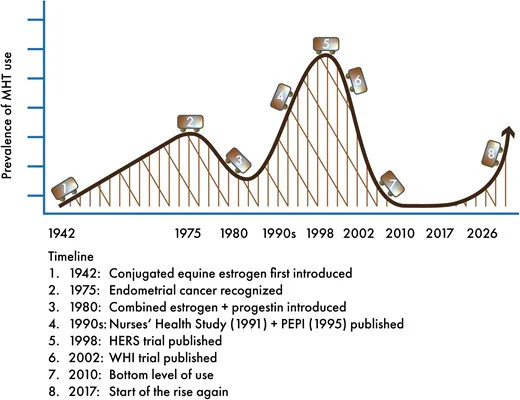
Estrogen therapy using conjugated equine estrogens originated in the 1940s. Early concerns were predominantly related to endometrial hyperplasia and cancer with unopposed estrogen use, which were effectively addressed by introducing progestogen co-therapy for women with an intact uterus to provide endometrial protection.
The Women’s Health Initiative (WHI) randomized controlled trials in the early 2000s markedly influenced perceptions of MHT safety, initially reporting increased risks of breast cancer, coronary heart disease, stroke, and VTE with combined estrogen-progestin therapy in older postmenopausal women. These findings led to a sharp decline in MHT prescriptions worldwide.
Key Findings: The Timing Hypothesis and Formulation-Specific Safety
Subsequent nuanced analyses of the WHI data, along with other observational and clinical studies, formulated the “timing hypothesis.” This posits that initiating MHT closer to menopause onset (typically before age 60 or within 10 years post-menopause) yields a more favorable benefit-risk profile, particularly regarding cardiovascular outcomes. Younger women tend to have less atherosclerotic burden, making estrogen’s vascular effects more protective than harmful.
Emerging evidence also highlights important safety differences between estrogen formulations and administration routes. Transdermal estradiol, bypassing first-pass hepatic metabolism, confers a lower risk of VTE relative to oral estrogen therapy which alters hepatic synthesis of coagulation factors. Additionally, progestogen type impacts breast safety: micronized progesterone and dydrogesterone show trends for a more favorable breast cancer risk profile compared with some synthetic progestins like medroxyprogesterone acetate; however, definitive randomized clinical trial data are still lacking.
Clinical Implications and Individualized Treatment Approach
Considering the evidence, clinical guidelines now emphasize a personalized MHT approach, weighing symptom severity, age, timing from menopause, and individual risk factors (e.g., personal and family history of breast cancer, thromboembolic events, cardiovascular disease).
For healthy women under 60 or within 10 years of menopause, MHT is generally safe and well-tolerated, with benefits often outweighing risks. Current recommendations encourage the use of the lowest effective dose for symptom control and consider transdermal estradiol coupled with micronized progesterone when appropriate to optimize safety. Continuous re-evaluation of patient risk factors and symptomatology is essential throughout therapy.
Expert Commentary
Leading endocrinology and gynecology experts agree that the paradigm of MHT safety has shifted toward more nuanced and individualized risk-benefit assessments. The WHI trial’s initial broad conclusions have been refined by subgroup analyses and newer research addressing hormone formulations and delivery methods. While randomized comparative data on different progestogens remain scarce, observational data guide safer prescribing choices. Further research is needed to delineate optimal MHT regimens, particularly for breast cancer risk modulation.
Conclusion
Menopausal hormone therapy remains the gold standard for managing menopausal symptoms related to estrogen deficiency. Its safety profile has evolved significantly with improved understanding of timing, formulations, and patient-specific factors. Initiation before 60 years of age or within 10 years post-menopause provides a favorable benefit-risk ratio, especially when utilizing transdermal estrogens and safer progestogens. Continued research focusing on formulation-specific safety and personalized approaches will enhance MHT’s clinical utility and patient outcomes.
References
- Hirschberg AL. Reappraising the safety of menopausal hormone therapy for women-implications for the clinic. J Clin Endocrinol Metab. 2026 Oct 23; PMID: 42924623.
- Hersh AL, et al. Duration of estrogen plus progestin use and risk of breast cancer in postmenopausal women. JAMA. 2004.
- Manson JE, et al. Menopausal hormone therapy and health outcomes during the intervention and extended poststopping phases of the Women’s Health Initiative randomized trials. JAMA. 2013.
- Beral V, et al. Breast cancer and hormone-replacement therapy in the Million Women Study. Lancet. 2003.
- Keech AC, et al. Oral versus transdermal hormone replacement therapy: effects on insulin sensitivity and coagulation markers. Clin Endocrinol (Oxf). 2000.
- Stute P, et al. Progestogens and breast cancer risk: A review. Climacteric. 2020.
- North American Menopause Society (NAMS) Guidelines for MHT use. Menopause. 2022.