Emma, a 58-year-old woman, has been struggling with a persistent cough for nearly seven years. Despite trying multiple treatments, her cough remains a constant disruptor of daily life. Chronic cough affects millions worldwide and can severely impact quality of life. Yet, defining what constitutes successful treatment has been a complex challenge for clinicians and patients alike. Traditional measures often focus on whether patients respond to treatment but may not capture if the cough is truly “controlled” to a level that patients feel comfortable without the need for further treatment.
Understanding Treatment Response versus Cough Control
Historically, clinical trials and therapies for refractory chronic cough (RCC)—where cough persists despite standard treatment—have used minimally important differences (MIDs) to define treatment success. MIDs mark the smallest change in symptoms that patients perceive as meaningful. However, these thresholds don’t clarify if the cough is under sufficient control. To put it simply, a patient may notice some improvement (responders) but still suffer from significant cough that disrupts their daily activities.
The question remains: how do clinicians and researchers define *cough control*—a benchmark reflecting patient-perceived sufficiency and actual relief from the cough burden?
The PROCOUGH Study: A Patient-Anchored Approach
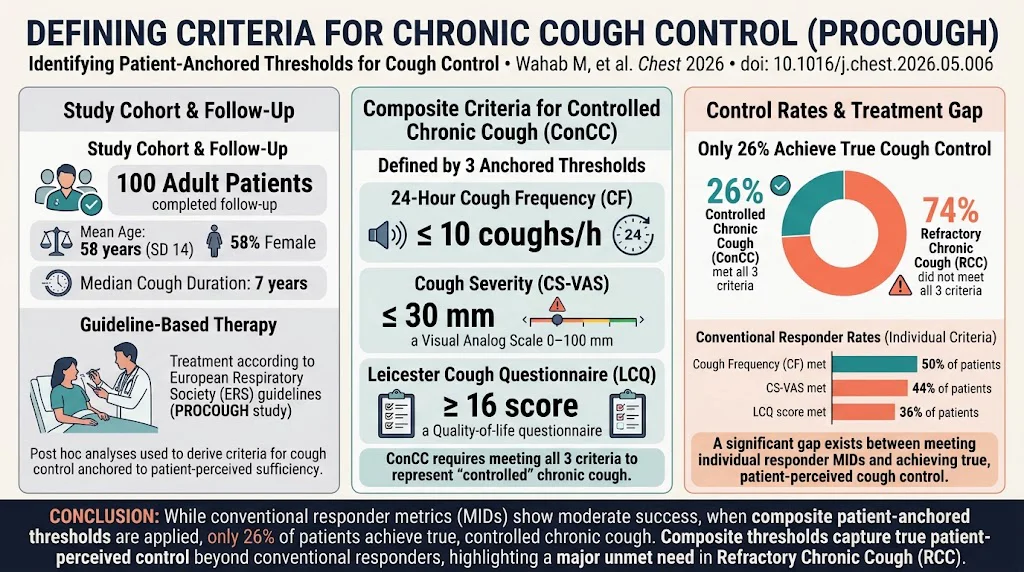
This question was addressed by a team led by Wahab et al. through a post hoc analysis within the PROCOUGH study, a prospective observational cohort conducted at McMaster University. One hundred patients with chronic cough were treated following European Respiratory Society guidelines, and their progress was carefully tracked using multiple objective and subjective measures.
The team focused on defining cough control using thresholds based on how patients reported their overall improvement:
– Objective 24-hour cough frequency (CF)
– Subjective cough severity measured by a visual analog scale (CS-VAS)
– Patient quality of life related to cough, assessed by the Leicester Cough Questionnaire (LCQ)
They anchored these criteria to patients’ answers about whether their cough was ‘‘sufficiently controlled’’ and whether they believed no further treatment was necessary.
Key Findings: New Criteria for Cough Control
The analysis revealed specific thresholds indicating cough control:
– 24-hour cough frequency of 10 or fewer coughs per hour
– CS-VAS score of 30 mm or less (on a 0-to-100 mm scale, where higher means worse severity)
– LCQ score of 16 or more (higher scores indicate better quality of life)
Only 26% of the patients met all three criteria for controlled chronic cough (ConCC) after treatment, while the remaining 74% were classified as having RCC—a persistence of troublesome cough symptoms despite therapy.
When looking at patient-reported outcomes alone (CS-VAS and LCQ), about 32% met the criteria for cough control. Individually, 36% met criteria on the LCQ, 44% on CS-VAS, and 50% on cough frequency.
Interpreting the Gap Between Individual and Composite Criteria
This disparity between the number of patients meeting individual criteria versus all three composite measures illustrates a critical issue: cough control is multifaceted, involving both the frequency of coughing and the patient’s subjective experience of severity and quality of life.
Emma’s story mirrors this complexity. While she saw some improvement in her cough frequency, she continues to experience episodes that cause discomfort and disrupt her activities—showing that partial improvement does not always equate to control.
Clinical Implications and the Need for Advancement
This patient-anchored definition of cough control serves as a valuable new benchmark for evaluating treatment effectiveness beyond traditional “responder” labels. Clinicians can use these thresholds to set realistic treatment goals and better communicate with patients about expected outcomes.
Moreover, the findings emphasize a pressing need for innovative therapies that can help a greater proportion of patients achieve meaningful cough relief and improve life quality. For researchers, incorporating such composite, patient-anchored criteria into clinical trials could refine how new treatments are assessed and approved.
Expert Insights
Dr. Imran Satia, lead author of the study, emphasized: “Our findings highlight the importance of looking beyond just symptom reduction and focusing on patient-perceived control of cough. This shift can better guide therapy decisions and future drug development.”
Conclusion
Chronic cough remains a stubborn and burdensome condition for many patients. This new research redefines successful treatment by incorporating patient-centered measures that reflect real-world control, not just improvement. Only one in four patients currently reach this benchmark with guideline-based therapy, signaling an urgent need to refine therapeutic strategies and outcomes assessment in refractory chronic cough.
For Emma and countless others, this represents hope for clearer goals and better relief in the future.
Funding and Clinical Trial Registration
The PROCOUGH study was conducted under the support of McMaster University and registered at ClinicalTrials.gov (NCT04758351).
References
1. Wahab M, Kum E, Diab N, et al. Moving Beyond Responders: A Post Hoc Analysis Identifying Criteria for Chronic Cough Control. Chest. 2026 May 14;170(4):1152-1163. PMID: 42140485. https://pubmed.ncbi.nlm.nih.gov/42140485/
2. European Respiratory Society Guidelines for the Diagnosis and Treatment of Chronic Cough. Eur Respir J. 2020;55(2):1900531.
3. Morice AH, Millqvist E, Bieksiene K, et al. ERS guidelines on the diagnosis and treatment of chronic cough in adults and children. Eur Respir J. 2020;55(1):1901136.

 By
No Comments