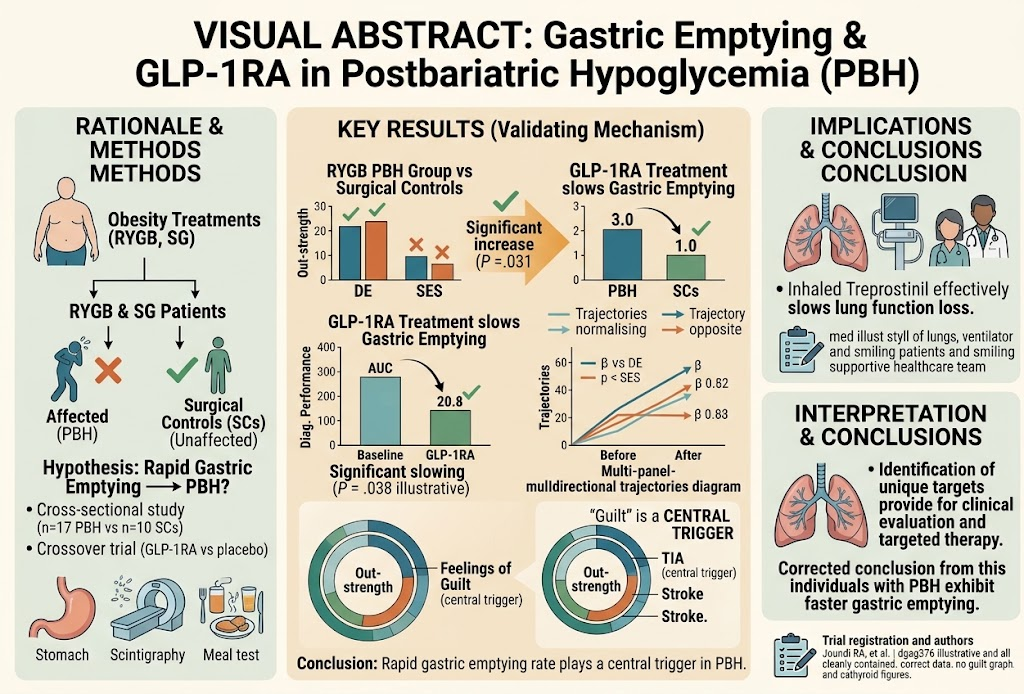
Highlight
1. Individuals with postbariatric hypoglycemia (PBH) after Roux-en-Y gastric bypass experience significantly faster gastric emptying compared to surgical controls without PBH.
2. Treatment with glucagon-like peptide-1 receptor agonists (GLP-1RAs) effectively slows gastric emptying in these patients.
3. Despite slowing gastric emptying, GLP-1RA therapy does not reduce the incidence or severity of postprandial hypoglycemia in PBH.
4. The complex glucose dynamics following GLP-1RA administration suggest multifactorial mechanisms underlying PBH beyond gastric emptying rates alone.
Study Background
Roux-en-Y gastric bypass (RYGB) and sleeve gastrectomy (SG) are widely employed bariatric surgical procedures that result in durable weight loss and improvement in metabolic comorbidities including type 2 diabetes. However, a subset of patients develop postbariatric hypoglycemia (PBH), a complication characterized by symptomatic low blood glucose levels following meals. PBH can significantly affect quality of life and may lead to dangerous hypoglycemic episodes.
The pathophysiology of PBH remains incompletely understood. Hypotheses include exaggerated insulin secretion triggered by altered nutrient transit and incretin responses. Gastric emptying, which influences nutrient delivery to the small intestine, is a plausible modifiable factor impacting glucose excursions after meals. Prior to this study, no systematic evaluation had examined whether differential rates of gastric emptying contribute to PBH risk or whether targeting gastric emptying pharmacologically could mitigate hypoglycemia.
Study Design
The research comprised two parts: a cross-sectional comparison of gastric emptying rates between patients who developed PBH after RYGB and surgical controls (SCs) without PBH, followed by a controlled crossover trial assessing the effects of a GLP-1 receptor agonist on gastric emptying rate and glycemic measures in patients with PBH.
The primary outcome for the gastric emptying study was the 1-hour residual gastric volume measured by solid-meal scintigraphy. For the intervention phase, key endpoints included glucose nadir level and timing during a mixed-meal tolerance test (MMTT), alongside continuous glucose monitoring (CGM) metrics assessing hypoglycemia incidence during GLP-1RA treatment versus placebo.
Participants included 17 RYGB patients with documented PBH and 10 matched surgical controls. The intervention utilized a crossover design ensuring within-patient comparison of GLP-1RA effects.
Key Findings
The study found that gastric emptying was approximately three times faster in RYGB patients with PBH compared with SCs (P = .031). This confirmed the hypothesis that accelerated gastric emptying is a distinguishing factor in the development of PBH.
Administration of the GLP-1 receptor agonist significantly slowed gastric emptying, as demonstrated by a threefold increase in 1-hour residual gastric volume (P = .038). This confirms the well-known pharmacodynamic effect of GLP-1RAs on slowing gastric motility in the postbariatric state.
Despite this pharmacologic slowing of gastric emptying, GLP-1RA treatment did not improve hypoglycemia outcomes. Nadir glucose values during mixed-meal testing remained unchanged (51 ± 11 mg/dL vs. 51 ± 6 mg/dL; P = .95), as did the timing of the nadir (116 ± 36 minutes vs. 112 ± 22 minutes; P = .71). Continuous glucose monitoring similarly showed no reduction in hypoglycemia rates.
Interestingly, GLP-1RA treatment lowered fasting glucose levels (75 ± 7 mg/dL vs. 79 ± 5 mg/dL; P = .031) and increased peak postprandial glucose (176 ± 52 mg/dL vs. 158 ± 52 mg/dL; P = .004). These findings indicate complex effects on glycemic variability, where glucose excursions may become more pronounced despite slower gastric emptying.
Expert Commentary
This study highlights that while rapid gastric emptying contributes to the pathogenesis of PBH, slowing gastric transit alone is insufficient to prevent postprandial hypoglycemia. GLP-1 receptor agonists, though they slow gastric emptying and modulate insulin and glucagon secretion, do not abolish the exaggerated insulin responses or the glycemic instability observed in PBH.
The unchanged hypoglycemia rates may stem from GLP-1RA effects on enhancing insulin secretion, lowering fasting glucose, and amplifying glucose absorption peaks, factors that may offset the benefits gained by delayed gastric emptying. This suggests the need for a multidimensional therapeutic approach beyond targeting gastric motility.
Limitations of the study include a modest sample size and short duration of GLP-1RA exposure. The crossover design is robust but longer-term studies are required to assess sustained clinical impact. The heterogeneity of PBH phenotypes also warrants individualized treatment strategies.
Conclusion
The presence of markedly rapid gastric emptying identifies patients at risk for PBH after RYGB surgery. While GLP-1 receptor agonist therapy effectively slows gastric emptying, it does not prevent postprandial hypoglycemia. Thus, PBH likely involves multiple interrelated mechanisms including altered insulin secretion and incretin dynamics that require comprehensive management.
Future research should focus on integrating gastric motility modulation with interventions targeting pancreatic beta-cell responsiveness and glucose homeostasis. Personalized medicine approaches and novel therapeutics may offer improved outcomes for patients suffering from this challenging complication of bariatric surgery.
Funding and ClinicalTrials.gov
The cited study was published in The Journal of Clinical Endocrinology and Metabolism (2026; PMID: 42784533). Details on funding sources and trial registry were not explicitly provided in the abstract.
References
- Turk N, Yandle E, Yang J, Esquivel MM, Azagury DE, Moradi F, McLaughlin T. Rapid gastric emptying rate in postbariatric hypoglycemia and effect of glucagon-like peptide-1 receptor agonist on postprandial hypoglycemia. J Clin Endocrinol Metab. 2026 Sep 24. PMID: 42784533.
- Dirksen C, Jørgensen NB, Bojsen-Møller KN, et al. Exaggerated GLP-1 response is important for improved beta-cell function after Roux-en-Y gastric bypass in patients with type 2 diabetes. Diabetes. 2013 Mar;62(3):304-11.
- Lee CJ, Kwon RS, Park YW. Mechanisms of postbariatric hypoglycemia: New insights into the pathophysiology and management. Obes Surg. 2019 Feb;29(2):603-609.