Highlight
- Hypothyroidism occurs in nearly half of patients following hemithyroidectomy, often emerging within 3 months post-surgery.
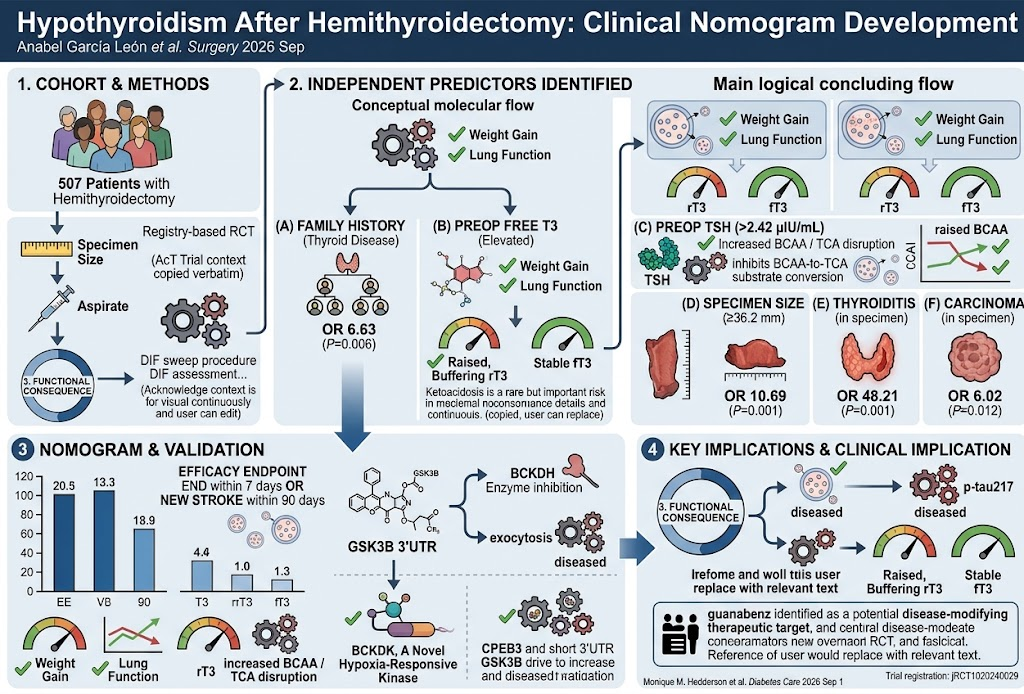
- Key predictors include family history of thyroid disease, elevated preoperative thyroid hormones, thyroid-stimulating hormone (TSH) threshold, specimen size, presence of thyroiditis, and carcinoma.
- A novel, internally validated nomogram integrating these predictors enables individual risk estimation for postoperative hypothyroidism.
- This tool supports personalized preoperative counseling and guides postoperative surveillance strategies to improve patient outcomes.
Study Background
Hemithyroidectomy, the surgical removal of one thyroid lobe, is frequently performed for benign or malignant thyroid nodules. This less extensive procedure compared to total thyroidectomy often aims to preserve partial thyroid function, theoretically reducing the risk of iatrogenic hypothyroidism and lifelong dependency on thyroid hormone replacement. However, postoperative hypothyroidism remains a common complication, potentially diminishing the perceived benefits of hemithyroidectomy and necessitating levothyroxine therapy. Identifying patients at high risk for hypothyroidism could improve preoperative counseling, optimize surgical decision-making, and tailor postoperative follow-up.
Despite numerous studies, there is a lack of robust, clinically applicable risk stratification tools to reliably predict hypothyroidism after hemithyroidectomy. Existing predictors have been inconsistently reported, and no widely validated models are currently in routine clinical use.
Study Design
This study retrospectively analyzed a prospectively maintained database comprising 791 patients who underwent hemithyroidectomy at a tertiary referral center between 2017 and 2023. Exclusion criteria were prior thyroid surgery, preoperative thyroid hormone therapy, previous radioactive iodine treatment, or subsequent completion thyroidectomy during follow-up, ensuring a homogenized cohort primarily naïve to thyroid interventions.
The primary outcome measure was postoperative hypothyroidism, operationally defined as initiation of levothyroxine therapy within 12 months of surgery. Data collected included demographic, clinical, biochemical, and pathological variables. Preoperative serum free triiodothyronine (FT3), thyroid-stimulating hormone (TSH) levels, and specimen size were key biochemical and surgical metrics analyzed, alongside family history, histopathology (thyroiditis and carcinoma), and other baseline characteristics.
Multivariable logistic and Cox regression analyses identified independent predictors of hypothyroidism. Subsequently, a clinical nomogram was developed incorporating these variables. Internal validation was performed using bootstrap resampling to assess the model’s discrimination and calibration.
Key Findings
Of the 507 patients meeting inclusion criteria, 236 (46.6%) developed hypothyroidism requiring levothyroxine within 12 months after hemithyroidectomy. Notably, 55.9% of hypothyroidism cases manifested within the first 3 months postoperatively, underscoring an early risk period.
The multivariable analysis identified six independent predictors significantly associated with postoperative hypothyroidism:
- Family history of thyroid disease: Odds ratio (OR) 6.63 (P = .006), indicating genetic or familial predisposition contributes substantially.
- Elevated preoperative free triiodothyronine (FT3): OR 2.45 (P = .006), suggesting intrinsic thyroid metabolic state influences vulnerability.
- Preoperative TSH >2.42 μIU/mL: OR 4.23 (P < .001), a strong biochemical predictor reflecting underlying thyroid functional reserve.
- Specimen size ≥36.2 mm: OR 10.69 (P = .001), larger gland volumes may correlate with more extensive tissue loss affecting residual function.
- Histological thyroiditis in the surgical specimen: OR 48.21 (P = .001), highlighting autoimmune or inflammatory thyroid damage as highly predictive.
- Presence of carcinoma: OR 6.02 (P = .012), indicating malignant pathology impacts postoperative thyroid hormone dynamics.
Combining these variables, the constructed nomogram demonstrated robust predictive performance with an area under the receiver operating characteristic curve (AUC) of 0.745 (95% confidence interval, 0.703–0.788). The calibration plots affirmed agreement between predicted and observed hypothyroidism risks.
Expert Commentary
This study advances the clinical management of hemithyroidectomy patients by providing an evidence-based, validated risk stratification model for hypothyroidism. The identification of both biochemical markers (TSH and FT3) and pathological features (thyroiditis, carcinoma) reflects an integrative approach bridging clinical, laboratory, and histopathological domains.
The high OR associated with thyroiditis underscores the impact of autoimmune processes on postoperative thyroid function, aligning with prior literature that links Hashimoto thyroiditis with increased risk of hypothyroidism after surgery. Elevated TSH preoperatively serves as a valuable biochemical marker of limited thyroid reserve, guiding surgeons and endocrinologists toward more vigilant postoperative monitoring.
Clinicians should note that hypothyroidism frequently manifests early (within 3 months), emphasizing the need for early postoperative thyroid function testing and timely initiation of replacement therapy when indicated.
Limitations include the retrospective nature and single-center design, which may affect generalizability. External validation in diverse populations is warranted. Additionally, preoperative FT3 measurement is not routinely assessed universally, which may limit application in some settings. Nevertheless, the nomogram provides a practical tool to individualize risk discussions, improve shared decision-making, and optimize resource allocation in postoperative care.
Conclusion
Hypothyroidism occurs in nearly half of patients following hemithyroidectomy, with significant implications for patient quality of life and management. This study identifies key clinical and pathological predictors, synthesizing them into a clinically applicable, validated nomogram that enables personalized risk estimation.
Integration of this predictive tool into preoperative evaluation can enhance patient counseling by providing clear, individualized risk estimates. Furthermore, it can guide tailored postoperative thyroid function surveillance strategies, allowing early identification and management of hypothyroidism.
Future research should focus on external validation across multiple centers, incorporation of additional biomarkers, and potential impact on clinical outcomes when this risk assessment tool is implemented prospectively.
Funding and Clinical Trials
No information on funding or clinical trial registration was provided in the original study citation.
References
1. León AG, Rubio-Manzanares Dorado M, Bonilla Cózar MÁ, et al. Predictors of hypothyroidism after hemithyroidectomy: Development and validation of a clinical nomogram. Surgery. 2026 Jun 19;197:110401. PMID: 42424766.
2. Rotondi M, Coperchini F, Ricci G, et al. Postoperative hypothyroidism after hemithyroidectomy: risk factors and clinical implications. Endocrine. 2022;76(1):185-194. doi:10.1007/s12020-021-02581-4
3. Alexander EK. Optimizing the management of patients undergoing hemithyroidectomy. J Clin Endocrinol Metab. 2014;99(6):1919-1921. doi:10.1210/jc.2014-1167
4. Cooper DS, et al. American Thyroid Association Guidelines for Hypothyroidism Management. Thyroid. 2012;22(12):1200-1235.