Highlight
- Physiological concentration platelet fibrin plasma (PFP) demonstrates comparable wound healing effectiveness to higher concentration platelet-rich plasma (PRP) in diabetic wounds.
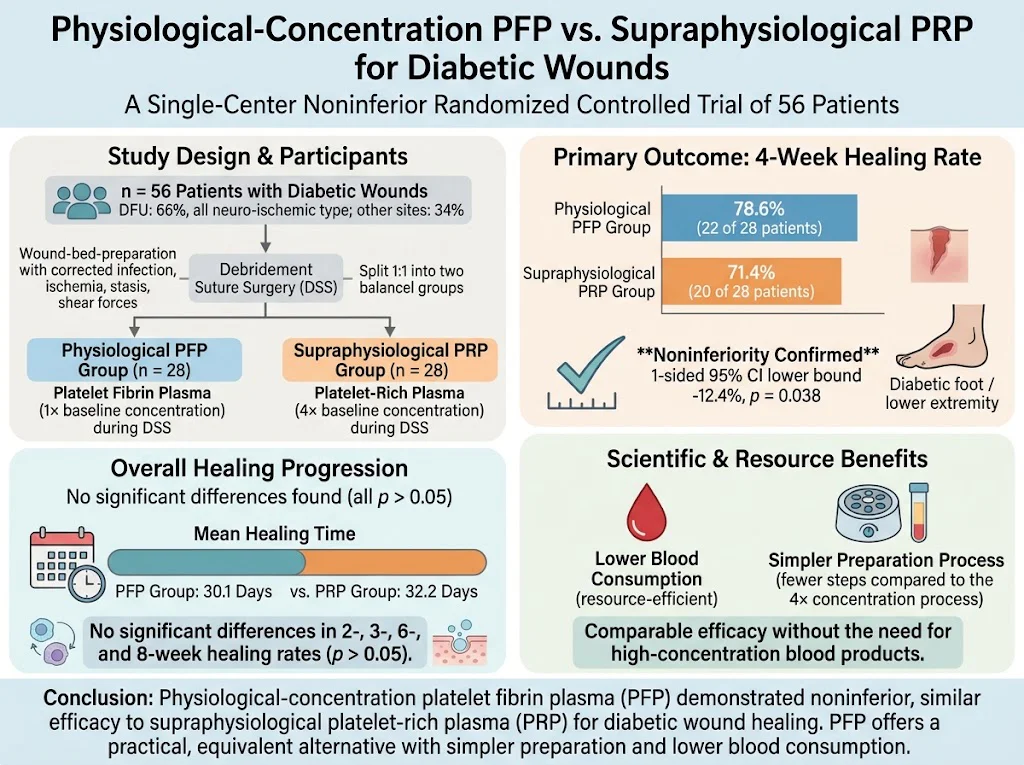
- A 4-week healing rate noninferiority was established between PFP (78.6%) and PRP (71.4%) in neuro-ischemic diabetic foot ulcers and other diabetic wounds.
- PFP offers practical advantages including simpler preparation and significantly reduced blood volume requirements, beneficial in clinical wound management.
Study Background
Diabetic foot ulcers (DFUs), particularly those complicated by neuro-ischemia, pose a significant clinical challenge due to their chronicity and susceptibility to poor healing. Current therapies aimed at enhancing wound repair include platelet concentrate applications, primarily platelet-rich plasma (PRP) at supraphysiological platelet concentrations, which are thought to promote tissue regeneration through growth factor release. However, preparation of PRP requires substantial blood volumes and complex processing, limiting practical clinical use. Whether platelet products at physiological concentrations, such as platelet fibrin plasma (PFP), can provide equivalent therapeutic benefit remains uncertain. This question holds importance given the global burden of diabetic wounds, high morbidity, and healthcare resource implications associated with their management.Study Design
This investigation was a single-center, noninferiority, randomized controlled trial designed to compare physiological concentration platelet fibrin plasma (PFP, 1× baseline) with supraphysiological concentration platelet-rich plasma (PRP, 4× baseline) in diabetic wound healing. Eligible patients had diabetic wounds, predominantly neuro-ischemic diabetic foot ulcers, or wounds at other anatomical sites. Prior to intervention, wounds underwent standardized wound-bed preparation addressing infection, ischemia, stasis, and mechanical shear forces. Patients were randomized to receive PFP or PRP application during debridement suture surgery (DSS). The primary efficacy endpoint was the wound healing rate at 4 weeks, with secondary time points at 2, 3, 6, and 8 weeks, plus mean healing time. Subgroup analysis stratified outcomes by ulcer location.Key Findings
The trial enrolled 56 patients (66% neuro-ischemic diabetic foot ulcers, 34% other diabetic wounds) with balanced baseline characteristics between groups (65.5% vs. 64.3% DFU, P = .922). The primary outcome demonstrated noninferiority of physiological PFP compared to supraphysiological PRP with a 4-week healing rate of 78.6% versus 71.4%, respectively (1-sided 95% confidence interval lower bound -12.4%, P = .038). Secondary endpoints including healing rates at 2, 3, 6, and 8 weeks and mean healing time (30.1 days for PFP vs. 32.2 days for PRP, P > .05) did not reveal statistically significant differences. Subgroup analyses by ulcer location revealed consistent trends supporting PFP equivalence. Treatment safety profiles were similar, and no complications related to platelet product concentration were reported.Expert Commentary
This study contributes critical evidence supporting that platelet therapy at physiological concentrations may suffice for effective diabetic wound healing. The findings challenge the prevailing paradigm favoring high-concentration PRP, suggesting biological mechanisms of platelet-mediated repair are adequately engaged at baseline platelet levels when delivered in fibrin plasma form. Advantages of PFP include simpler preparation protocols and reduced blood volume requirements, which enhance feasibility and patient throughput in clinical settings. The study’s single-center design and limited sample size warrant caution and necessitate external validation with larger cohorts and multicenter trials. Nonetheless, the pragmatic implications are compelling, especially for resource-limited environments or patients with poor venous access.Conclusion
Physiological concentration platelet fibrin plasma demonstrates noninferior efficacy to supraphysiological platelet-rich plasma in healing neuro-ischemic diabetic foot ulcers and other diabetic wounds. This approach simplifies clinical platelet therapy by reducing preparation complexity and blood consumption without compromising therapeutic outcomes. Future studies should investigate mechanistic pathways underpinning these observations and optimize application protocols for broader clinical implementation, potentially improving accessibility and reducing healthcare burdens associated with diabetic wound care.Funding and Trial Registration
The study details as provided did not specify funding sources or clinical trial registry information. For transparency and clinical research standards, readers should consult the original publication for any updates on financial disclosures and registration identifiers.References
Li Y, Zhang J, Yang Z, Zhang H, Zhao J, Chen L, Hu B, Wang W, Tie L, Zhang L. Physiological-concentration platelet fibrin plasma vs supraphysiological-concentration platelet rich plasma for neuro-ischemic diabetic foot ulcer and other diabetic wounds: A randomized controlled trial. Journal of the American Academy of Dermatology. 2026-07-14;95(5):1344-1351. PMID: 42447963. Additional literature supporting context: 1. Driver VR, et al. “A prospective, randomized, controlled trial of autologous platelet-rich plasma for treatment of diabetic foot ulcers.” Wound Repair Regen. 2006; 14(6): 622–626. 2. Margolis DJ, et al. “Effectiveness of platelet-rich plasma in healing chronic diabetic foot ulcers: A meta-analysis.” J Diabetes Complications. 2017;31(10):1467-1474. 3. Falanga V. “Wound healing and its impairment in the diabetic foot.” Lancet. 2005;366(9498):1736-1743.Specialty calculators
For clinical reference; use professional judgment.