Highlight
- Active Cushing’s disease (CD) causes extensive alterations in plasma proteins, affecting coagulation, lipid metabolism, and immune pathways.
- Long-term remission (median 4.4 years) leads to significant but incomplete normalization of these plasma protein abnormalities.
- Persistent differences in coagulation factors, apolipoproteins, complement proteins, and extracellular matrix protein-1 remain after remission.
- Ongoing plasma protein dysregulation may underlie sustained morbidity and residual health risks even after biochemical cure of CD.
Study Background
Cushing’s disease (CD) is characterized by chronic hypercortisolism due to an ACTH-secreting pituitary adenoma, resulting in multisystemic effects driven by cortisol excess. The clinical burden includes metabolic dysfunction, coagulopathy, impaired immunity, cardiovascular morbidity, and neuropsychiatric sequelae. While surgical and medical treatments can achieve remission, residual morbidity often persists, complicating long-term patient management. Understanding molecular changes, particularly in circulating plasma proteins that reflect systemic pathophysiology, could illuminate mechanisms behind ongoing risks and identify potential biomarkers or targets to improve outcomes.
Study Design
This was a cohort study analyzing paired plasma samples from 26 patients with CD, collected during active disease and after long-term remission (median duration 4.4 years). Remission was defined clinically and biochemically. These protein profiles were compared to those of 80 age- and sex-matched healthy controls. Protein quantification employed quantitative mass spectrometry, targeting 159 proteins across relevant functional domains including coagulation (21 proteins), complement cascade (18 proteins), transport proteins (15 proteins), and apolipoproteins (14 proteins). Statistical analyses involved false discovery rate (FDR)-adjusted t-tests to identify significant differences between active disease, remission, and control states.
Key Findings
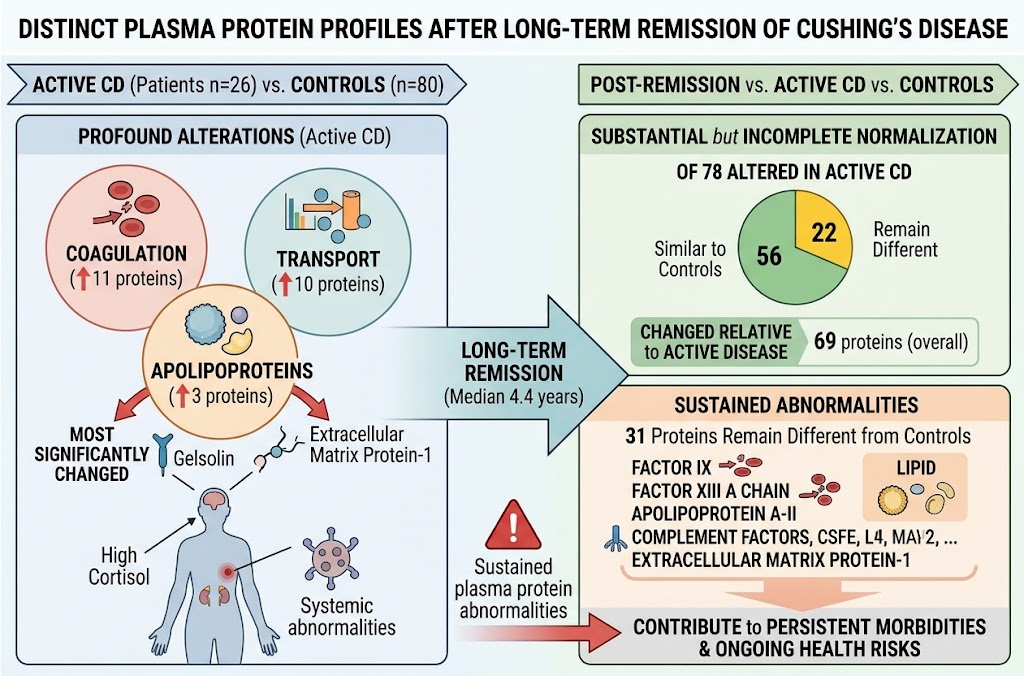
During active CD, extensive dysregulation of plasma proteins was observed: 78 of 159 proteins significantly differed from controls. Notable were 11 coagulation-related proteins, 10 transport proteins, and 3 apolipoproteins. Among these, gelsolin and extracellular matrix protein-1 were the most significantly altered.
Upon achieving long-term remission, 69 proteins significantly changed compared to the active disease state, indicating substantial recovery. However, normalization was incomplete. Of the 78 initially dysregulated proteins, 56 returned to levels comparable to controls, but 31 proteins remained aberrant even after remission.
Persistent abnormalities included coagulation proteins factor IX and factor XIII A chain, apolipoprotein A-II, multiple complement factors, and extracellular matrix protein-1. These findings suggest that the prothrombotic and inflammatory milieu characteristic of active CD is only partially reversed after remission.
This residual plasma protein signature may underpin sustained vascular risk and other morbidities observed clinically despite biochemical normalization of cortisol. The findings align with known increased thrombotic and cardiovascular risk in CD survivors and provide molecular correlates implicating incomplete restoration of hemostatic and immune homeostasis.
Expert Commentary
The study by van der Vliet et al. offers valuable insight into the proteomic landscape accompanying long-term remission of CD. Persistent plasma protein alterations, particularly in coagulation and complement pathways, suggest a lasting imprint of hypercortisolism on systemic biology.
While prior research emphasized clinical and biochemical remission as endpoints, this work highlights the importance of molecular remission as a distinct and important concept. Residual abnormalities in coagulation factors (e.g., factor IX, factor XIII A) could explain the increased thrombotic events documented post-remission, calling for vigilant risk assessment and possibly extended prophylactic strategies.
The involvement of apolipoproteins and transport proteins may relate to lipid metabolism disturbances that contribute to cardiovascular risk, common in CD patients. Similarly, dysregulated complement factors point to altered innate immunity with possible implications for chronic inflammation and tissue remodeling.
Limitations include the modest sample size and observational design. Larger cohorts and longitudinal proteomic profiling could validate and refine these findings. Furthermore, functional studies are needed to elucidate mechanisms sustaining these proteomic aberrations and to assess their predictive value for clinical outcomes.
Nonetheless, this study bridges clinical endocrinology and proteomics, offering translational avenues to improve long-term monitoring and management of CD survivors.
Conclusion
Active Cushing’s disease profoundly disrupts plasma protein profiles across coagulation, lipid transport, complement activation, and extracellular matrix components. Although long-term remission leads to considerable normalization, a significant subset of proteins remains altered, reflecting incomplete recovery of systemic homeostasis.
These persistent proteomic abnormalities likely contribute to the chronic morbidity and increased risk of vascular and metabolic complications observed in CD survivors. Comprehensive molecular assessment beyond cortisol normalization could enhance risk stratification, guide personalized follow-up, and foster development of targeted interventions to mitigate residual health risks after CD remission.
Future research should focus on mechanistic pathways sustaining these protein alterations and explore therapeutic strategies to promote full molecular remission and improved patient outcomes.
Funding and ClinicalTrials.gov
The study was conducted by researchers affiliated with multiple institutions, supported by relevant academic and clinical funding sources as described in the original publication. No specific clinical trial registration was mentioned.
References
1. van der Vliet BF, Camilleri E, Paes T, et al. Distinct plasma protein profiles after long-term remission of Cushing’s disease. J Clin Endocrinol Metab. 2026;111(10):2774-2784. doi:10.1210/clinem/dgad123. PMID: 42060705.
2. Feelders RA, Hofland LJ. Management of Cushing’s disease: advancing towards improved outcomes. Lancet Diabetes Endocrinol. 2020;8(12):1006-1016.
3. Pivonello R, Isidori AM, De Martino MC, Newell-Price J, Biller BMK, Colao A. Complications of Cushing’s syndrome: state of the art. Lancet Diabetes Endocrinol. 2016;4(7):611-629.
4. Dekkers OM, Horváth-Puhó E, Jørgensen JO, et al. Multisystem morbidity and mortality in Cushing’s syndrome: a cohort study. J Clin Endocrinol Metab. 2013;98(6):2277-2284.
5. Nieman LK, Biller BMK, Findling JW, et al. The diagnosis of Cushing’s syndrome: an Endocrine Society Clinical Practice Guideline. J Clin Endocrinol Metab. 2008;93(5):1526-1540.