Background
Health systems are increasingly exploring the integration of artificial intelligence (AI) chatbots into patient portals as a way to enhance patient engagement and streamline access to medical information. Patient portals are digital platforms connected to patients’ electronic health records, enabling them to view test results, communicate with providers, and manage appointments. However, concerns remain about how patients, especially those in primary care settings, perceive these AI tools—particularly chatbots powered by large language models (LLMs) that present answers derived from complex algorithms. While LLMs have shown impressive capabilities, limitations include occasional inaccuracies or misunderstandings in responses, which could affect patient safety and trust. Despite these challenges, the potential benefits of chatbots—such as instant information, 24/7 availability, and assistance with routine questions—motivate health systems to consider pilot programs.Study Objective
This study aimed to assess primary care patients’ perceptions and acceptance of a hypothetical AI chatbot embedded within their patient portal prior to its implementation. Evaluating acceptability, trust in accuracy, perceived safety, and willingness to interact with such a chatbot provides valuable insights that can inform deployment strategies. Additionally, the study sought to identify patient characteristics influencing these perceptions, including demographic factors, portal usage experience, and attitudes towards technology (technophobia).Study Design and Methods
Researchers conducted a cross-sectional survey among active users of a primary care patient portal at an academic health system. The survey included a detailed description of a hypothetical chatbot similar to Epic’s Emmie, a well-known health chatbot platform. Participants rated four key perceptions on a 5-point Likert scale: 1. Acceptability of the chatbot in their portal 2. Trust in the accuracy of the health information provided 3. Perceived patient safety when using the chatbot 4. Willingness to engage in conversation with the chatbot Multivariable linear and ordinal logistic regression models analyzed how these perceptions were associated with sociodemographic variables (age, race, gender, employment status), the number of portal tasks completed (portal task count), frequency of portal use, and technophobia (fear or discomfort with technology).Participants
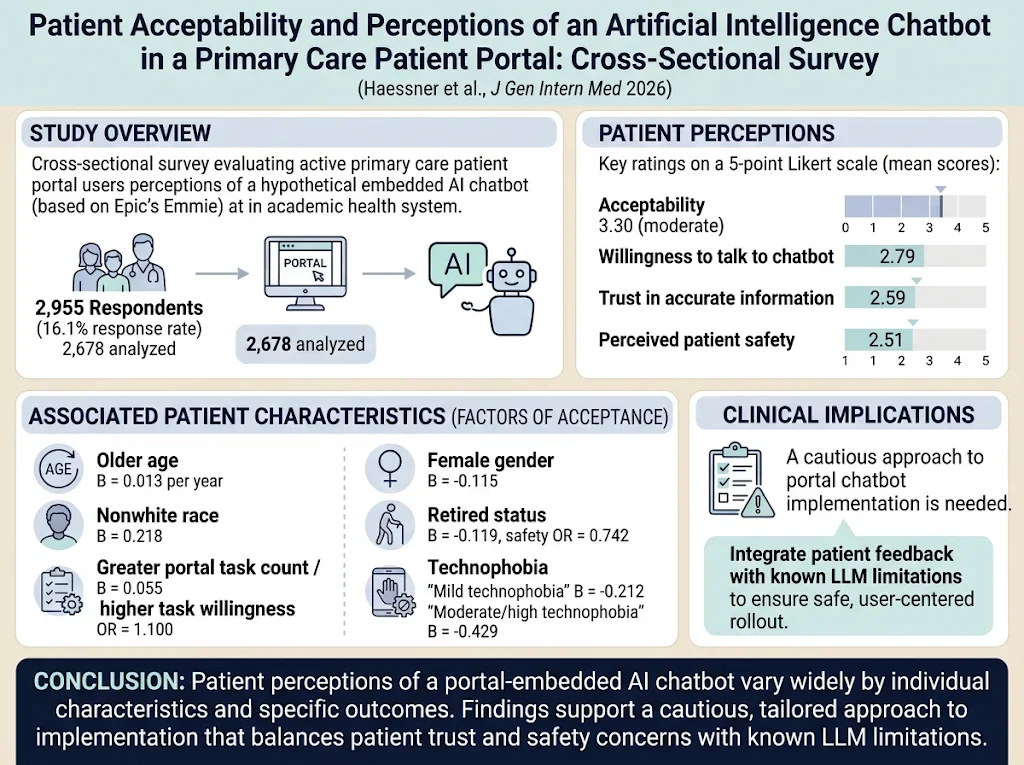
Out of 2955 respondents (a 16.1% response rate), 2678 participants were considered for analysis after data quality checks. These participants were active portal users, primarily engaged with their primary care providers in the academic health system.Key Findings
Mean scores on a 5-point scale were as follows: – Acceptability: 3.30 – Trust in accuracy: 2.59 – Perceived safety: 2.51 – Willingness to talk to the chatbot: 2.79 Associations identified included: – Age: Older patients had higher acceptability, trust, safety, and willingness to converse with the chatbot, with a small but statistically significant increase per year of age. – Race: Nonwhite participants reported higher acceptability and trust than White participants. – Gender: Female participants showed lower acceptability, trust, safety, and willingness to talk than male participants. – Portal Experience: Greater portal task count strongly correlated with higher acceptability and willingness to talk, suggesting familiarity with portal features fosters openness to AI tools. – Technophobia: Patients expressing mild to moderate or high technophobia had significantly lower acceptability scores. – Employment Status: Retired participants reported lower acceptability and perceived safety compared to others, perhaps reflecting different comfort levels with technology.Implications and Interpretation
The study reveals that patient perceptions of portal-embedded AI chatbots vary notably with individual characteristics and previous experience using digital health tools. Age and nonwhite race groups demonstrated more openness, while female gender and technophobia correlate with reservations. Lower trust and safety perceptions suggest patients still harbor concerns about the reliability and potential risks of AI-generated health information. Given that large language models powering chatbots can sometimes provide inaccurate or incomplete responses, health systems must tread carefully in rolling out these tools. The positive association between portal use frequency and chatbot acceptability indicates that efforts to enhance patient digital literacy and portal engagement may improve future chatbot adoption. Tailored patient education addressing common fears and misconceptions about AI-driven healthcare technology is essential.Recommendations for Implementation
1. Patient Education: Clearly communicate the chatbot’s capabilities and limitations, emphasizing it as a supplemental tool rather than a replacement for professional medical advice. 2. Incremental Rollout: Start with limited chatbot functions, such as answering basic administrative questions, before enabling more complex health-related interactions. 3. Feedback Mechanisms: Integrate opportunities for patients to provide feedback and report inaccuracies, fostering continuous improvement. 4. Focus on Trust-building: Consider transparent disclosures about data privacy, AI decision processes, and safety measures. 5. Address Technophobia: Provide targeted support and training for patients less comfortable with technology, especially older adults and retired individuals.Conclusion
AI chatbots embedded within primary care patient portals hold promise for enhancing patient engagement but face varied patient acceptability influenced by demographic factors and prior digital experience. Incorporating patient perceptions alongside the known limitations of large language models will help health systems implement these technologies responsibly and effectively, ensuring they augment care without compromising trust or safety. This study underscores the importance of a cautious, patient-centered approach to integrating AI chatbots into everyday healthcare settings, reinforcing that technology adoption is as much about understanding users as it is about innovation.Specialty calculators
For clinical reference; use professional judgment.