Highlight
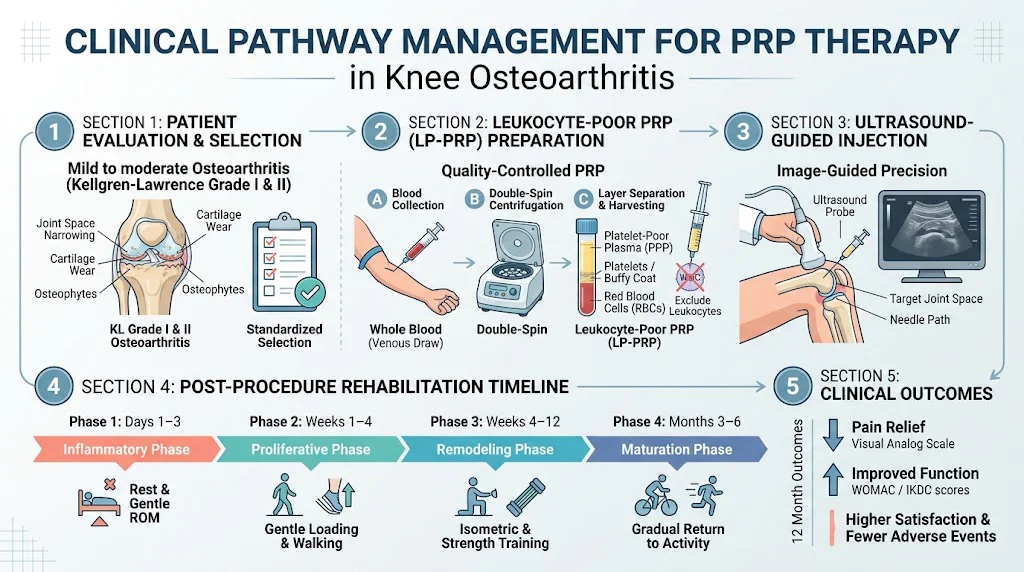
- A standardized clinical pathway incorporating strict patient selection, leukocyte-poor PRP, ultrasound-guided injections, structured rehabilitation, and systematic follow-up significantly improves 12-month pain and function in early knee osteoarthritis over conventional PRP care.
- The clinical pathway led to fewer adverse events and higher patient satisfaction, despite a marginal increase in treatment cost, demonstrating cost-effectiveness.
- This trial clarifies that bundled components of PRP care can influence outcomes, though it does not establish PRP efficacy against placebo or isolate individual component effects.
Study Background
Knee osteoarthritis (OA) is a highly prevalent degenerative joint disease causing chronic pain and functional impairment, particularly in older adults. Early to moderate disease, classified as Kellgren-Lawrence grade I and II, presents a therapeutic window where disease-modifying interventions may alter clinical course and relieve symptoms. Platelet-rich plasma (PRP) therapy has attracted interest due to its potential to modulate inflammation and enhance tissue repair via growth factors concentrated in autologous plasma. However, clinical outcomes following PRP treatment vary widely, with some rigorous studies reporting no significant benefit over placebo controls. Variability in PRP preparation, injection protocols, patient selection, rehabilitation, and follow-up may partly explain these inconsistent results. Hence, there is an unmet need to standardize PRP delivery as a comprehensive clinical pathway to improve reproducibility and therapeutic effectiveness in early knee OA management.Study Design and Methods
This investigation was a prospective, multicenter, double-blind randomized controlled trial (Level 1 evidence) enrolling 240 patients with Kellgren-Lawrence grade I-II knee osteoarthritis. Participants were randomized 1:1 to either a standardized clinical pathway for PRP therapy (PRP-CP, n = 120) or conventional physician-directed PRP care (PRP-C, n = 120) across three hospitals. The PRP-CP group received a multicomponent intervention bundle including:- Standardized patient selection criteria limiting variability in demographic and clinical characteristics likely to influence outcomes
- Quality-controlled leukocyte-poor PRP preparation ensuring consistent platelet concentration and reduced pro-inflammatory leukocytes
- Ultrasound-guided intra-articular injection to improve accuracy and targeted delivery
- A staged rehabilitation protocol designed to optimize joint function and recovery post-injection
- Systematic follow-up visits to monitor outcomes and adverse events
- Visual Analog Scale (VAS) pain score
- Western Ontario and McMaster Universities Osteoarthritis Index (WOMAC) total score
- International Knee Documentation Committee (IKDC) subjective knee evaluation
Key Findings
At one-year follow-up, patients managed under the PRP-CP demonstrated significantly greater improvements in all primary outcomes compared to the conventional care group:- VAS pain: Mean difference (MD) -2.98 (95% CI, -3.64 to -2.32), P < .001
- WOMAC total score: MD -8.63 (95% CI, -11.35 to -5.90), P < .001
- IKDC score: MD 10.25 (95% CI, 8.37 to 12.13), P < .001
Expert Commentary
This landmark trial addresses a critical gap in PRP therapy research by rigorously evaluating a multicomponent clinical pathway rather than isolated procedural elements. The observed benefits highlight the importance of quality control in PRP preparation (particularly leukocyte-poor formulations that reduce inflammatory stimuli), precise ultrasound-guided injections for targeted therapy, and comprehensive rehabilitation aligned with evidence-based principles. The reduction in adverse events further supports protocolized care enhancing patient safety. These findings align with emerging consensus that heterogeneity in PRP methods contributes to conflicting study results and impede broader adoption. However, limitations include the absence of a placebo or sham control group, precluding definitive conclusions about PRP’s efficacy compared to no treatment. Additionally, the bundled intervention design does not parse the relative contributions of individual components to the overall effect. Future mechanistic and dismantling studies are warranted to optimize each element.Conclusion
In patients with early knee osteoarthritis (Kellgren-Lawrence grade I and II), a standardized, multicomponent clinical pathway for PRP therapy significantly enhances pain relief, function, patient satisfaction, and safety over conventional physician-led care at 12 months. While the trial does not establish PRP’s efficacy per se or isolate specific treatment components’ effects due to a lack of placebo control, it compellingly demonstrates that comprehensive protocol-driven management improves clinical outcomes and reduces adverse events. These insights are valuable for clinicians seeking to optimize PRP interventions in OA and highlight the need for future controlled studies to confirm efficacy and elucidate mechanisms. Meanwhile, adopting standardized care pathways may enhance therapeutic consistency and patient benefits in clinical practice.Funding and Registration
The trial was conducted across three hospitals in China with reported funding not expressly detailed in the original publication. Study registration details were not provided. Future publications should elucidate funding sources and trial registration information to enhance transparency.References
1. Yang S, Wang H, Liu Y, et al. Clinical Pathway Management for Platelet-Rich Plasma Therapy in Kellgren-Lawrence Grade I and II Knee Osteoarthritis: A Prospective, Multicenter, Double-Blind Randomized Controlled Trial. Am J Sports Med. 2026 Oct 26; PMID: 42929654. 2. Filardo G, Di Matteo B, Di Martino A, et al. Platelet-rich plasma for the treatment of knee osteoarthritis: an update on clinical applications. Clin Exp Rheumatol. 2019;37 Suppl 120(5):125-131. 3. Andia I, Maffulli N. Platelet-rich plasma for managing pain and inflammation in osteoarthritis. Nat Rev Rheumatol. 2018 May;14(5):281-292. 4. Khoshbin A, Leroux T, Wasserstein D, et al. The efficacy of platelet-rich plasma in the treatment of symptomatic knee osteoarthritis: a systematic review with quantitative synthesis. Arthroscopy. 2013 Dec;29(12):2037-2048.e1. 5. McCarrel TM, Fortier LA. Temporal growth factor release from platelet-rich plasma, trehalose lyophilized platelets, and bone marrow aspirate and their effect on tendon and ligament gene expression. J Orthop Res. 2009 Nov;27(11):1551-1557.Specialty calculators
For clinical reference; use professional judgment.