Highlight
1. Nearly half of patients with hidradenitis suppurativa (HS) treated with biologics achieve only partial disease control, highlighting a critical need for optimization strategies.
2. The study introduces and evaluates an end-of-dose effect–guided framework to tailor biologic therapy adjustments in partial responders.
3. Dose intensification based on the end-of-dose effect versus addition of long-term antibiotics demonstrated clinically meaningful improvements across multiple disease activity and patient-centered measures.
4. These findings suggest that phenotyping HS patients by response pattern could refine biologic optimization, though prospective validation is needed.
Study Background
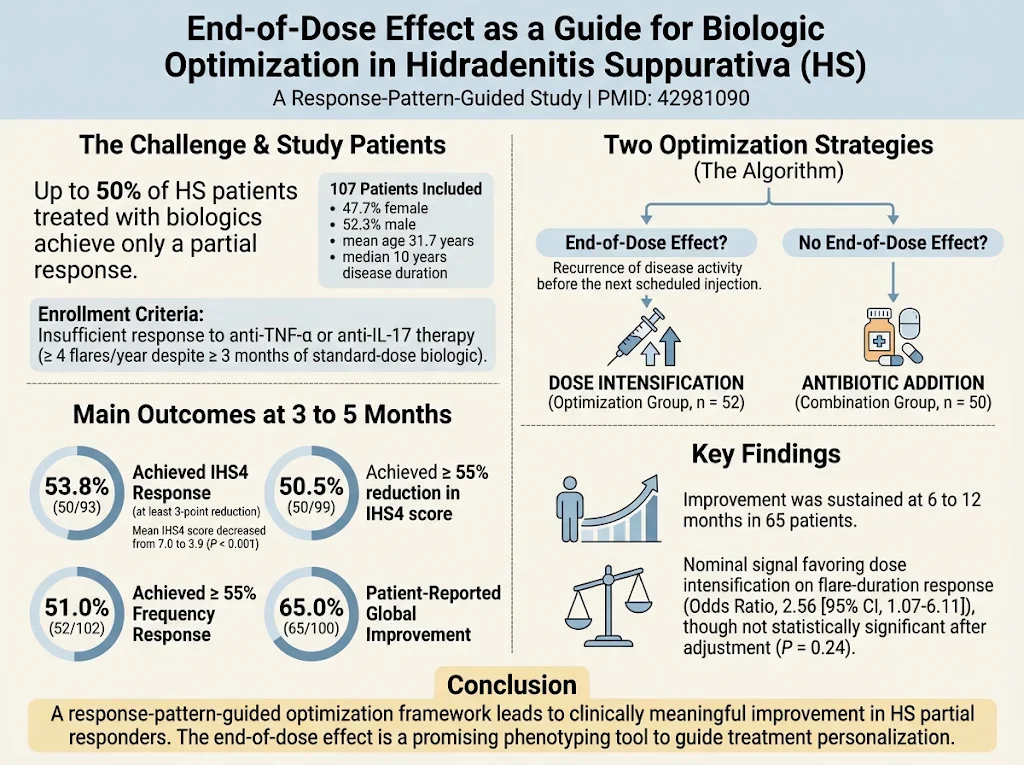
Hidradenitis suppurativa (HS) is a chronic, recurrent inflammatory skin disorder marked by painful nodules, abscesses, sinus tracts, and scarring primarily affecting intertriginous areas. The disease profoundly impairs quality of life and imposes substantial morbidity. Although anti–tumor necrosis factor-alpha (anti-TNF-α) and anti-interleukin 17 (anti–IL-17) biologics represent pivotal advances, up to 50% of patients experience only partial response under standard dosing regimens. Currently, no consensus guides the management of these partial responders, leading clinicians to employ dose escalation or adjunct long-term antibiotics empirically. However, data on the real-world effectiveness of these strategies and methods to individualize optimization remain sparse.
Study Design
This retrospective cohort study was conducted at a tertiary dermatology center in France between January 2022 and March 2025. It enrolled 107 patients diagnosed with HS who had inadequate disease control defined by at least four flares per year despite a minimum of three months on standard-dose biologic therapy with either anti-TNF-α or anti–IL-17 agents. Patients were stratified by the presence of an “end-of-dose effect,” characterized by the recurrence of disease activity before the next scheduled biologic injection.
Participants with the end-of-dose effect were assigned to the dose intensification group (n=52), increasing biologic exposure, whereas those without this effect entered the combination therapy group (n=50), receiving added long-term antibiotics, per a prespecified response-pattern-guided algorithm. The primary endpoint was clinical response defined as a reduction of at least 3 points on the International Hidradenitis Suppurativa Severity Score System (IHS4) at 3 to 5 months. Secondary endpoints included a ≥55% reduction in IHS4, improvement in IHS4 staging, decrease in pain numeric rating scale, reduction in flare frequency and duration, and patient-reported global improvement. Statistical analysis accounted for treatment allocation bias using inverse probability of treatment weighting with doubly robust adjustment.
Key Findings
Of the 107 patients analyzed, the mean age was 31.7 years, with a slight male predominance (52.3%). The median disease duration was 10 years, underscoring a chronic disease population with established HS. Both intervention groups achieved significant improvement in disease severity scores and patient-centered outcomes at 3 to 5 months:
- The mean IHS4 score decreased from 7.0 to 3.9 (P < .001), reflecting a substantial reduction in disease activity.
- 53.8% of patients attained the defined IHS4 response (≥3-point reduction).
- 50.5% achieved a 55% or greater reduction in IHS4 score.
- 51.0% demonstrated meaningful flare-frequency control.
- 65.0% reported global clinical improvement.
Notably, in the exploratory comparison between groups, dose intensification was associated with a nominally significant benefit in flare-duration response (odds ratio 2.56, 95% CI 1.07–6.11), though this did not meet statistical significance after adjustment for multiple comparisons (adjusted P=0.24). Improvements were durable, persisting at 6 to 12 months in a subset of 65 patients followed longitudinally.
The study did not report major safety concerns associated with either strategy, although detailed safety data and adverse event profiling were not the focal point of this analysis.
Expert Commentary
This investigation provides insightful evidence supporting a pragmatic and biomarker-like approach to HS biologic optimization by harnessing the clinical manifestation of the end-of-dose effect. The end-of-dose effect serves as a readily observable indicator of suboptimal drug exposure duration, guiding clinicians toward dose intensification rather than empirical antibiotic addition, which may carry risks of resistance and adverse effects.
The study’s strength includes a well-defined patient cohort typical of refractory HS, real-world applicability, and the use of validated outcome measures like IHS4. However, limitations stem from its retrospective design and potential confounders inherent in observational studies despite robust statistical corrections. The nominal difference favoring dose intensification on flare-duration requires confirmation in prospective randomized trials to definitively ascertain superiority.
Current clinical guidelines for HS suggest individualized treatment adaptations but lack consensus on response-pattern-guided strategies. This study provides a conceptual framework that could be integrated into clinical pathways to personalize biologic maintenance therapy for HS partial responders, potentially improving long-term disease control and quality of life.
Conclusion
For patients with hidradenitis suppurativa experiencing partial response to biologics, utilizing the end-of-dose effect as a phenotyping tool offers a promising approach to treatment optimization. Dose intensification targeting this response pattern yielded clinically meaningful improvements across disease severity and patient-reported outcomes. While these retrospective findings are encouraging, prospective validation is warranted to establish evidence-based guidelines for integrating this strategy into routine clinical practice. This novel framework may help close the therapeutic gap in HS management and exemplify personalized medicine in dermatology.
Funding and ClinicalTrials.gov
The original study details did not specify funding sources or clinical trial registration identifiers.
References
- Lynch A, Archimbaud J, Lesort C, et al. End-of-Dose Effect as a Guide for Biologic Optimization in Hidradenitis Suppurativa. JAMA Dermatol. 2026;PMID: 42981090.
- Kimball AB, Sobell JM, Zouboulis CC, et al. Adalimumab for the treatment of moderate to severe hidradenitis suppurativa: a parallel randomized trial. Ann Intern Med. 2016;165(9):681-689.
- Garg A, Kirby JS, Lavian J, et al. Recurrence and progression of hidradenitis suppurativa following discontinuation or dose reduction of adalimumab. J Eur Acad Dermatol Venereol. 2020;34(5):940-944.
- Prens EP, Deckers IE, van der Zee HH. Pathophysiology of hidradenitis suppurativa: an update. J Am Acad Dermatol. 2020;82(6):1445-1456.
Specialty calculators
For clinical reference; use professional judgment.