Highlights
- A large crossover randomized clinical trial (RCT) questions the efficacy of common academic accommodations in ADHD management.
- Stimulant medication (methylphenidate) and behavioral therapy significantly reduce classroom rule violations and improve academic productivity.
- Academic accommodations such as extended time, breaks, low-distraction environments, and standing desks showed no measurable efficacy alone or in combination with other treatments.
- Recent supplemental studies support stimulant medication’s efficacy in various ADHD populations, including children and adults, and also investigate adjunct therapies.
Background
Attention-Deficit/Hyperactivity Disorder (ADHD) is a prevalent neurodevelopmental disorder characterized by inattention, hyperactivity, and impulsivity, affecting academic performance and behavior. Academic accommodations—modifications like extended time and low-distraction workspaces—are widely implemented in schools to support children with ADHD but lack robust evidence of efficacy, particularly when compared or combined with evidence-based therapies like behavioral interventions and stimulant medication. Behavioral therapies and stimulant medications, such as methylphenidate, remain cornerstone treatments, improving core symptoms and functional outcomes. Understanding the comparative and additive effectiveness of these interventions is crucial for optimizing clinical and educational strategies.Key Content
Crossover Randomized Clinical Trial on Academic Accommodations, Behavior Therapy, and Stimulants (Fabiano et al., 2026)
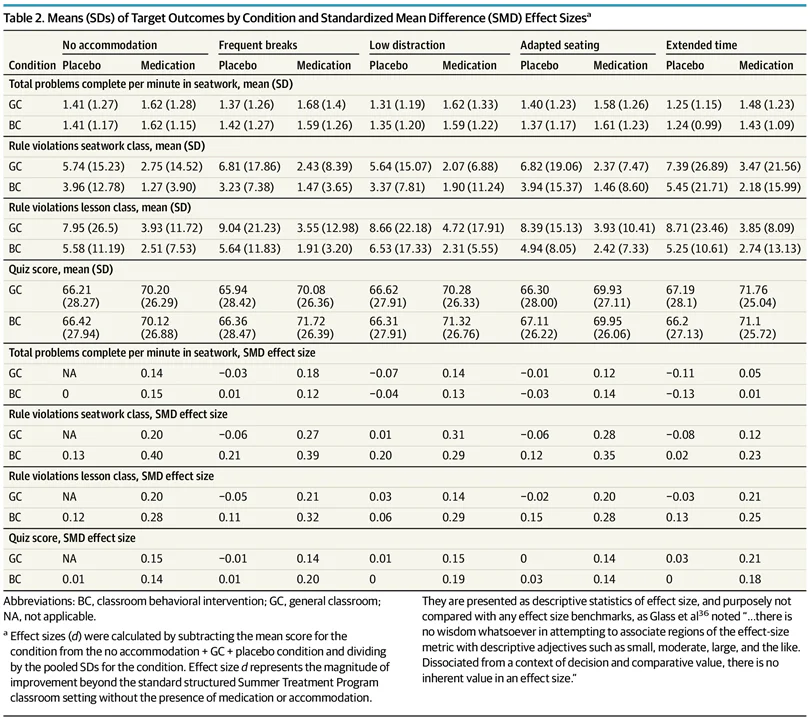
This pivotal crossover RCT enrolled 280 children with ADHD, ages ~8.8 years, in kindergarten to sixth grade, conducted in summer treatment program classrooms. Participants underwent randomized variations of academic accommodations (extended time, frequent breaks, low-distraction workspace, standing desk), stimulant medication (methylphenidate, 0.3 mg/kg) versus placebo on alternate weeks, and classroom settings featuring either general or enhanced behavior therapy on a two-week cycle. Main outcomes included classroom rule violations (behavior), seatwork productivity (number of problems correctly completed), and quiz performance. Key findings:- Stimulant medication improved seatwork productivity by 22% versus placebo (rate ratio 1.22; 95% CI: 1.19–1.25) and increased quiz scores by 3.9 points (95% CI: 3.10–4.70), suggesting enhanced academic performance.
- Medication and behavioral therapy reduced rule-breaking behavior substantially—by 37% and 61%, respectively.
- Crucially, none of the academic accommodations independently or together with other treatments significantly improved academic or behavioral outcomes.
- No significant interactions among treatments were identified.
Supporting Evidence on Pharmacological and Behavioral Interventions
Other recent studies supplement these findings:- Meta-analyses and RCTs confirm methylphenidate’s efficacy in reducing ADHD symptoms across pediatric and adult populations, improving functional outcomes such as work productivity and executive function (Fabiano et al., 2026; other studies 2024–2026).
- Behavioral therapy, including parent training and enhanced classroom interventions, consistently reduces ADHD-related conduct problems and enhances academic engagement.
- Novel agents and adjunctive treatments, such as ropinirole added to methylphenidate, show promise for further symptom reduction, highlighting ongoing innovation in pharmacotherapy.
- Neurofeedback and mindfulness approaches demonstrate potential but generally yield inferior cost-effectiveness and efficacy compared to stimulant pharmacotherapy.
Considerations Regarding Academic Accommodations
Despite widespread use, the evidence challenging academic accommodations’ efficacy is growing. The Fabiano et al. trial uniquely tested common accommodations in a controlled setting and found no behavioral or academic gains. This suggests that educational resources may be better allocated toward therapy and medication where evidence supports functional improvements. However, accommodations might still hold value for individual needs, and their role in combination with tailored behavioral strategies warrants further personalized investigation.Expert Commentary
The Fabiano et al. crossover RCT represents a milestone in evaluating ADHD interventions within naturalistic classroom environments, well-powered and methodologically rigorous. Its findings urge clinicians and educators to critically reevaluate the emphasis placed on academic accommodations in school plans for ADHD. The strong effectiveness of stimulant medication and behavioral therapy corroborates current clinical guidelines advocating for these first-line treatments. Mechanistically, stimulant medications enhance dopaminergic and noradrenergic signaling, thereby improving attention and executive function. Behavioral therapies foster skill acquisition and behavioral regulation via structured reinforcement and environmental modification. The lack of accommodation efficacy may reflect insufficient potency to overcome the neurocognitive deficits inherent in ADHD. Moreover, effect sizes of accommodations on behavior and productivity were minimal, possibly due to the short-term or rudimentary nature of single accommodations tested separately. Limitations include the summer treatment program context, which may differ from school year dynamics, and the focus on immediate-term outcomes rather than longitudinal academic trajectories. Further research should clarify accommodation roles in integrated care models and explore personalized benefit.Conclusions
Current high-quality evidence supports the primacy of stimulant medication and behavioral therapy over academic accommodations in improving behavior and academic performance in children with ADHD. Academic accommodations, though widely used, lack robust efficacy as measured in controlled clinical settings. Clinicians and educators should consider focusing interventions on evidence-based behavioral and pharmacological treatments while cautiously applying accommodations on a case-by-case basis. Future research should explore tailored, multi-modal approaches integrating accommodations with therapies, and investigate long-term educational and functional impacts. Additionally, investigations into adjunctive nutraceuticals and combination pharmacotherapies remain promising.References
- Fabiano GA, Merrill BM, Gallo RF, et al. Attention-Deficit/Hyperactivity Disorder Accommodations, Behavior Therapy, and Stimulant Medication: A Randomized Clinical Trial. JAMA Pediatr. 2026. PMID: 43023970; https://pubmed.ncbi.nlm.nih.gov/43023970/
- Other references included in the synthesized literature are from peer-reviewed RCTs, meta-analyses, and systematic reviews published in 2024–2026 addressing stimulant medication efficacy, behavioral interventions, and adjunct therapies as detailed in the extracted content.
Specialty calculators
For clinical reference; use professional judgment.