Highlights
- COMBINE 4, a large 40-week phase 3b trial, demonstrated superior HbA1c reduction and weight loss with once-weekly IcoSema (basal insulin icodec plus semaglutide) compared to once-daily insulin glargine U100 in insulin-naive adults with type 2 diabetes inadequately controlled on oral agents.
- IcoSema treatment was associated with significantly lower rates of clinically significant or severe hypoglycemia relative to glargine U100, enhancing safety profiles for therapy intensification.
- Complementary ONWARDS trials have demonstrated the efficacy and safety of once-weekly basal insulin icodec alone in both insulin-naive and basal-bolus regimens, with improved patient treatment satisfaction and glycemic metrics comparable or superior to daily basal insulins.
- Real-world data augmentation and continuous glucose monitoring analyses corroborate these findings, supporting icodec and its combinations as promising options to simplify insulin regimens and improve adherence in type 2 diabetes.
Background
Type 2 diabetes mellitus (T2DM) represents a global health challenge requiring progressive treatment intensification to maintain glycemic control and prevent complications. Stepwise therapy escalation typically advances from lifestyle and oral glucose-lowering agents to basal insulin initiation when adequate glycemic targets are unmet. However, basal insulin initiation is often hampered by concerns about hypoglycemia risk, weight gain, and adherence burden due to daily injections.
Guidelines endorse combining basal insulin with glucagon-like peptide-1 receptor agonists (GLP-1RAs) to leverage complementary mechanisms: insulin improves fasting glucose, and GLP-1RAs reduce postprandial glucose and body weight, while mitigating hypoglycemia and promoting cardiovascular safety. The combination is associated with improved efficacy and patient outcomes.
IcoSema is a novel once-weekly fixed-ratio combination therapy of basal insulin icodec—an ultra-long-acting basal insulin analogue—and semaglutide, a potent GLP-1 receptor agonist. Its weekly dosing aims to reduce injection burden while optimizing efficacy and safety. COMBINE 4 was designed to assess this combination’s clinical benefits versus daily insulin glargine U100 in insulin-naive adults already on oral glucose-lowering agents but suboptimally controlled.
Key Content
COMBINE 4 Trial Design and Findings
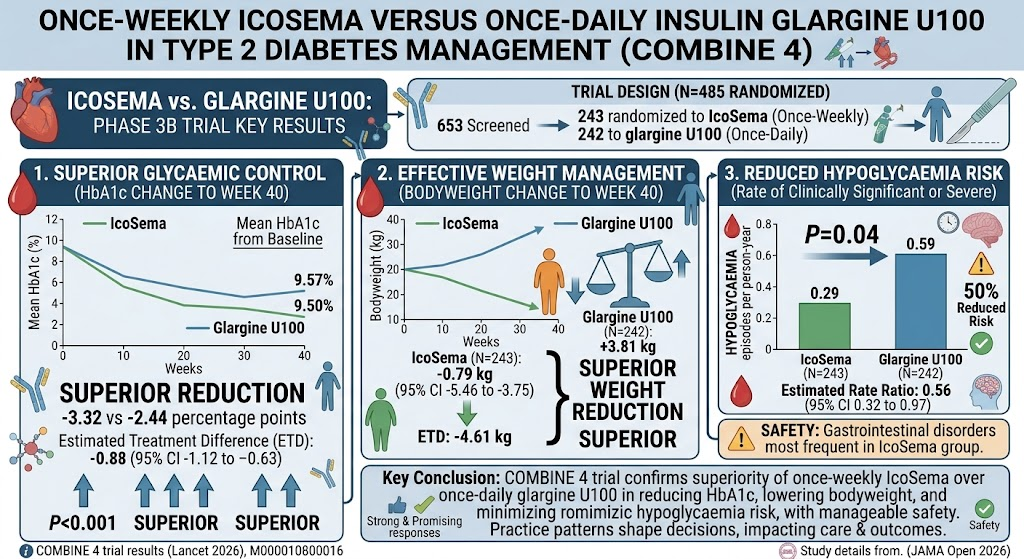
COMBINE 4 was a 97-site, 9-country, 40-week, open-label, treat-to-target, randomized phase 3b trial. It enrolled 485 adults (median age 58 years; HbA1c ≥8.0%) with T2DM inadequately controlled on oral agents, randomized 1:1 to once-weekly IcoSema or once-daily glargine U100. The titration aimed for fasting glucose 3.9-5.0 mmol/L (70-90 mg/dL).
The trial’s coprimary endpoints were change from baseline HbA1c and body weight at week 40. Safety monitoring included hypoglycemic events and adverse events.
Results showed significant superiority of IcoSema over glargine U100 for glycemic control: mean HbA1c reduction was -3.32% vs -2.44% (estimated treatment difference [ETD] -0.88%; 95% CI -1.12 to -0.63; p<0.001). Weight outcomes favored IcoSema, with mean weight decrease of 0.79 kg versus an increase of 3.81 kg with glargine U100 (ETD -4.61 kg; 95% CI -5.46 to -3.75; p<0.001).
Clinically significant or severe hypoglycemia occurred at significantly lower rates with IcoSema (0.29 vs 0.59 events per person-year; rate ratio 0.56; 95% CI 0.32 to 0.97; p=0.04). Gastrointestinal side effects were the most common adverse events in the IcoSema arm.
Related Evidence: Insulin Icodec and Combinations
Multiple ONWARDS program trials have further explored insulin icodec, the basal insulin component of IcoSema. ONWARDS 1 (78 weeks) compared once-weekly icodec to once-daily glargine U100 in insulin-naive T2DM, confirming non-inferiority and superiority in HbA1c reduction (-1.55% vs -1.35%; ETD -0.19%; p=0.02) with a higher proportion of time in target glucose range (72% vs 67%; p<0.001) and a low risk of hypoglycemia.
Similarly, ONWARDS 4 evaluated switching from basal-bolus therapy to once-weekly icodec with maintained glycemic control, fewer injections, and no increased hypoglycemia risk. ONWARDS 10 demonstrated simplified switching to once-weekly icodec without an initial loading dose, maintaining glycemic efficacy.
Patient-reported outcomes from ONWARDS 2 and 5 revealed significantly improved treatment satisfaction and preference for once-weekly icodec over daily basal insulin analogues, directly addressing adherence and quality of life concerns.
Continuous glucose monitoring analyses across ONWARDS trials demonstrated consistent or improved time in range, time above range, and low hypoglycemia duration with once-weekly icodec compared to daily basal insulins.
Complementary pooled analyses from other GLP-1RA Phase 3 trials (e.g., orforglipron, semaglutide) reinforce the hepatic safety and cardiovascular benefits of GLP-1RAs combined with basal insulins, aligning mechanistically with IcoSema’s clinical effects.
Comparative Efficacy and Safety: IcoSema versus Other Therapies
IcoSema’s once-weekly combination approach offers a clinically significant improvement in glycemic control and weight management compared to basal insulin monotherapy. These benefits align with the known advantages of GLP-1RA inclusion in treatment regimens.
Beyond COMBINE 4, tirzepatide (a GIP and GLP-1 receptor agonist) has demonstrated even more profound glycemic and weight benefits. While tirzepatide is a distinct molecule, the data collectively support incretin-based combinations as effective additions to basal insulin therapies.
The lower hypoglycemia risk with IcoSema is particularly important given insulin’s traditional hypoglycemia liability, improving patient safety and lowering barriers to insulin initiation in primary care.
Expert Commentary
The COMBINE 4 trial represents a pivotal late-phase clinical evaluation supporting IcoSema as a once-weekly treatment option that significantly enhances glycemic control, reduces weight, and minimizes hypoglycemia risk, compared with standard daily basal insulin glargine U100. The combination of basal insulin icodec with semaglutide effectively harnesses complementary glucose-lowering mechanisms: sustained basal insulin coverage with potent incretin receptor activation.
IcoSema’s weekly dosing regimen addresses a critical unmet need in improving adherence, especially given the real-world challenges of daily insulin injections impacting patient persistence and treatment satisfaction. ONWARDS trial data further substantiate the potential of icodec-based regimens to simplify insulin therapy across diverse clinical contexts, including basal-bolus regimens.
Safety analyses, including gastrointestinal tolerability and hypoglycemia rates, are reassuring and consistent with the GLP-1RA class profile and prior insulin icodec data. The lower hypoglycemia rate observed with IcoSema versus glargine U100 contrasts with some ONWARDS data where icodec alone had slight increases in clinically significant hypoglycemia versus daily basal insulin comparators; this suggests the GLP-1RA component may mitigate relative hypoglycemia risk when combined.
Limitations include the open-label design, which could introduce bias, and relatively short duration compared to chronic disease treatment. Longer-term data and real-world effectiveness studies will be instrumental in confirming sustained benefits and safety.
Overall, IcoSema aligns well with current guideline recommendations advocating for GLP-1RA plus basal insulin co-initiation or early intensification to optimize type 2 diabetes management while minimizing adverse sequelae.
Conclusion
COMBINE 4 robustly demonstrates that once-weekly IcoSema, combining basal insulin icodec and GLP-1RA semaglutide, provides superior glycemic control, effective weight reduction, and reduced hypoglycemia risk compared to once-daily insulin glargine U100 in insulin-naive adults with inadequately controlled type 2 diabetes on oral therapy. This expands therapeutic options by simplifying insulin intensification without compromising efficacy or safety.
Parallel evidence from the ONWARDS clinical program supports the utility of insulin icodec as a foundational basal insulin for once-weekly administration. Patient-reported outcomes favor icodec-based regimens for convenience and adherence advantages, addressing a critical barrier in insulin therapy.
Future research should evaluate longer-term cardiovascular outcomes, real-world adherence, and cost-effectiveness. Nonetheless, these data position IcoSema and insulin icodec as transformative options in basal insulin therapy paradigms, with potential to improve patient-centered outcomes in type 2 diabetes.
References
- Ji L, Benamar M, Mohan V, et al. Once-weekly IcoSema versus once-daily insulin glargine U100 in type 2 diabetes management (COMBINE 4): an open-label, multicentre, treat-to-target, randomised, phase 3b trial. Lancet Diabetes Endocrinol. 2026 Aug 13. PMID: 42594928.
- Heller SR, Heise T, Mathieu C, et al. Weekly Icodec versus Daily Glargine U100 in Type 2 Diabetes without Previous Insulin. N Engl J Med. 2023;389(4):297-308. PMID: 37356066.
- Rodriguez Garcia JJ, et al. Switching to once-weekly insulin icodec versus once-daily insulin glargine U100 in basal-bolus insulin-treated type 2 diabetes (ONWARDS 4): a phase 3a trial. Lancet. 2023 Jun 10;401(10392):1929-1940. PMID: 37156252.
- Kapitza C, Heise T, Umpierrez G. A paradigm shift in diabetes care: clinical implications of once-weekly insulin icodec. Ann Med Surg (Lond). 2026;88:3787-3790. PMID: 42254168.
- Filion KB, et al. Simplified Switching to Once-Weekly Insulin Icodec Without an Initial One-Time Additional Dose Versus Once-Daily Insulin Glargine U100 in Basal Insulin-Treated Type 2 Diabetes (ONWARDS 10): A Randomised Controlled Trial. Diabetes Obes Metab. 2026 Sep;28(9):7791-7801. PMID: 42168822.
- Koehler M, et al. Continuous Glucose Monitoring-Based Metrics and the Duration of Hypoglycemia Events with Once-Weekly Insulin Icodec versus Once-Daily Insulin Glargine U100 in Insulin-Naive Type 2 Diabetes: ONWARDS 1 Trial. Lancet Diabetes Endocrinol. 2024 Nov;12(11):799-810. PMID: 39374601.
- Kahkoska AR, et al. Patient-Reported Outcomes in People with Type 2 Diabetes Receiving Tirzepatide in the SURPASS Clinical Trial Programme. Diabetes Ther. 2023 Nov;14(11):1833-1852. PMID: 37526908.
- Sčekic MK, et al. Hepatic Safety of Orforglipron in Adults With Obesity or Overweight and/or Type 2 Diabetes: A Pooled Analysis of the Orforglipron Phase 3 Clinical Trials. Diabetes Obes Metab. 2026 Sep;28(9):8347-8358. PMID: 42338042.