Highlight
– Morning salivary cortisone demonstrates diagnostic accuracy comparable to serum cortisol for adrenal insufficiency screening.
– Non-invasive saliva sampling offers practical advantages over serum testing, including home-based collection.
– Established diagnostic thresholds for salivary cortisone enable effective rule-in, rule-out, and intermediate risk stratification.
– Implementing salivary cortisone screening may reduce the need for early morning venepuncture and improve patient convenience.
Study Background
Adrenal insufficiency is a potentially life-threatening endocrine disorder characterized by insufficient production of cortisol, a vital glucocorticoid hormone involved in stress response, metabolism, and immune regulation. Early and accurate diagnosis is critical to prevent adrenal crises and optimize management. The adrenocorticotropin hormone (ACTH) stimulation test is the gold standard for confirming adrenal insufficiency. However, initial screening relies primarily on measurement of morning serum cortisol levels, which requires venepuncture during early clinic hours, presenting logistical challenges and patient discomfort.
Serum cortisol measurement may also be confounded by fluctuations in corticosteroid-binding globulin (CBG), which affects total cortisol levels but not free cortisol availability. Hence, free cortisol or its proximate metabolites such as cortisone in saliva have been proposed as non-invasive markers less influenced by CBG, allowing for easier, home-based sampling. Despite preliminary evidence supporting salivary cortisol for adrenal function assessment, diagnostic yield has been variable, and salivary cortisone—a downstream metabolite—may better reflect active glucocorticoid status.
Study Design
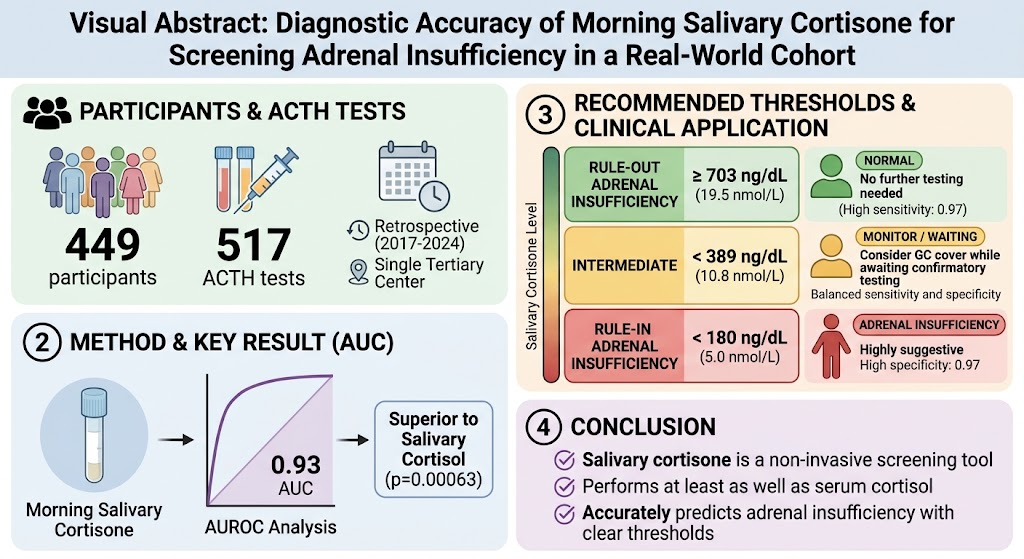
This retrospective cross-sectional diagnostic accuracy study was conducted at a single tertiary oncology and endocrinology center in the United Kingdom over the period of 2017 to 2024. The study included 449 consecutive patients undergoing ACTH stimulation testing for suspected adrenal insufficiency, contributing 517 test encounters.
Baseline salivary samples were collected for both cortisol and cortisone measurements. The diagnostic performance of baseline salivary cortisone was compared against morning serum cortisol, with confirmed adrenal insufficiency determined by standard ACTH stimulation criteria as the reference standard.
Main outcomes were sensitivity, specificity, and area under the receiver operating characteristic curve (AUC) for baseline salivary cortisone, with aim to establish clinically relevant thresholds for ruling out or ruling in adrenal insufficiency.
Key Findings
Adrenal insufficiency was confirmed in 104 of 517 (20.1%) ACTH stimulation tests. Baseline morning salivary cortisone predicted adrenal insufficiency with high accuracy, yielding an AUC of 0.93 (95% CI 0.91–0.95), which was statistically equivalent to serum cortisol (AUC 0.93, 0.90–0.95; p=0.67) and superior to salivary cortisol (AUC 0.87, 0.82–0.91; p=0.00063).
Diagnostic threshold analysis revealed a two-tier strategy that maximized clinical utility:
- A rule-out threshold at ≥703 ng/dL (19.5 nmol/L) cortisone provided a sensitivity of 97% and specificity of 59%, enabling reliable exclusion of adrenal insufficiency in most patients.
- A rule-in threshold at <180 ng/dL (5.0 nmol/L) cortisone offered specificity of 97% with moderate sensitivity (58%), allowing confident identification of adrenal insufficiency cases requiring urgent management.
- An intermediate zone, with cortisone <389 ng/dL (10.8 nmol/L), had sensitivity 83% and specificity 87%, suggesting that patients in this range warrant glucocorticoid cover while awaiting confirmatory testing.
These thresholds provide actionable guidance for clinical pathways, optimizing diagnostic decisions and resource utilization.
Expert Commentary
By circumventing the limitations of serum cortisol testing, including the need for invasive venepuncture and early clinic attendance, salivary cortisone emerges as a patient-friendly biomarker with robust diagnostic performance. Its relative independence from CBG variability addresses an important confounder in adrenal function testing. The high AUC and well-calibrated sensitivity/specificity thresholds support its implementation in both outpatient and remote settings.
However, the retrospective design and single-center nature of this study may limit generalizability. Validation in diverse populations, including different ethnicities, comorbid states, and medication contexts, is warranted. Moreover, standardization of salivary sampling protocols and assay methods are critical for widespread adoption. While salivary cortisone shows superior diagnostic accuracy compared to salivary cortisol, cost-effectiveness analyses and integration into existing clinical workflows remain to be explored.
Current international guidelines have yet to endorse salivary cortisone for routine screening; this study provides compelling evidence that could inform future recommendations and practice algorithms.
Conclusion
Baseline morning salivary cortisone is a highly accurate, non-invasive alternative to serum cortisol for screening adrenal insufficiency. It enables convenient home-based sampling and has clearly defined diagnostic thresholds to support clinical decision-making. Adoption of salivary cortisone testing may improve patient experience, reduce reliance on early morning venepuncture, and streamline adrenal insufficiency diagnosis.
Future prospective studies and guideline updates should address implementation strategies and confirm the utility of salivary cortisone across broader clinical settings.
Funding and Clinicaltrials.gov
Details of study funding were not specified in the source publication. The study is a retrospective diagnostic accuracy analysis conducted at a single UK tertiary center; no clinicaltrial.gov registration number was provided.
References
- Televantos C, Monaghan PJ, Michaelidou M, Chen LR, Ahmed M, Ho JH, Dhage S, Higham C, Keevil B, Adam S. Diagnostic Accuracy Study of Morning Salivary Cortisone for Screening Adrenal Insufficiency in a Real-World Cohort. J Clin Endocrinol Metab. 2026 Sep 29. PMID: 42806822.
- Bornstein SR, Allolio B, Arlt W, et al. Diagnosis and Treatment of Primary Adrenal Insufficiency: An Endocrine Society Clinical Practice Guideline. J Clin Endocrinol Metab. 2016;101(2):364-389.
- Keevil BG. Salivary cortisone as a biomarker for adrenal insufficiency: progress and challenges. Clin Chem Lab Med. 2021;59(9):1505-1512.
- Shapiro LE, Jessurun J, McCloskey L, et al. Evaluation of salivary cortisol and cortisone assays to screen for adrenal insufficiency. Clin Endocrinol. 2019;90(5):656-663.