Highlights
- The HPTN 094 trial rigorously evaluated mobile integrated delivery of PrEP and MOUD plus peer navigation versus peer navigation alone among people who inject drugs across five major US cities.
- No significant improvement in PrEP or MOUD uptake at 26 or 52 weeks was observed with mobile integrated services compared to peer navigation alone.
- A notable reduction in all-cause mortality at 52 weeks was found in the intervention arm, suggesting potential survival benefit from mobile integration.
- Low overall uptake of PrEP and MOUD underscores persistent barriers in engaging people who inject drugs in HIV prevention and addiction treatment.
Background
Injection drug use remains a critical driver of HIV transmission in the United States and globally. People who inject drugs (PWID) face disproportionate risk for HIV acquisition and opioid use disorder (OUD)-related morbidity and mortality. Evidence-based interventions—HIV preexposure prophylaxis (PrEP) and medication for opioid use disorder (MOUD)—have demonstrated efficacy in reducing infection risk and improving addiction outcomes. However, delivery and uptake of these interventions among PWID remain suboptimal due to multifaceted barriers including stigma, fragmented care systems, logistical accessibility, and social determinants of health. Integrated models that co-locate PrEP and MOUD services, particularly through mobile units, have been proposed to improve access and continuity of care. The HPTN 094 trial was designed to rigorously test the effectiveness of such an integrated mobile approach combined with manualized peer navigation versus peer navigation directing to existing community services alone.Key Content
Study Design and Population
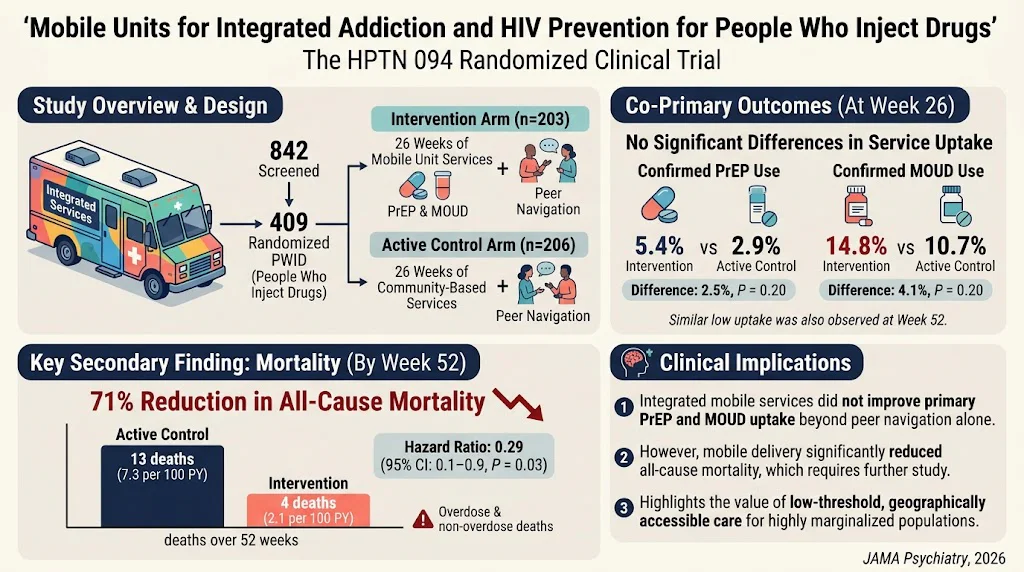
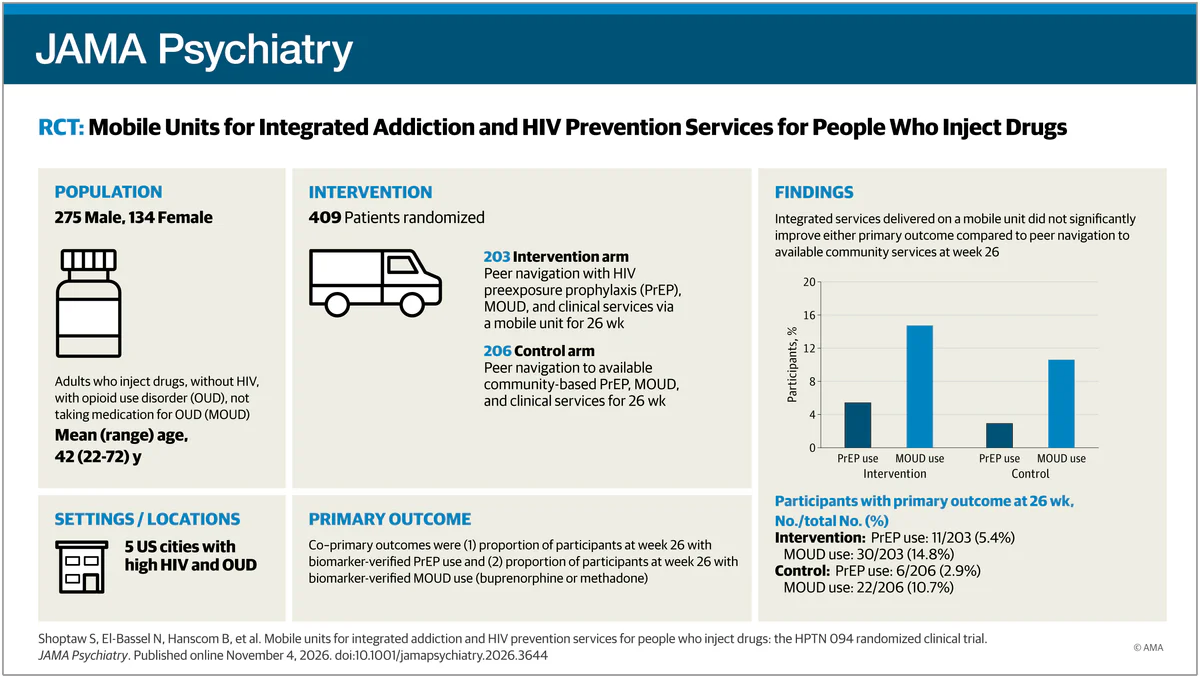
HPTN 094 was a multisite, prospective, open-label randomized clinical trial conducted from May 2021 through September 2024 in five US metropolitan areas (Houston, Los Angeles, New York City, Philadelphia, and Washington, DC). Eligible participants were adults (≥18 years) currently injecting drugs, HIV-negative, diagnosed with OUD, not on MOUD, and willing to consider MOUD. A total of 842 people were screened and 409 randomized: 203 to the intervention arm and 206 to the active control arm. The demographic was 32.8% female and majority older than 30 years, reflecting the target population for HIV prevention and addiction treatment.Interventions
The intervention arm received 26 weeks of manualized peer navigation plus integrated PrEP, MOUD, and limited clinical and supportive services delivered via a mobile health unit directly accessible to PWID communities. The active control arm received 26 weeks of manualized peer navigation to existing community-based services encompassing PrEP, MOUD, harm reduction, and supportive programs, without direct mobile service delivery.Primary and Secondary Outcomes
Co-primary outcomes at 26 weeks were confirmed PrEP use and MOUD use. At 26 weeks, PrEP use was low and statistically similar: 5.4% in the intervention arm versus 2.9% in control (P not significant). MOUD use was 14.8% versus 10.7%, respectively (P not significant). At 52 weeks, both arms showed similarly low PrEP (2.0% vs 1.9%) and MOUD use (13.3% vs 14.1%). The HIV incidence was low across arms with one seroconversion in the intervention and two in the control arm, equating to 0.9 per 100 person-years (95% CI, 0.2-2.6). Significantly, all-cause mortality was markedly reduced in the intervention arm with 4 deaths versus 13 in control (hazard ratio 0.29; 95% CI, 0.1-0.9; P=0.03).Contextual Evidence and Related Studies
Previous studies and systematic reviews have underscored the challenges of delivering PrEP and MOUD to PWID. Barriers include structural factors (e.g., scarce integrated programs), social determinants (e.g., unstable housing, stigma), and patient-level factors such as ambivalence or misinformation. Mobile health units providing integrated services have been proposed to mitigate these barriers by bringing care to high-risk populations in their communities. Prior randomized trials of peer navigation alone have demonstrated modest improvements in linkage to addiction and HIV prevention services but often faced challenges in sustained medication adherence and retention. The HPTN 094 trial’s findings align with this broader evidence base in showing that peer navigation is effective to a degree, while adding mobile integrated services did not yield significant incremental gain in primary outcomes. However, the mortality benefit seen in HPTN 094’s intervention arm is notable and somewhat novel, suggesting that integrated mobile approaches might confer survival advantages potentially through broader supportive care or reduction in fatal overdoses and related complications.Mechanistic and Translational Insights
Integrated mobile service delivery may impact health outcomes through enhanced accessibility, increased trust via peer-led engagement, and provision of low-threshold, stigma-reducing care environments. The lack of significant increase in PrEP or MOUD uptake may reflect the complexity of behavior change in PWID populations, requiring multifaceted interventions beyond geographic access. The mortality reduction suggests that integration may influence intermediate risk factors such as overdose prevention or engagement in ancillary support services, underscoring the need for further mechanistic studies exploring causal pathways.Expert Commentary
The HPTN 094 trial provides high-quality evidence from a rigorous RCT that manualized peer navigation remains a critical component in engaging PWID in addiction treatment and HIV prevention. While mobile integrated service delivery did not enhance PrEP or MOUD uptake, the reduction in mortality invites deeper investigation into how integrated models influence survival beyond immediate medication adherence. Several potential factors may explain trial results. First, community-based services available to the control arm might have been sufficiently accessible and comprehensive, reducing the marginal value of mobile integration during the study period. Second, low overall uptake of PrEP and MOUD highlights persisting systemic challenges, such as stigma, mistrust, and competing social needs in PWID populations. Importantly, HPTN 094 was conducted in a US context with existing but variably available community resources; findings may not generalize to settings with more limited infrastructure. The trial also underscores the continuing need for innovation to increase initiation and retention on PrEP and MOUD among PWID, including leveraging behavioral interventions, stigma reduction strategies, and policy reforms that facilitate harm reduction. Current guidelines from the Centers for Disease Control and Prevention (CDC) and Substance Abuse and Mental Health Services Administration (SAMHSA) support integrated approaches to PrEP and MOUD delivery but recognize the limited data on optimal service models. The mortality benefit seen in HPTN 094 should prompt replication studies and exploration of integrated mobile units as a component of comprehensive overdose prevention strategies.Conclusion
HPTN 094 is a landmark trial examining a critical question in HIV and addiction medicine: can integrated mobile delivery of PrEP and MOUD improve uptake in PWID beyond peer navigation to community services? While the intervention did not enhance primary outcomes of PrEP and MOUD use, the observed reduction in mortality suggests a promising benefit needing further validation. This underscores the complex interplay between access, engagement, and survival in PWID with OUD at risk for HIV. Future research should focus on optimizing integrated service delivery models, addressing structural and social barriers, and expanding the scope of supportive services to harness mortality benefits. Policy efforts should continue to promote low-barrier, stigma-free frameworks combining HIV prevention with addiction treatment to improve health outcomes for PWID.References
- Shoptaw S, El-Bassel N, Hanscom B, et al. Mobile Units for Integrated Addiction and HIV Prevention Services for People Who Inject Drugs: The HPTN 094 Randomized Clinical Trial. JAMA Psychiatry. 2026; PMID: 42981102.
- Centers for Disease Control and Prevention. Preexposure Prophylaxis (PrEP). 2024. https://www.cdc.gov/hiv/basics/prep.html
- Substance Abuse and Mental Health Services Administration. Medication-Assisted Treatment (MAT). 2024. https://www.samhsa.gov/medication-assisted-treatment
- Platt L, Minozzi S, Reed J, et al. Needle syringe programmes and opioid substitution therapy for preventing hepatitis C transmission in people who inject drugs. Cochrane Database Syst Rev. 2017;9(9):CD012021.
- Low A, Hocking JS, Hellard ME. Uptake of HIV pre-exposure prophylaxis among people who inject drugs: a systematic review. Int J Drug Policy. 2019;70:102-110.
Specialty calculators
For clinical reference; use professional judgment.