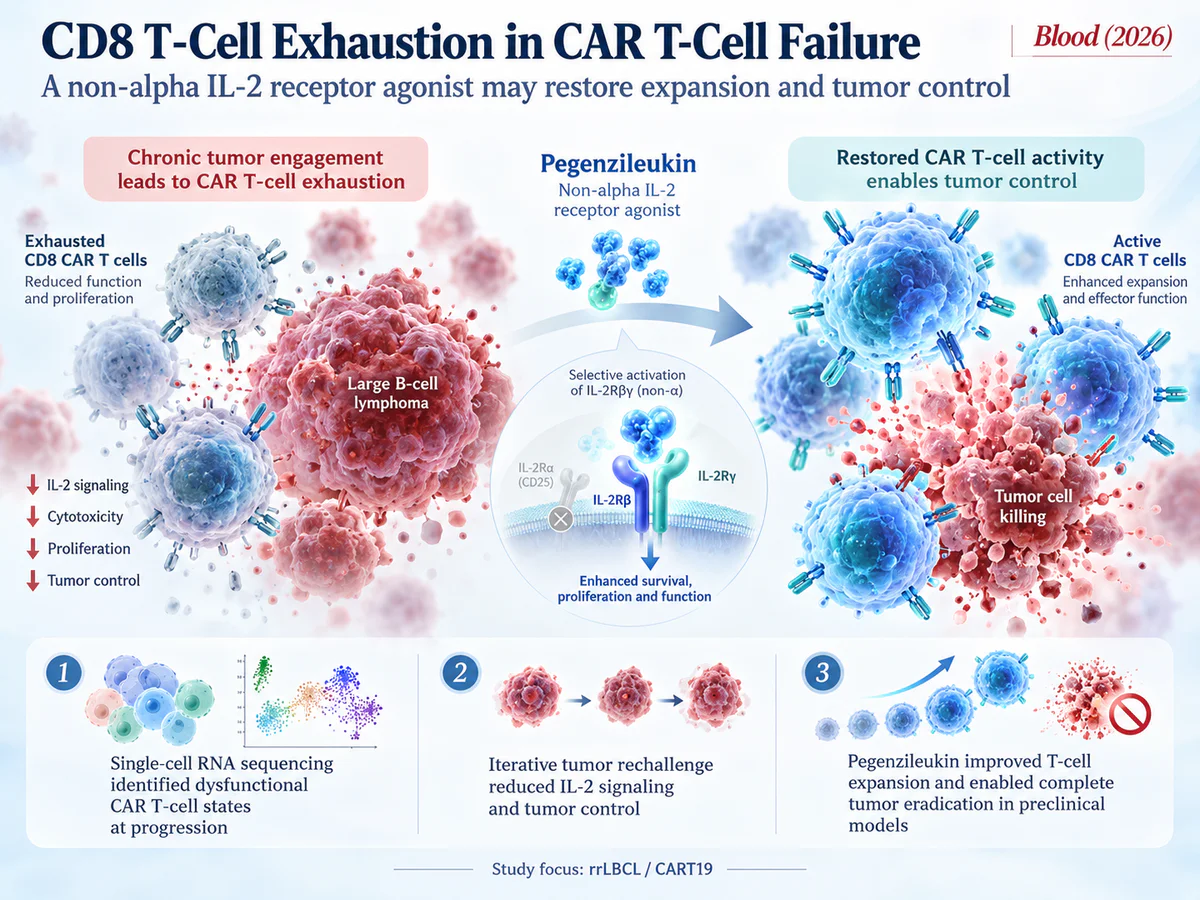
CAR T-cell therapy (CART19) faces significant challenges due to T-cell exhaustion leading to treatment failure in relapsed/refractory large B-cell lymphoma (rrLBCL).
In vitro modeling shows repetitive tumor antigen exposure reduces IL2 signaling and induces CART19 dysfunction.
Pegenzileukin, a non-alpha IL2 receptor agonist, prevents T-cell exhaustion and enhances tumor control both in vitro and in vivo.
Preclinical in vivo models validate pegenzileukin’s ability to achieve complete tumor eradication when combined with CART19, suggesting therapeutic potential for overcoming CAR T-cell failure.
Study Background
Chimeric antigen receptor T-cell (CAR T-cell) therapy, particularly those targeting CD19 (CART19), has transformed the treatment landscape for relapsed or refractory large B-cell lymphoma (rrLBCL). Despite remarkable remissions, a significant subset of patients experiences therapeutic failure, often accompanied by rapid disease progression and poor prognosis. T-cell exhaustion, marked by transcriptional and functional impairment following chronic antigen stimulation, is increasingly recognized as a central mechanism behind CAR T-cell therapy failure. Exhausted CD8+ T cells exhibit diminished proliferation, cytokine production, and cytotoxic function, limiting sustained antitumor activity.
Attempts to enhance CART19 efficacy have focused on modulating T-cell persistence and functionality. Interleukin-2 (IL2) signaling plays a pivotal role in T-cell proliferation and survival; however, classical IL2 receptor agonists can have off-target effects, including regulatory T-cell expansion, that limit their therapeutic window. Pegenzileukin, a non-alpha IL2 receptor agonist, selectively stimulates IL2 receptors lacking the alpha chain, potentially mitigating exhaustion without undesired effects associated with standard IL2 therapy.
Study Design
This study integrates clinical tumor sample analysis, in vitro modeling, and in vivo evaluation to elucidate the mechanisms behind CART19 failure and to assess the therapeutic potential of pegenzileukin. Key methodologies included:
– Single-cell RNA sequencing (scRNA-seq) of tumor biopsies obtained at disease progression after CART19 therapy, characterizing T-cell clonality, proliferation status, and exhaustion signatures.
– An in vitro CART19 rechallenge system that mimics repetitive tumor antigen exposure to induce T-cell dysfunction and assess IL2 signaling pathways.
– Preclinical in vivo murine models developed from post-CART19 progression tumor cell lines, replicating clinical response and failure kinetics.
– Treatment comparisons between CART19 monotherapy and combination with pegenzileukin to evaluate tumor control and central nervous system relapse.
End points included transcriptional profiles of exhausted T cells, T-cell expansion, tumor burden, and survival outcomes in animal models.
Key Findings
The study uncovered several critical insights:
1. Clonal Expansion and Dysfunction of CART19 Cells at Progression: scRNA-seq of tumor samples at progression in rrLBCL patients revealed a subset of CART19 cells with clonal expansion and active proliferation but exhibiting transcriptional hallmarks of dysfunction and exhaustion. These exhausted T cells demonstrate ongoing engagement with tumor antigens, suggesting that chronic stimulation fosters dysfunctional states limiting efficacy.
2. In Vitro Repetitive Antigen Rechallenge Induces Exhaustion and IL2 Signaling Defects: Repeated exposure of CART19 cells to target tumor cells in vitro resulted in lost tumor control and acquisition of exhaustion-associated gene signatures. This dysfunction correlated with impaired IL2 signaling, indicating cytokine-mediated pathways are disrupted during chronic antigen engagement.
3. Pegenzileukin Prevents CART19 Exhaustion In Vitro: Incorporation of pegenzileukin into the CART19 in vitro rechallenge model restored IL2 signaling, prevented exhaustion phenotypes, enhanced T-cell expansion, and improved tumor control despite repetitive stimulation.
4. In Vivo Model Recapitulates Clinical Failure and CNS Relapse: The developed murine model using a cell line from a post-CART19 progression tumor exhibited transient responses to CART19 monotherapy followed by tumor progression and secondary central nervous system relapse, mirroring clinical observations.
5. Combination Therapy Achieves Complete Tumor Eradication In Vivo: Addition of pegenzileukin to CART19 therapy in this model led to durable complete responses with eradication of tumors and prevention of CNS relapse, underscoring the translational potential of targeting IL2 receptor pathways to overcome exhaustion.
Expert Commentary
The detailed characterization of CART19 exhaustion via scRNA-seq provides compelling mechanistic insights into why some patients experience CAR T-cell failure. Chronic antigen exposure underpins the epigenetic and transcriptional reprogramming that compromises T-cell function, a concept consistent with emerging immunological paradigms across chronic infections and cancer.
Pegenzileukin’s selective targeting of non-alpha IL2 receptors presents an elegant pharmacological approach to revive dysfunctional CAR T cells while circumventing undesired Treg expansion linked with conventional IL2 therapy. These findings resonate with prior preclinical studies showing that modulation of cytokine signaling can enhance CAR T-cell persistence and antitumor effects.
Limitations include the preclinical nature of the intervention; translation to human trials will require careful dosing and safety evaluation. Additionally, heterogeneity within patient tumors and the tumor microenvironment may influence exhaustion dynamics and response to IL2 receptor agonists.
Conclusion
This study elucidates T-cell exhaustion as a pivotal mechanism of CART19 therapy failure in rrLBCL and identifies pegenzileukin, a non-alpha IL2 receptor agonist, as a promising agent to restore CAR T-cell functionality. The comprehensive preclinical validation supports the rationale for clinical trials investigating the addition of non-alpha IL2 receptor agonists to CAR T-cell therapy regimens. If successful, such combinatorial strategies could significantly improve long-term remission rates and patient outcomes in aggressive lymphomas refractory to current therapies.
Funding and Clinical Trials
The original study was conducted by a collaborative team across multiple institutions, with funding sources and potential clinical trials related to pegenzileukin yet to be detailed in published registries. Future clinical development should be monitored via clinicaltrials.gov for emerging interventional studies.
References
1. Arita K, Dai E, Li X, et al. CD8 T-cell exhaustion linked with CAR T-cell failure can be mitigated by a non-alpha IL2 receptor agonist. Blood. 2026 Oct 23. PMID: 42913488.
2. Wherry EJ, Kurachi M. Molecular and cellular insights into T cell exhaustion. Nat Rev Immunol. 2015;15(8):486-499.
3. Klebanoff CA, Gattinoni L, Restifo NP. CD8+ T-cell memory in tumor immunology and immunotherapy. Immunol Rev. 2006;211:214-224.
4. Boyman O, Sprent J. The role of interleukin-2 during homeostasis and activation of the immune system. Nat Rev Immunol. 2012;12(3):180-190.
5. Locke FL, Miklos DB, Jacobson CA, et al. Phase 1 Results of ZUMA-6, a Study of Axicabtagene Ciloleucel Plus Atezolizumab in Patients With Relapsed/Refractory Large B-cell Lymphoma. Blood. 2020;136(Supplement 1):12-13.