Highlight
- Minimally invasive radical hysterectomy may not compromise survival or increase recurrence in patients with low-risk cervical cancer defined by stringent SHAPE criteria.
- In contrast, in high-risk patients, minimally invasive surgery is linked to significantly worse oncologic outcomes including increased mortality and recurrence.
- Risk stratification based on tumor size and invasion depth is critical to guiding surgical approach decisions in cervical cancer.
- These findings support ongoing investigation into surgery tailoring based on precise pathological risk profiles to optimize patient safety.
Study Background
Cervical cancer remains a significant global health challenge, particularly in women of reproductive age. Standard treatment for early-stage cervical cancer traditionally involves radical hysterectomy, often performed via open surgery to ensure thorough tumor removal. However, recent randomized trials such as the SHAPE trial have suggested that simple hysterectomy may be sufficient for low-risk cases, sparking debate about the extent of surgery needed. Simultaneously, the adoption of minimally invasive surgical (MIS) techniques like laparoscopic or robotic-assisted radical hysterectomy has risen due to perceived benefits in recovery and morbidity. Yet, conflicting evidence has emerged regarding the oncologic safety of MIS, especially after studies suggested worse outcomes compared with open surgery in certain populations. This retrospective cohort study sought to clarify whether the association between surgical approach (minimally invasive vs open radical hysterectomy) and oncologic outcomes in cervical cancer patients varies according to disease risk status. The study specifically applied strict SHAPE criteria to stratify patients into low- and high-risk groups based on pathologic depth of stromal invasion and tumor size.Study Design
This population-based retrospective cohort included 903 cervical cancer patients treated with primary radical hysterectomy by gynecologic oncologists across Ontario, Canada, between 2006 and 2017. Patients were stratified into low-risk (depth of invasion 20 mm) groups according to Canadian Cancer Trials Group CX.5 SHAPE criteria. The main exposures compared were minimally invasive radical hysterectomy versus open radical hysterectomy. Overlap propensity score weighting was used to balance demographic, clinical, and pathological confounders between groups. Outcomes analyzed included all-cause mortality, cervical cancer-specific mortality, and cancer recurrence over a median follow-up of 10 years.Key Findings
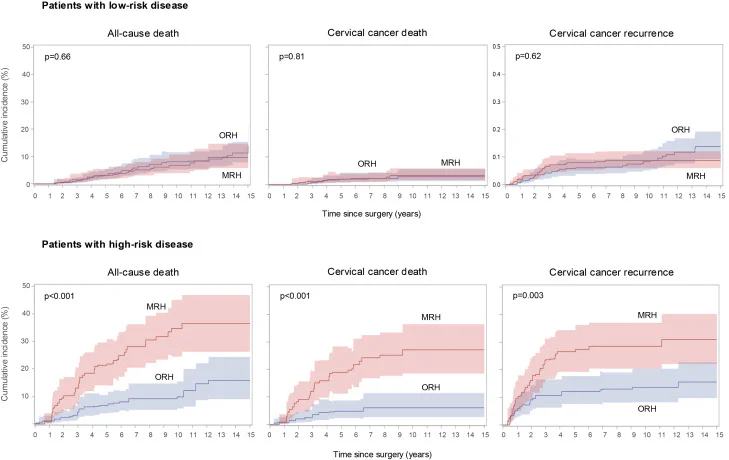
Among the 621 low-risk patients, no statistically significant differences were observed between minimally invasive and open surgery in all-cause death (HR 0.88; 95% CI, 0.39-2.01; P=0.76), cervical cancer death (HR 1.15; 95% CI, 0.27-4.87; P=0.85), or recurrence (HR 0.88; 95% CI, 0.4-1.91; P=0.74). Conversely, in the 282 high-risk patients, minimally invasive radical hysterectomy was associated with significantly increased risks of all-cause death (HR 3.22; 95% CI, 1.37-7.58; P=0.008), cervical cancer death (HR 4.88; 95% CI, 1.50-15.83; P=0.008), and recurrence (HR 2.32; 95% CI, 1.01-5.34; P=0.048) compared to open surgery. These results indicate a clear heterogeneity in surgical approach impact influenced by the baseline tumor risk profile. The data suggest minimally invasive radical hysterectomy is oncologically safe in carefully selected low-risk cervical cancer patients but poses potential harm in more advanced low-risk or high-risk disease scenarios.Expert Commentary
This study contributes important population-level evidence stratified by rigorous pathology-based risk criteria, reinforcing the concept of tailored surgical management in cervical cancer. Dr. Lorne Gien, senior author, emphasizes the importance of adhering to SHAPE criteria when considering minimally invasive approaches, noting that despite reassuring results in low-risk patients, oncologic vigilance remains paramount. The findings align with prior randomized trials that questioned the routine use of MIS in cervical cancer but provide nuance by identifying a subset of low-risk patients who may still benefit from the minimally invasive approach in terms of safety and recovery. Limitations of this retrospective study include potential unmeasured confounding and the possibility that surgical technique and surgeon experience varied over the study period. Additionally, longer-term data and prospective validation are needed to confirm safety conclusively. Mechanistically, concerns about tumor spillage, intracorporeal colpotomy, and insufflation pressures during MIS may underlie worse outcomes in high-risk patients. Avoiding MIS in these cases may reduce residual microscopic disease and local recurrence.Conclusion
This robust population-based analysis demonstrates that the oncologic safety of minimally invasive radical hysterectomy in cervical cancer depends significantly on tumor characteristics defining disease risk. For patients with low-risk disease as defined by SHAPE criteria, minimally invasive approaches were not associated with increased recurrence or mortality, suggesting a reasonable alternative to open surgery. In contrast, minimally invasive surgery markedly increased adverse outcomes in high-risk patients and should be avoided in this group. These findings support risk-adapted surgical strategies and highlight the need for continued prospective studies to refine patient selection and optimize cervical cancer surgical management. Clinicians should weigh the benefits and risks of surgical modalities carefully and employ detailed pathologic assessment for informed decision-making. Shared decision-making incorporating patient preferences, surgical expertise, and individualized risk stratification will optimize outcomes in cervical cancer treatment.Funding and Clinical Trials
This study was funded by Canadian research grants and conducted with institutional approvals. Clinical trial registration information for the SHAPE study is referenced within the primary literature.References
1. Cusimano MC, et al. Association of surgical approach with oncologic outcomes in low-risk cervical cancer. Am J Obstet Gynecol. 2026 Jul;235(5):1081-1092. PMID: 42401251. 2. Nam JH, et al. Simple hysterectomy versus radical hysterectomy for low-risk early-stage cervical cancer: SHAPE randomized trial. J Clin Oncol. 2021. 3. Ramirez PT, et al. Minimally invasive versus abdominal radical hysterectomy for cervical cancer. N Engl J Med. 2018;379(20):1895-1904. 4. Melamed A, et al. Survival after minimally invasive radical hysterectomy for early-stage cervical cancer. N Engl J Med. 2018;379(20):1905-1914.Specialty calculators
For clinical reference; use professional judgment.