Highlight
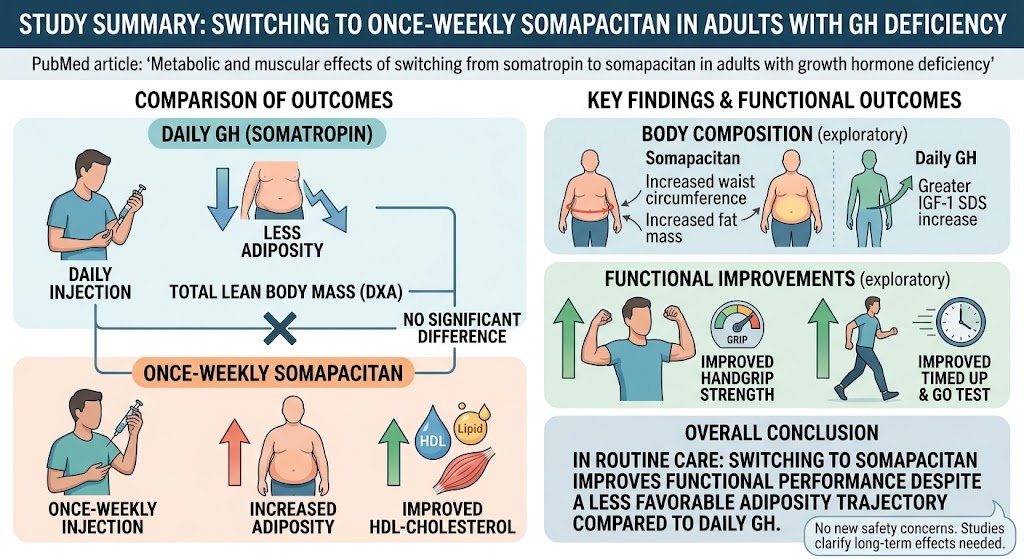
Once-weekly somapacitan is a novel growth hormone (GH) replacement therapy approved for adults with GH deficiency, showing similar efficacy to daily somatropin on lean mass. Although somapacitan is linked to increased adiposity indices, it improves HDL cholesterol and physical performance measures such as handgrip strength and mobility. This real-world, prospective study demonstrates functional benefits despite differing metabolic trajectories, underscoring the importance of personalized therapy selection.
Study Background
Growth hormone deficiency (GHD) in adults is a complex endocrine disorder characterized by impaired metabolism, reduced muscle mass and strength, increased fat mass, unfavorable lipid profiles, and diminished quality of life. Chronic replacement therapy with daily injections of somatropin (recombinant human GH) has been the standard treatment. However, daily injections can be burdensome, affecting adherence and patient satisfaction.
Somapacitan, a once-weekly long-acting GH derivative, was developed to improve patient convenience while maintaining therapeutic efficacy. Phase 3 clinical trials have shown noninferiority of somapacitan to daily GH in biochemical and clinical parameters. Still, comprehensive metabolic and functional outcomes during routine clinical practice, especially muscle strength and body composition changes, remain insufficiently explored.
Study Design
This prospective, observational, nonrandomized comparative study enrolled 57 adults with established GH deficiency who were already undergoing GH replacement therapy. Conducted at a single tertiary endocrine center, patients opted to either switch from daily somatropin to weekly somapacitan or continue daily somatropin, reflecting patient preference and mimicking real-world clinical decision-making.
Primary endpoint: change in total lean body mass from baseline to 52 weeks, measured by dual-energy X-ray absorptiometry (DEXA).
Secondary exploratory endpoints included body composition indices (fat mass, adiposity), lipid profiles (HDL, LDL cholesterol), and physical performance measures such as handgrip strength and the Timed Up and Go (TUG) test.
Insulin-like growth factor 1 (IGF-1) standard deviation (SD) scores were monitored as biochemical markers of GH activity.
Key Findings
The study demonstrated several important results:
- Lean Mass: The primary endpoint showed no statistically significant difference between groups, with a mean between-group difference of -0.2 kg (95% CI -1.5 to 1.1), indicating maintenance of lean mass after switching to somapacitan over 52 weeks.
- IGF-1 Levels: Baseline and week 52 IGF-1 SD scores were comparable overall; however, the increase in IGF-1 was more pronounced in the daily GH group than the somapacitan group.
- Adiposity Indices: Patients switching to somapacitan exhibited an increase in adiposity parameters compared to those continuing daily somatropin, suggesting less favorable fat mass trajectories with weekly therapy.
- Lipid Profile: Despite increased adiposity, somapacitan was associated with an improvement in high-density lipoprotein cholesterol (HDL-C), which may translate into cardiovascular benefits.
- Functional Outcomes: Exploratory analyses revealed significant improvements in muscle strength measured by handgrip dynamometry and physical mobility assessed by the Timed Up and Go test in the somapacitan group.
- Safety: No novel or unexpected safety concerns emerged during the 52-week follow-up period in either treatment group.
Expert Commentary
This study provides valuable real-world data on the metabolic and functional effects of transitioning to somapacitan in adult GHD patients. The noninferiority in lean mass preservation aligns with randomized trial data, reinforcing somapacitan as a viable alternative to daily injections. However, the observed increase in adiposity parameters warrants caution and may indicate subtle differences in the pharmacodynamics of extended-release versus daily GH dosing.
The improvement in HDL-C coupled with enhanced physical function is encouraging, hinting at complex metabolic interplay not fully captured by traditional surrogate endpoints alone. Muscle function is an often underappreciated but critical outcome influencing quality of life and morbidity in GHD, thus these functional gains with somapacitan are clinically meaningful.
Limitations include the study’s observational and nonrandomized design, modest sample size, and single-center setting, which may affect generalizability. The patient-driven treatment allocation could introduce selection bias, although it reflects patient-centered care.
Future research should focus on long-term cardiovascular outcomes, fat distribution patterns, and patient-reported quality of life metrics to define the optimal role of somapacitan. Additionally, mechanistic studies could elucidate how sustained GH receptor activation differs in metabolic tissues relative to daily pulsatile GH dosing.
Conclusion
In adults with growth hormone deficiency, switching from daily somatropin to once-weekly somapacitan maintained lean body mass and improved muscle strength and mobility over one year, despite a less favorable adiposity profile. These findings support somapacitan as an effective, patient-preferred alternative to daily GH therapy in routine endocrine practice, though clinicians should monitor fat mass changes carefully. Further longitudinal studies are necessary to establish the long-term metabolic and cardiovascular impacts of somapacitan therapy.
Funding and ClinicalTrials.gov
The article does not specify funding sources or clinical trial registry numbers, underscoring the need for transparency in future reports.
References
1. Oi-Yo Y, Urai S, Yamamoto M, et al. Metabolic and muscular effects of switching from somatropin to somapacitan in adults with growth hormone deficiency. J Clin Endocrinol Metab. 2026;111(9):e2096–e2107. PMID: 41955533.
2. Johannsson G, et al. Safety and efficacy of once-weekly somapacitan in adults with growth hormone deficiency: a 52-week randomized controlled trial. J Clin Endocrinol Metab. 2020;105(5):dgaa072.
3. Molitch ME. Diagnosis and treatment of adult growth hormone deficiency. Endocrinol Metab Clin North Am. 2015;44(3):597-628.